Junius Ho’s budget no-vote unimportant, is it?
Flashed back to mid-2020, a group of pan-democrats said they would veto the government budget as part of a game plan to fight for universal suffrage if, a big if, they succeeded in grabbing two-thirds of seats in the Legislative Council in an election scheduled for the end of 2020.
To maximise their chance of getting the critical two-thirds majority of seats, an informal territory-wide Legco primary was held by the pro-democracy camp in July 2020. More than 600,000 people cast their votes. The 2020 Legco election never happened. When an election was held in 2021, the pan-dems were no longer in the race.
The democrats’ threat of opposing the government’s budgetary blueprint indiscriminately was cited as proof in a government prosecution of 47 of them for subverting state power under the national security law. The rest is history.
Following the electoral revamp in 2021, there is no longer any opposition force in the “patriots-only” legislature. The possibility of a veto of the Budget by a two-thirds majority is zero. Its passage is a foregone conclusion.
Junius Ho Kwan-yiu’s act of not-voting
That is what it has been since the legislature was constituted in accordance with the new election system in 2021.
The budget debate, followed by its passage, has been a non-event. There is no exception this year. The Budget, in the form of an appropriation bill, was passed by a show of hands with the respective votes of each member not being recorded.
Veteran lawmaker Junius Ho Kwan-yiu, an Election Committee member, was the only legislator who did not raise his hand, the second year in a row. He argued not opposing the bill was indeed a vote of support. Whether you and I agree is unimportant.
During the debate, he has criticised the government’s management of public finance, raising concerns about government control over spending.
A vote is a vote is a vote
Ho’s political antics are indeed no big deal. But when Financial Secretary Paul Chan Mo-po said Ho’s vote, or more accurately, act of not-voting, was inconsequential, it became one. When a government official dismisses the importance of the vote of a legislator, it should not be taken lightly.
On its face, Chan was telling the plain truth. The appropriate bill was passed eventually. Ho’s no-vote made no difference whatsoever.
But for a top official to say Ho’s vote was unimportant is an act of disrespect to him and, more importantly, to the legislature. A vote is a vote is a vote.
The truth Chan was telling was more than plain, but deplorable. This is despite the fact that citizens deem Ho’s political play and Chan’s soft fight-back as, in Chan’s words, inconsequential.
Hopes, if any, that the elected lawmakers, albeit with a much smaller electoral base, would be able to exercise effective checks and balances towards the executive authorities have faded.
And expectations, if any, that the executive authorities would see the merits of checks and balances by the legislature and society at large have been low.
When the passage of his budget was already secured with zero risk, the dismissal attitude of Chan towards dissenting views and votes of lawmakers should not come as a surprise.
A case in point is Chan’s response to members’ concerns over the rare move to tap the Exchange Fund – a pillar of the US dollar peg mechanism and the city’s financial stability – and to increase bond issuance to fund the Northern Metropolis plan. He dismissed their worries as “overly alarmist.”
Who should take the blame?
In any democracy, every vote counts, not just in popular elections, but in the elected legislature. Despite their thin electoral base, the legislators are given a role and powers under the Basic Law. Article 64 says the SAR government must abide by the law and be accountable to the Legislative Council.
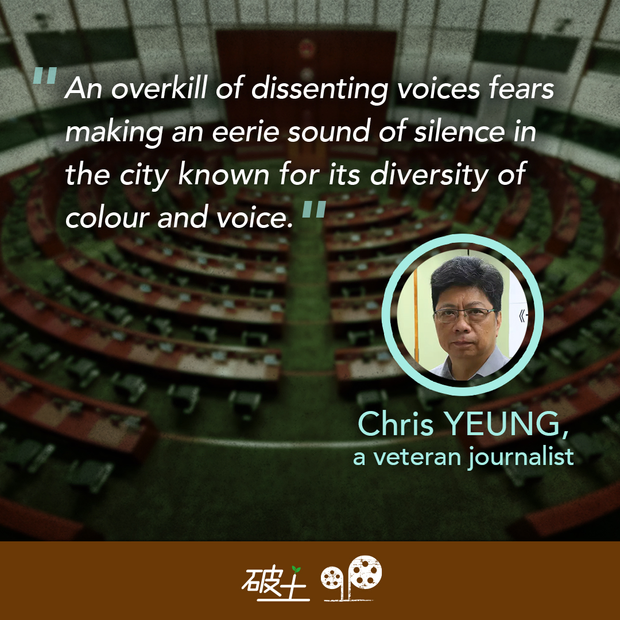
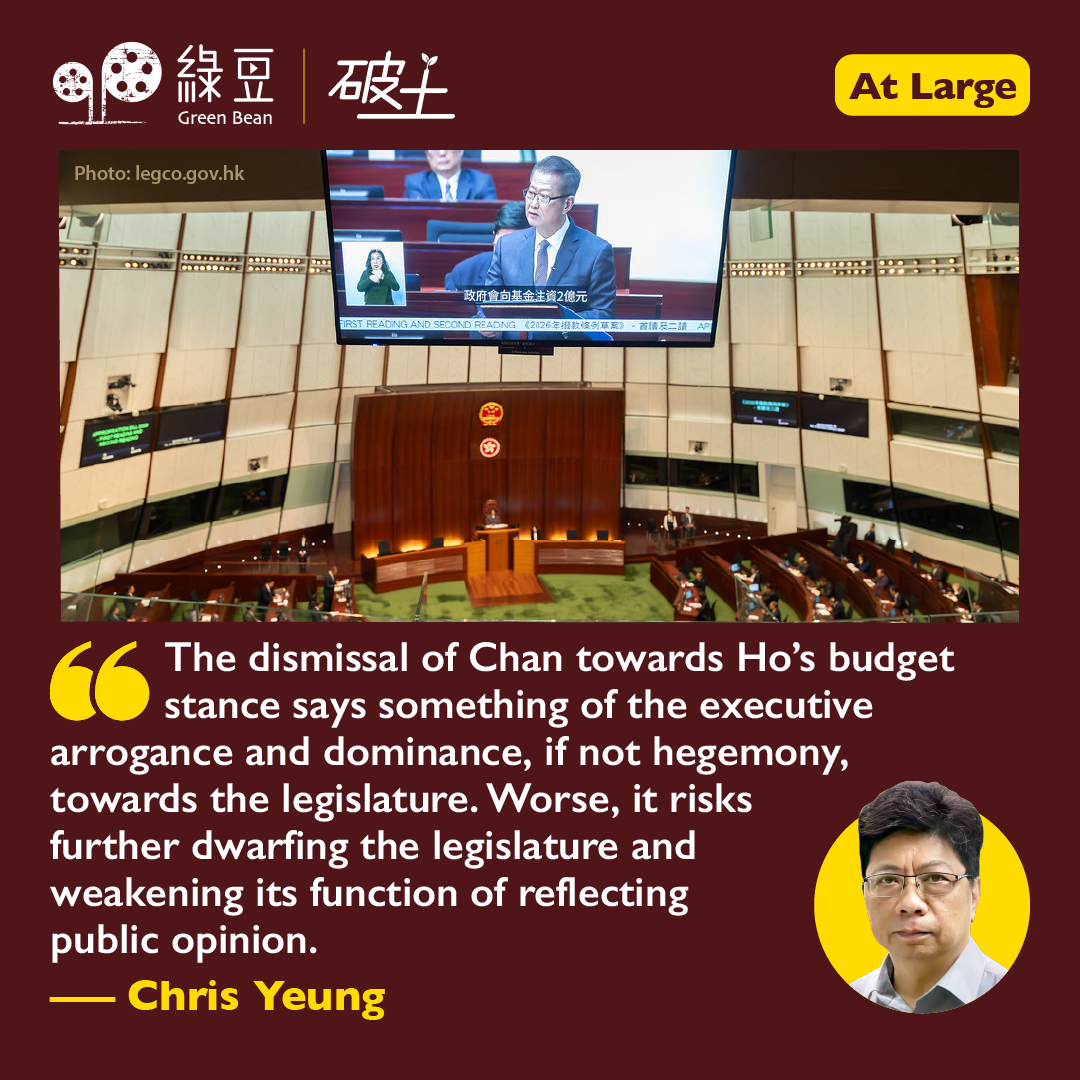
The dismissal of Chan towards Ho’s budget stance says something of the executive arrogance and dominance, if not hegemony, towards the legislature. Worse, it risks further dwarfing the legislature and weakening its function of reflecting public opinion.
Responding to Chan’s rebuttal to members’ concerns as “overly alarmist”, Reverend Koon Ho-ming said legislators, as the “red team”, have a duty of raising concerns about the city’s public finance.
He said: “We are patriots, not the opposition. We were being criticised when we kept silent… and when we acted as rubberstamp. (We are in a) very difficult (situation). “
It could not be more ironic that most of the members in the current legislature had voted in favour of the electoral revamp, which marks the beginning of the decline of Legco force as a force to be reckoned with in some quarters of the society. They should take the blame, at least part of it.
▌ [At Large] About the Author
Chris Yeung is a veteran journalist, a founder and chief writer of the now-disbanded CitizenNews; he now runs a daily news commentary channel on Youtube. He had formerly worked with the South China Morning Post and the Hong Kong Economic Journal.