Hong Kong bus seat belts law bungled
Language failed us in the case of Hong Kong officials and legislators having bungled a law mandating bus passengers buckling up seat belts, which was passed into law within hours by a Legco subcommittee last year but was declared void on last Friday (Jan 30) six days after it took effect.
It was dubbed as “seat belt chaos” by some media outlets. But the word “chaos” comes up short in the latest policy failure. The fiasco has made the executive authorities and the Legislative Council – or more accurately, the previous legislature – a laughing stock.
Too absurd for words
The Chinese-language Ming Pao’s editorial on Saturday, one day after the government announced a repeal of the law, described the mistake as “unbelievable.” Some called it a “farce”, “absurdist drama”. Words cannot tell.
The shortage of the befitting language to tell the feeling of absurdities and disbelief among the citizens is in ironical contrast with the abundance of official rhetoric to tone down the U-turn of the seat belt law.
Transport minister Mable Chan, whose portfolio also includes logistics, told a hastily-convened stand-up media briefing on Friday afternoon the legislation would be back to the drawing board due to “technical deficiencies,” adding they would listen to what people said.
The would-be-repealed legislation, she said, failed to reflect the policy’s intent of requiring all passengers on public and light buses – including franchised and school services – to wear seat belts where available. The situation, she lamented, was “undesirable.”
After consulting the Department of Justice for its legal opinions, she said they will repeal the law as soon as possible “so that there will be no statutory requirement stipulating passengers on franchised or non-franchised buses must wear safety belts.”
The Department of Justice is responsible for law drafting. Its head, Paul Lam, whose official title is Secretary for Justice, has declined questions about the “unbelievable” mistake in law-drafting. Some lawmakers who scrutinised the subsidiary legislation have admitted they have not examined it thoroughly.
No government officials and lawmakers have said sorry as of Saturday.
Straw that broke the camel’s back
Taking effect on Sunday (Jan 25), the seat belt rules have emerged as a subject of complaints by passengers against its rationale, necessity and penalty. Anyone convicted of breaching the law faces a maximum fine of HK$5,000 and up to three months’ imprisonment.
Some passengers have complained of poorly fitting restraints, hygiene of the belts and concerns over whether early unbuckling before alighting would constitute a breach of the law.
Critics and doubters questioned the government legislative justifications. They include a recommendation of mandatory wearing of seat belts in a government-appointed committee probing a deadly Tai Po bus accident in 2018 and similar seat belt wearing requirements in other countries.
Despite its failure to convince the populace, the government showed no sign of a backdown. Stressing that they would focus on “promotion and education”, officials have refrained from saying clearly there would not be prosecution at this stage.
A claim made by former lawmaker Doreen Kong Yuk-foon, who sat on the subcommittee that scrutinised the proposed legislative amendment last year, has emerged as the last straw on the back of the camel.
Citing the legislation, she wrote on facebook on last Thursday the law applied only to new buses registered from January 25, the date the seat belt rule took effect. Media reports said there were no buses registered after January 25.
The way the relevant clause in the law was written means anyone who travels on all buses and mini-buses on the road do not breach the law if they do not buckle up.
Although that cannot possibly be the intent of the legislative amendment, it has become clear to the government and lawmakers that the law meant differently. What should be an impossible mistake was indeed made and being found out six days after it became effective.
“Listening to the people?”
Hot on the heels of calls on Monday by Xia Baolong, Beijing’s pointed man on Hong Kong affairs, for closer collaboration between the government and the Legco for good governance, the “seat belts chaos” have caused embarrassment to the patriots who were given the task of administering the city.
To add more irony into the government-legislature fiasco, pro-Beijing newspaper reports on the U-turn gave a positive spin, lauding the government for “heeding public opinions to do the right thing” – and did it “decisively.”
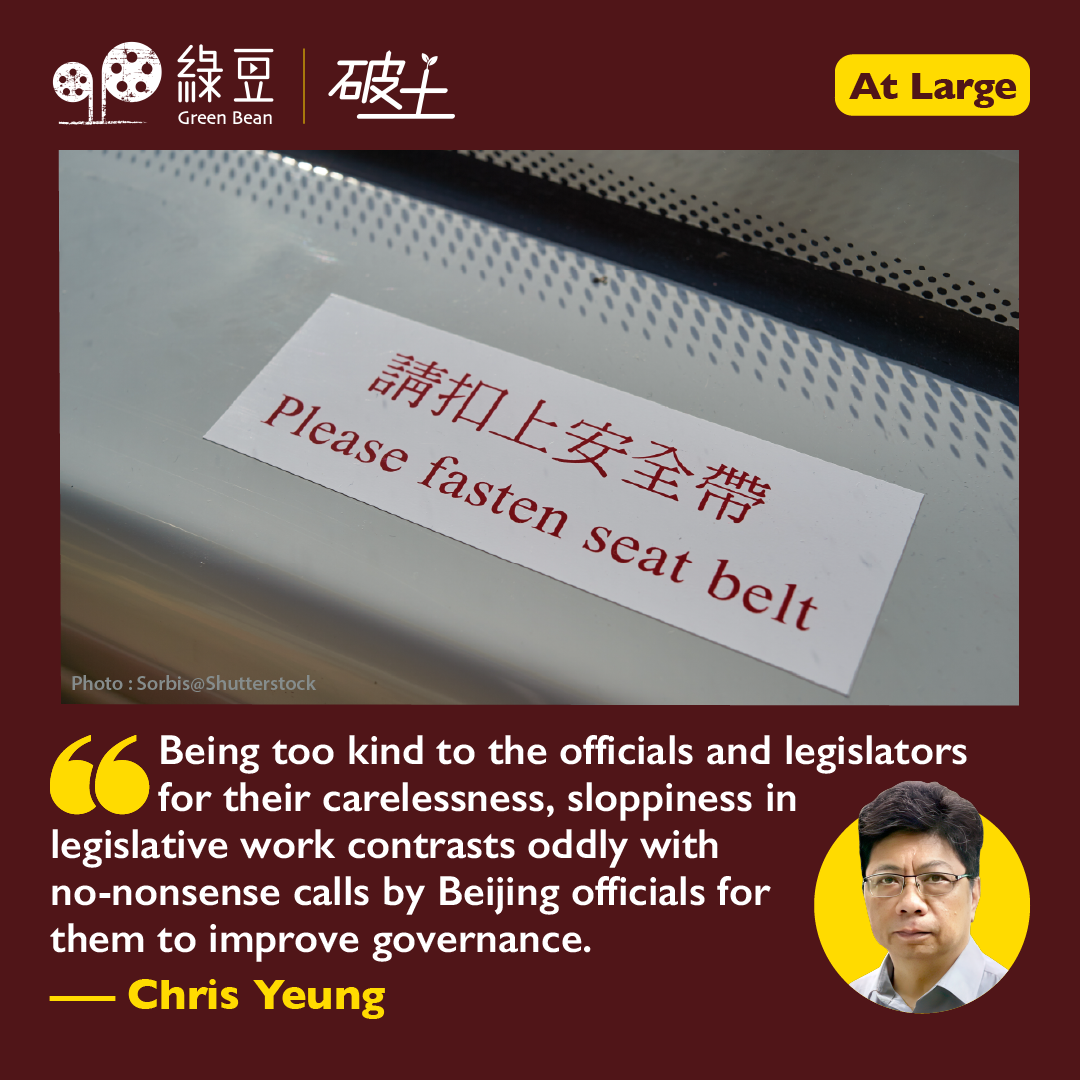
Being too kind to the officials and legislators for their carelessness, sloppiness in legislative work contrasts oddly with no-nonsense calls by Beijing officials for them to improve governance. That will not help achieve good governance, but does the opposite. What a mess!
▌ [At Large] About the Author
Chris Yeung is a veteran journalist, a founder and chief writer of the now-disbanded CitizenNews; he now runs a daily news commentary channel on Youtube. He had formerly worked with the South China Morning Post and the Hong Kong Economic Journal.