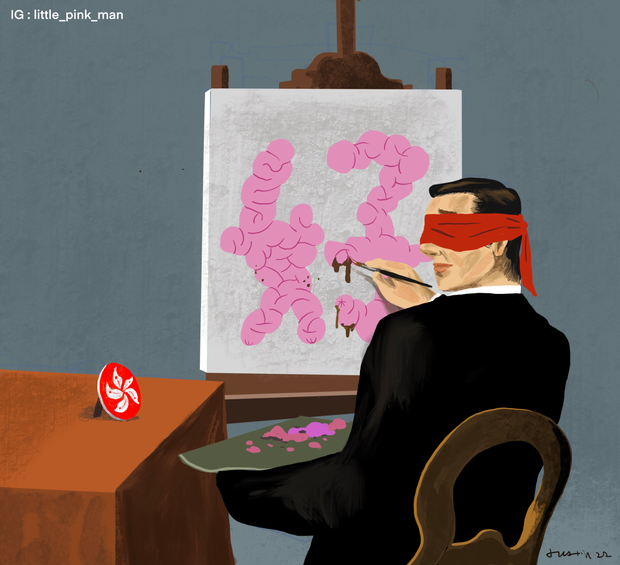
The irrelevance of Election Committee election
Flashed back to this time in 1996, four heavyweight figures were locked in a historic fight for the post of the first chief executive of the Hong Kong SAR after the end of the British colonial rule.They included late shipping magnate Tung Chee-hwa, former Chief Justice Ti-liang Yang, billionaire Peter Woo Kwong-ching and former Appeal Court judge Simon Li.
There was no candidate from the pro-democracy camp. Dubbed as a “small-circle election,” the 1996 race had emerged as a contest, at least on the face of it. It saw candidates not just soliciting votes by making phone calls with the 400 members who sat on the Selection Committee, but charming the populace through mass election campaigns.
Importantly, the four contestants either had blessings from the central authorities or had not been dissuaded from joining the race.
It was widely understood that Justice Yang had the backing of the then Xinhua News Agency, the unofficial office of Beijing in Hong Kong that was renamed as Liaison Office after 1997. Tung was the choice of the Hong Kong and Macau Affairs Office under the State Council.
◾Election on Election Committee
The 400-strong selection committee was renamed as Election Committee after 1997; and it grew bigger. Its membership was doubled to 800 in 2002, then 1,200 from 2012. Following an overhaul of the election system for the Legislative Council, the District Council and the Election Committee in 2020, the total membership of the Election Committee further rose to 1,500.
On Sunday(Nov 22), 5,700-odd eligible voters were scheduled to cast their votes to fill up 723 seats in the 1500-member Election Committee. The remaining seats were uncontested.
On its face, the 1,500-strong election body has become more important after the election system revamp. In addition to the role of electing the chief executive, it is given the right to elect 40 members in the 90-seat Legco as it had done so in the 2021 and 2025 elections.
To ordinary citizens, however, the opposite is true. Its relevance and importance have increasingly depleted. Sunday’s election has been a non-event.
◾Benny Tai
Memories of it loaded with mixed feelings of the “small-circle elections” held since 1996 are just memories; they belong to the past with no relevance to the city’s present and future political development.
It seems to be purely coincidental – and ironical – that a campaign pamphlet of Benny Tai Yiu-ting, one of the “Occupy Central trio” and a key figure of the ill-fated 2020 Legco primaries, for the 1998 Election Committee subsector election appeared on social media recently.
Tai, who was a University of Hong Kong law professor then, was one of the candidates contesting for seats for the higher education subsector in the 800-member Election Committee. (Eligible voters in dozens of subsectors such as doctors and lawyers were given the right to handpick a certain number of members to join the election college.)
Flying the banner of democracy and justice, Tai had attempted to fight for speedier democratisation by being part of the partial-democratic political system. He won a seat.
Fast-tracked to 2014, Tai was one of the three flag-bearers of the Occupy Central movement aimed to drum up public support for speedier full universal suffrage. The rest is history.
◾The pro-democracy camp changed tactics
Rolled back to 2002, Tung grabbed up 712 nominations from the then 800-member Election Committee, making it impossible for another contestant to meet the 100-nomination threshold to join the race
Since then, the pro-democracy camp changed tactics. Instead of boycotting the “small-circle election,” they decided to fight for democracy by taking part in what they deemed as an undemocratic and unfair election system.
Alan Leong of the now-dissolved Civic Party took on Donald Tsang, who sought re-election, in the 2007 CE election. In 2012, Albert Ho of the now-disbanded Democratic Party faced two Beijing-backed candidates, namely Leung Chun-ying and Henry Tang.
Two years after the end of the Occupy Central movement, the pro-democracy camp mounted a “300+” campaign to fight for seats in the 2016 Election Committee election. They grabbed a total of 325 seats, which proved to be instrumental in securing an entry ticket for former financial secretary John Tsang to run for the 2017 chief executive election.
◾Rubber-stamp
Election Committee (EC) subsector election has been seen as a curtain-raiser to the chief executive election to be held thereafter. Like the 2021 EC election, results of Sunday’s Election Committee subsector election have become less and less irrelevant to next year’s chief executive election, or none at all.
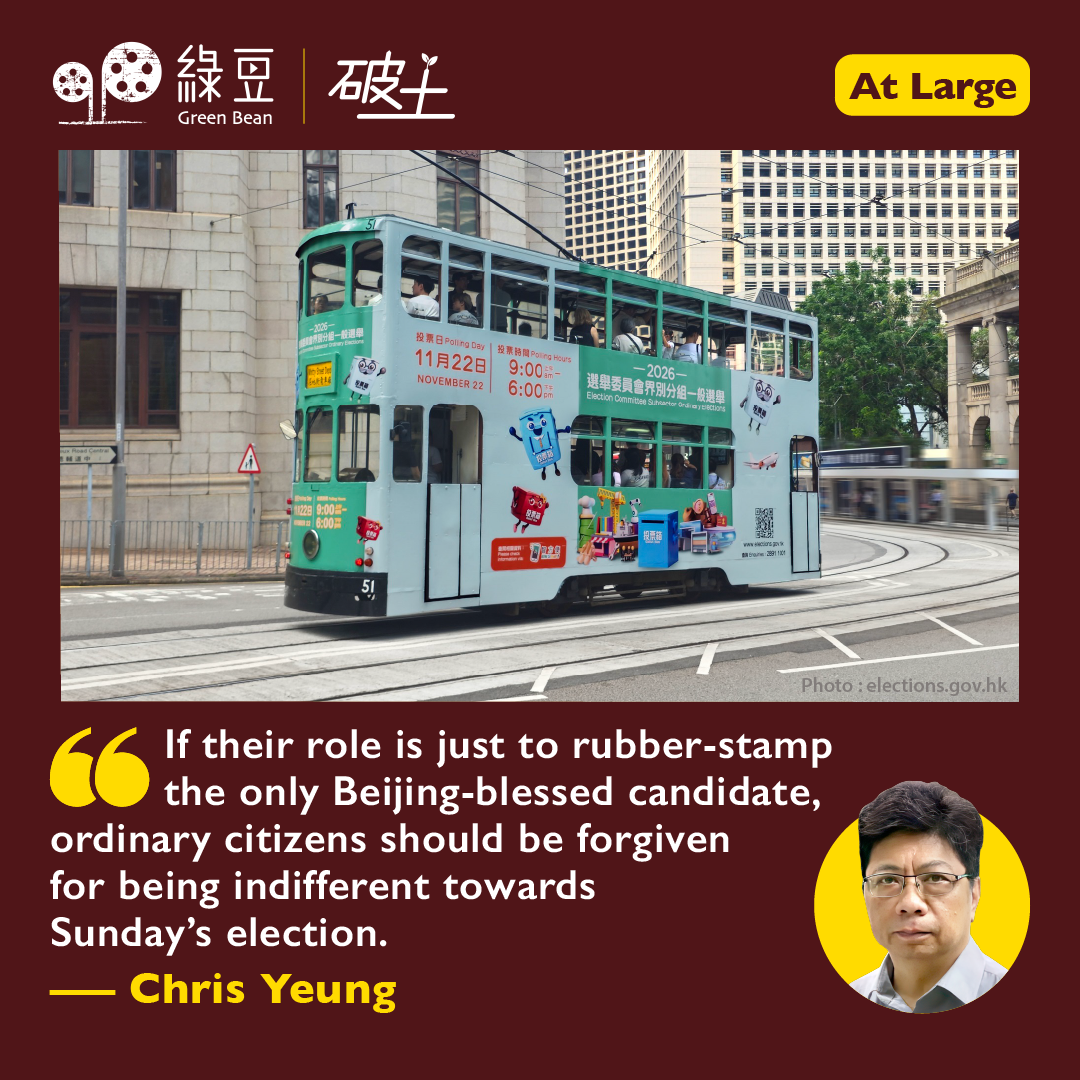
Who sits on the Election Committee only matters if they are given a free hand to nominate those they support to run for the next chief executive race. If their role is just to rubber-stamp the only Beijing-blessed candidate, ordinary citizens should be forgiven for being indifferent towards Sunday’s election.
It has come as no surprise that no candidates have openly called for a genuine contest with more than one candidate in next year’s chief executive election. If they are just waiting for Beijing’s choice, why should citizens care who gets a seat in Sunday’s election?
▌ [At Large] About the Author
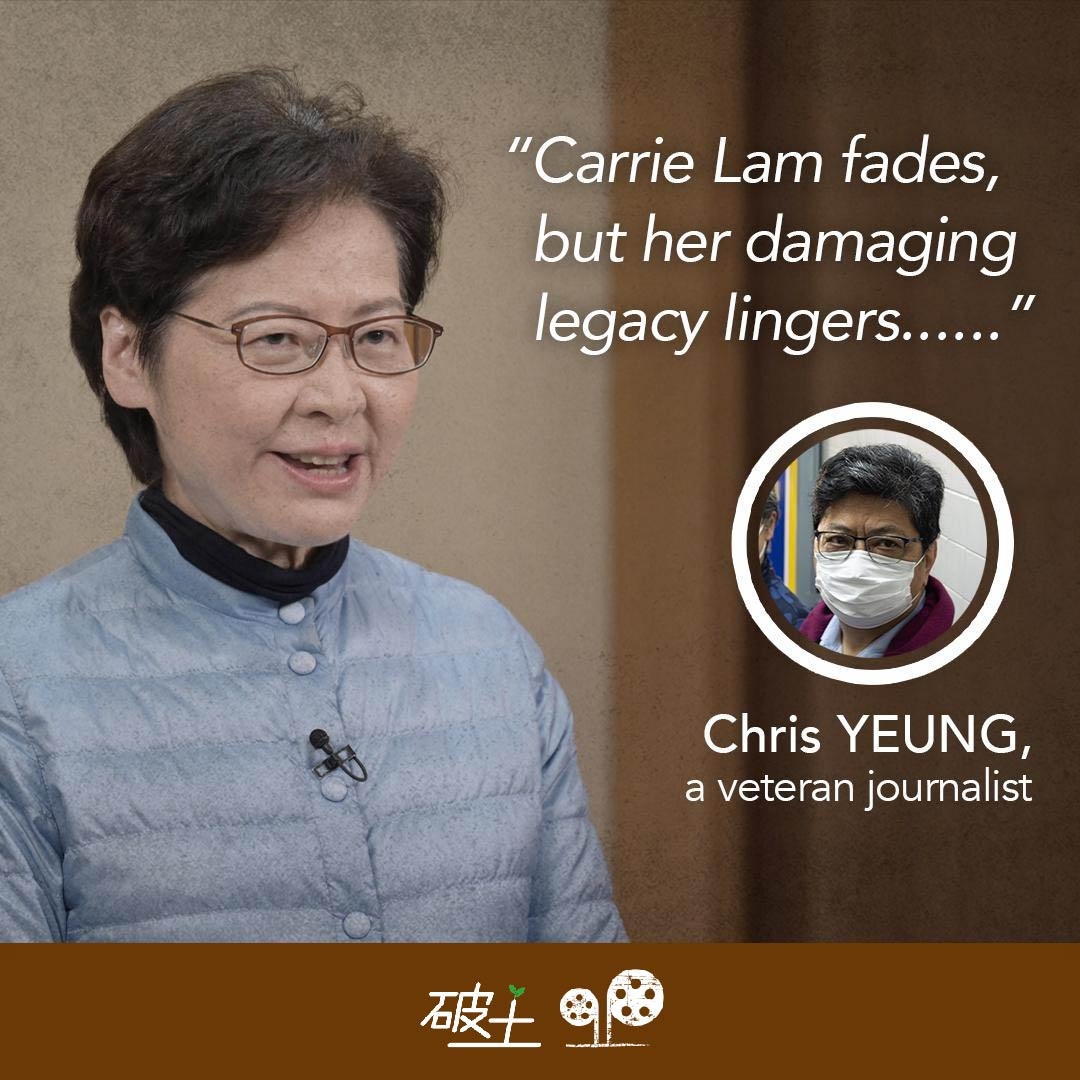
Chris Yeung is a veteran journalist, a founder and chief writer of the now-disbanded CitizenNews; he now runs a daily news commentary channel on Youtube. He had formerly worked with the South China Morning Post and the Hong Kong Economic Journal.