
A Promise to Hong Kong’s BN(O) Holders Is a Promise to Keep
Britain has a long memory when it comes to honour, history and the rule of law. Yet when it comes to the people of Hong Kong, is it now prepared to move the goalposts after inviting them to make Britain their home.
In a recent letter to Greenbean Media, Minister for Migration and Citizenship Jo White MP offered reassuring words, declaring that “the promise Britain made to the people of Hong Kong will never change”. She also confirmed that British National (Overseas) visa holders would retain their five-year route to settlement, rather than be moved onto the standard ten-year pathway.
That is welcome, but only up to a point. Retaining the five-year timetable while tightening the conditions for settlement risks preserving the promise in name while hollowing it out in substance. The Government’s Earned Settlement reforms, with tougher English-language requirements and a far stricter approach to criminality, raise a fundamental question: can Britain claim to honour its historic commitment while quietly rewriting the terms on which Hong Kong families staked their future?
The issue is not whether newcomers should contribute to British society. Of course they should. It is whether a community admitted under an exceptional historical and moral undertaking should now be treated as just another category of economic migrant, required to prove its worth all over again.
The answer lies in Britain’s own history.
◾A nationality without a home
BN(O) status was not devised as a conventional immigration category. It was created by the British Government as part of the arrangements for Hong Kong’s return to Chinese sovereignty in 1997, following decades in which successive Acts of Parliament had progressively narrowed the rights associated with British nationality.
Before the Commonwealth Immigrants Act 1962, British subjects generally enjoyed the right to enter and reside in the United Kingdom. That legislation marked a decisive break with the principle of unrestricted entry for Commonwealth citizens. The British Nationality Act 1981 then fundamentally recast the system. Hong Kong-connected Citizens of the United Kingdom and Colonies became British Dependent Territories Citizens, without an automatic right of abode in Britain.
The Sino-British Joint Declaration of 1984 sealed the political bargain. Britain agreed to transfer sovereignty over Hong Kong to China in 1997, with the undertaking that Hong Kong’s existing way of life, rights and freedoms would be preserved for 50 years after the handover. The Hong Kong Act 1985 and the Hong Kong (British Nationality) Order 1986 subsequently established BN(O) status.
It was a peculiar compromise, to say the least. Eligible Hong Kong residents could register as British Nationals (Overseas), hold a British passport and receive British consular assistance abroad. Yet they were denied the automatic right to live and work in Britain itself.
In effect, Britain retained a formal bond with Hong Kong’s people while withholding the most fundamental privilege associated with full British citizenship: the right of abode.
The British Nationality (Hong Kong) Act 1990 offered a limited route to citizenship for selected residents under the British Nationality Selection Scheme. The British Overseas Territories Act 2002 later extended British citizenship to qualifying citizens of the remaining British Overseas Territories. Hong Kong, having ceased to be a British dependent territory in 1997, was not included.
The result was an enduring anomaly. BN(O) holders possessed a form of British nationality but not British citizenship or an automatic right to live in Britain. They were neither ordinary foreign nationals nor citizens enjoying the full rights of British citizenship. Their distinctive position was not an accident of history. It was the product of Britain’s own legislative and political choices.
It is therefore misleading to assess BN(O) holders solely through the lens of conventional economic migration. Their connection with Britain did not begin when they applied for a visa. It was written into the history and legislation of Britain’s relationship with Hong Kong.
◾A moral obligation, not a migration bargain
The imposition of the National Security Law in Hong Kong in June 2020 fundamentally altered the circumstances under which the Sino-British Joint Declaration was supposed to operate. The British Government concluded that the law breached the Joint Declaration and undermined the rights and freedoms Britain had undertaken to safeguard.
In January 2021, the UK opened the BN(O) immigration route, allowing eligible status holders and certain family members to live, work and study in Britain, with the opportunity to apply for settlement after five years and subsequently for British citizenship.
This was no routine immigration concession. It was a response to a profound constitutional and political rupture, and an acknowledgement of Britain’s particular responsibility towards the people of its former territory.
For Hong Kong families, the decision to relocate was rarely a simple calculation of salaries, career prospects or living standards. It meant selling homes, abandoning established careers, transferring savings, uprooting children from schools and leaving behind elderly parents, relatives and familiar communities.
Some had spent decades living under British administration, educated in institutions shaped by British traditions and working within a legal and administrative system inherited from Britain. For them, moving to the UK was not simply another overseas migration project. It was a return to a country with which they had a longstanding national and historical connection.
The five-year settlement pathway was central to that decision. Families made irreversible choices in reliance on the Government’s published policy. They did not relocate on the understanding that, once settled, they would face a new and substantially more demanding set of conditions just as they approached permanent residence.
A debt of honour cannot be discharged through reassuring words alone. Nor can a solemn commitment be quietly diluted through administrative reform.
◾Contributors, not dependants
The Government’s Earned Settlement reforms rest on the proposition that permanent residence should be earned through sustained economic contribution, integration and compliance with the law. The standard qualifying period has been extended from five to ten years, while the new framework introduces tougher requirements, including B2 English proficiency and more stringent criminality provisions.
BN(O) holders have retained their five-year route, but that does not mean they have escaped the tightening of settlement conditions. The proposed requirements expose them to a higher language threshold and a much stricter approach to UK criminal records, subject to applicable exemptions and safeguards.
Why should a community admitted under a distinct historical and moral commitment be assessed through a framework designed around a generalised model of earned migration?
Hong Kong families did not arrive expecting the British taxpayer to underwrite their resettlement. Many brought substantial personal savings, bought homes with their own capital, established businesses, transferred professional expertise and entered the workforce. They have paid visa fees and the Immigration Health Surcharge, alongside taxes and National Insurance contributions where applicable.
BN(O) visa holders are also generally subject to a no-recourse-to-public-funds condition, meaning they must support themselves and their families without access to most welfare benefits, unless an exemption applies.
Their contribution cannot be reduced to an annual salary figure. It includes the capital they bring, the homes they buy, the businesses they establish, the skills they transfer, the taxes they pay and the communities they help sustain.
Nor should economic contribution be confused with earnings alone. A parent who reduces working hours to care for children, an older family member who supports a household, or a professional who takes time to retrain after relocation may contribute substantially to society without necessarily meeting a rigid income threshold.
The Government’s own decision to preserve a separate five-year pathway acknowledges that BN(O) holders are not interchangeable with conventional migrant groups. It would be perverse to recognise their exceptional circumstances when setting the qualifying period, only to overlook them when determining the conditions for settlement.
◾Moving the goalposts halfway through the race
The most troubling aspect of the reforms is not simply that the requirements are tougher. It is that they are being changed after families have already embarked on the journey.
Thousands of Hong Kong families made life-changing decisions from 2021 onwards on the strength of an explicit Government commitment: five years’ residence, followed by eligibility to apply for settlement under the requirements then in force. They arrived the country in good faith, believing Britain was offering not merely a visa but a reasonably secure path to a new life.
To change the conditions after the journey has begun is fundamentally unfair. The Government cannot reasonably expect families to honour their side of the bargain, make substantial personal and financial sacrifices and establish their lives in Britain, only to find the goalposts shifting as they approach the finishing line.
The principle of legitimate expectation is relevant. Immigration rules can evolve, and no applicant has an unconditional guarantee of settlement. But the Government should not disregard the reasonable reliance placed on its own published policy commitments. At the very least, those who entered the route under the original arrangements deserve clear transitional protection.
Two aspects of the proposed changes are particularly concerning.
First, the increase in the English-language requirement from B1 to B2 risks imposing a new hurdle on people who have already demonstrated their ability to integrate and participate in British society. Many Hong Kong applicants studied and worked in an environment where English has long been an official language and an established medium of education, business and public administration. A higher formal test threshold should not become an arbitrary barrier for families who have already made Britain their home.
Second, the proposed tightening of criminality requirements could have consequences far out of proportion to the offences involved.
Under the existing framework, mandatory refusal is generally triggered by a custodial or suspended sentence of 12 months or more, while lesser sentences and non-custodial disposals may be considered at the Home Office’s discretion. The proposed Earned Settlement regime takes a markedly tougher approach, extending its definition of a UK criminal record to include court-imposed fines, absolute and conditional discharges, conditional cautions, community sentences and other specified disposals.
The distinction is crucial. A person who receives a modest fine for a relatively minor offence, pays it and otherwise leads a law-abiding life could find that the incident jeopardises not merely their own settlement prospects but the future of their family.
The criminal courts distinguish between serious offending and minor infractions for good reason. A settlement regime that treats every recorded disposal as an automatic bar risks sweeping aside those distinctions. A minor lapse in judgement should not become a life sentence in immigration terms.
There is also a question of proportionality. When a court imposes a fine or conditional discharge, the individual is expected to comply with the order and move on. To use that same disposal as an automatic obstacle to permanent settlement extends its consequences far beyond the original penalty. Although an immigration refusal is not technically a second criminal sentence, its practical effects may be considerably more severe: years of uncertainty, the loss of a secure future and even the possibility of family separation.
The chilling effect on civic participation is equally troubling. Many Hong Kongers came to Britain precisely because they value freedom of expression, peaceful assembly, the rule of law and democratic participation. A settlement regime built around an unblemished record could leave people fearful that a minor public-order incident arising from a peaceful demonstration or community campaign might jeopardise their family’s future.
The Government has offered reassurance that overseas convictions for conduct which is not criminal in the UK will not automatically prejudice applicants. That is welcome, particularly given the politically sensitive cases arising from Hong Kong’s 2019 protests and the subsequent National Security Law. But the issue is more complicated than whether an offence exists in both jurisdictions.
A conviction under a law recognised in both places does not, by itself, establish that the prosecution was fair, the evidence reliable or the sentence proportionate. The circumstances in which a conviction was obtained matter, particularly where there is credible evidence of political interference or serious procedural unfairness.
A foreign court record should not be treated as conclusive proof of bad character without proper scrutiny. The Home Office needs clear criteria and a transparent mechanism for assessing politically affected convictions. Reassurance must be backed by safeguards, not left as a matter of administrative discretion.
◾Grandfather the promise
The Government’s response to the Earned Settlement consultation, published on 2 November 2026, reaffirmed the five-year settlement pathway for BN(O) holders. That is an important commitment. But preserving the timetable while changing the conditions is not necessarily preserving the promise.
Hong Kong people who entered a specific pathway in reliance on published Government assurances should not be made to bear the cost of subsequent policy changes. The Home Office should grandfather existing BN(O) applicants and their eligible family members, preserving the settlement criteria in force when they entered the pathway, while applying the revised framework prospectively to future applicants.
This should cover not only those who have already completed five years’ residence, but also those part-way through the qualifying period. It should preserve the existing B1 English-language requirement and criminality threshold for these families, while ensuring that their eligible dependants receive equivalent protection. The Home Office should publish clear transitional provisions covering applications already submitted, those awaiting decisions and those yet to complete the five-year period.
Where applicants have already disclosed relevant convictions or disposals and were granted BN(O) visas, their settlement prospects should not be automatically undermined by a subsequent change in policy. Politically affected Hong Kong convictions should also be subject to a fair and transparent review.
This is not a demand for preferential treatment, still less immunity from the law. It is a request for consistency, proportionality and respect for legitimate reliance on a commitment made in exceptional circumstances.
Fairness cannot mean moving the goalposts after the race has begun. Nor can good character be reduced to a spotless administrative record. Above all, the preservation of a five-year label must not be mistaken for the preservation of a five-year promise.
Hong Kong families have brought their savings, skills, ambitions and families to Britain. They have taken the risk, made the sacrifice and begun again. They have placed their trust in a country that asked them to do so.
Now it is Britain’s turn to honour its word.
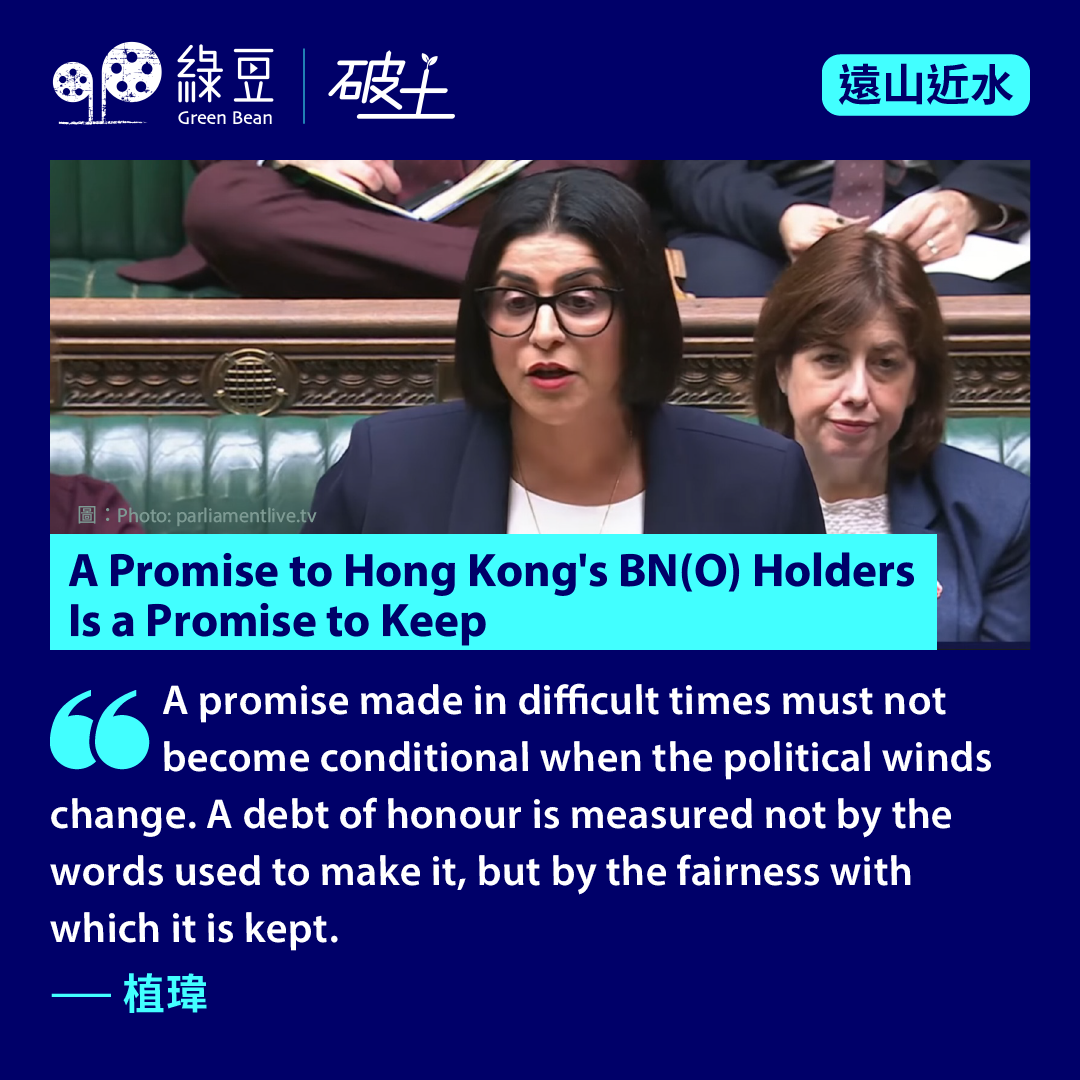
A promise made in difficult times must not become conditional when the political winds change. A debt of honour is measured not by the words used to make it, but by the fairness with which it is kept.
