A guessing game on the next chief executive – with no fun
As the fifth Chief Executive of the Hong Kong SAR, the list of John Lee Ka-chiu’s self-proclaimed achievements sounds impressive. He said he has changed the culture of the civil service towards results-oriented. He pioneered a light public housing scheme, which, he said, could help solve the notorious “shoe-box units”, or subdivided flats. He has introduced a regulatory regime for ride-hailing services which, if works smoothly, will put taxi service on the right track. Or more chaos if it fails. He gave the greenlight to allow stock market trading during typhoons.
During the reign of his predecessor Carrie Lam Cheng Yuet-ngor, the Northern Metropolis was still a pipe dream. Lee, after taking the helm in July 2022, has done some walking, not just talking and dreaming. Before the end of the third quarter, he plans to give birth to the city’s first five-year plan, which will align with the nation’s 15th Five-Year Plan. On the national security front, he has finished the task of Article 23 legislation that his four predecessors either had failed or had put it on the shelves.
The list of “achievements” goes on – and will run much longer if shelving a waste levy scheme is counted as one and ditching the notion of poverty line is another.
With that seemingly impeccable record that he has propagated, Lee, the only candidate with Beijing’s blessing who won the “one-horse” chief executive race in 2022, should have been assured another five years after his current term ends next year.
Not shed any light
The “thumbs-up” to him given by China’s point man on Hong Kong affairs, Xia Baolong, as he said goodbye to Xia at the end of his two-day inspection trip to the city last week, would have given a big boost to his re-election bid if he is keen to go for it. To put it on the record, he has neither said nor hinted he will run or will not run.
At least on Xia’s “thumbs-up” gesture, a veteran pro-Beijing political figure Tam Yiu-chung was telling the truth, cautioning pundits not to read too much into his raised finger.
With the beginning of the final year of his five-year term nearing, Lee has been cautious not to give any indications of his re-election plan, if there is one, in his current round of media interviews marking the fourth anniversary of his rule.
In an interview with the South China Morning Post published on June 15, Lee shrugged off a question on seeking re-election. He said “a year is a long time in politics.” “One year is a long period for a lot of things to be achieved … So a lot of these things can happen in one year.” “Time will come when I see.”
In a joint interview with the city’s electronic media on Friday, he thanked Xia for the recognition of his work, encouragement and “four affirmations,” but added that it was too early to talk about re-election.
Lee said Xia has affirmed the government’s work on the city’s first five-year plan, national security, technological innovation and economic development.
The Beijing authorities have not been shy from offering “affirmations” to the work of the four former chief executives during their tenure. A “thumbs-up” to Lee by Xia is no more, and no less; it did not shed any light on whether Lee will be given another five-year term.
The main question Xi consider
Admittedly, Lee will make history if he emerges again as Beijing’s “one-only” blessed candidate in the 2027 chief executive election.
Of the four former CEs, Leung Chun-ying and Carrie Lam were “one-term” CE. Tung Chee-hwa, the city’s first CE, had his second term ended at its mid-point when he tendered his resignation, citing sore legs, in March 2005. His remaining 27-month-long term was completed by Donald Tsang. Tsang was re-elected for a full five-year term in 2007.
Under the Basic Law, the chief executive “may serve for not more than two consecutive terms.” None of the four ex-CEs had completed two full five-year terms. Whether the post of the city’s chief executive has been jinxed is anybody’s guess.
If the city’s five chief executives have one thing in common, it is their different backgrounds. Tung’s reign had been dubbed as “businessman ruling Hong Kong”; Tsang and Lam “AO ruling Hong Kong”, which stood for Administrative Officer; Leung Chun-ying “professionals ruling Hong Kong”.
John Lee joined the government as a police inspector. His election to the top post has been dubbed as the flag-bearer of a new phase of “disciplined services’ officials running Hong Kong.”
Shocked by the 2019 political unrest, Beijing’s pick to displace Lam was clearly aimed to help end chaos and restore stability in the city rocked by the protests and the Covid epidemic, smothering the path to prosperity.
Six years after the first national security law took effect, the legal mechanism and enforcement machinery have been largely up and running. Their deterrent and chilling effects have been abundantly clear.
God knows whether the post of the Chief Executive is jinxed. But whether Lee will be given five more years is a question for Beijing, or more accurately, President Xi Jinping to decide.
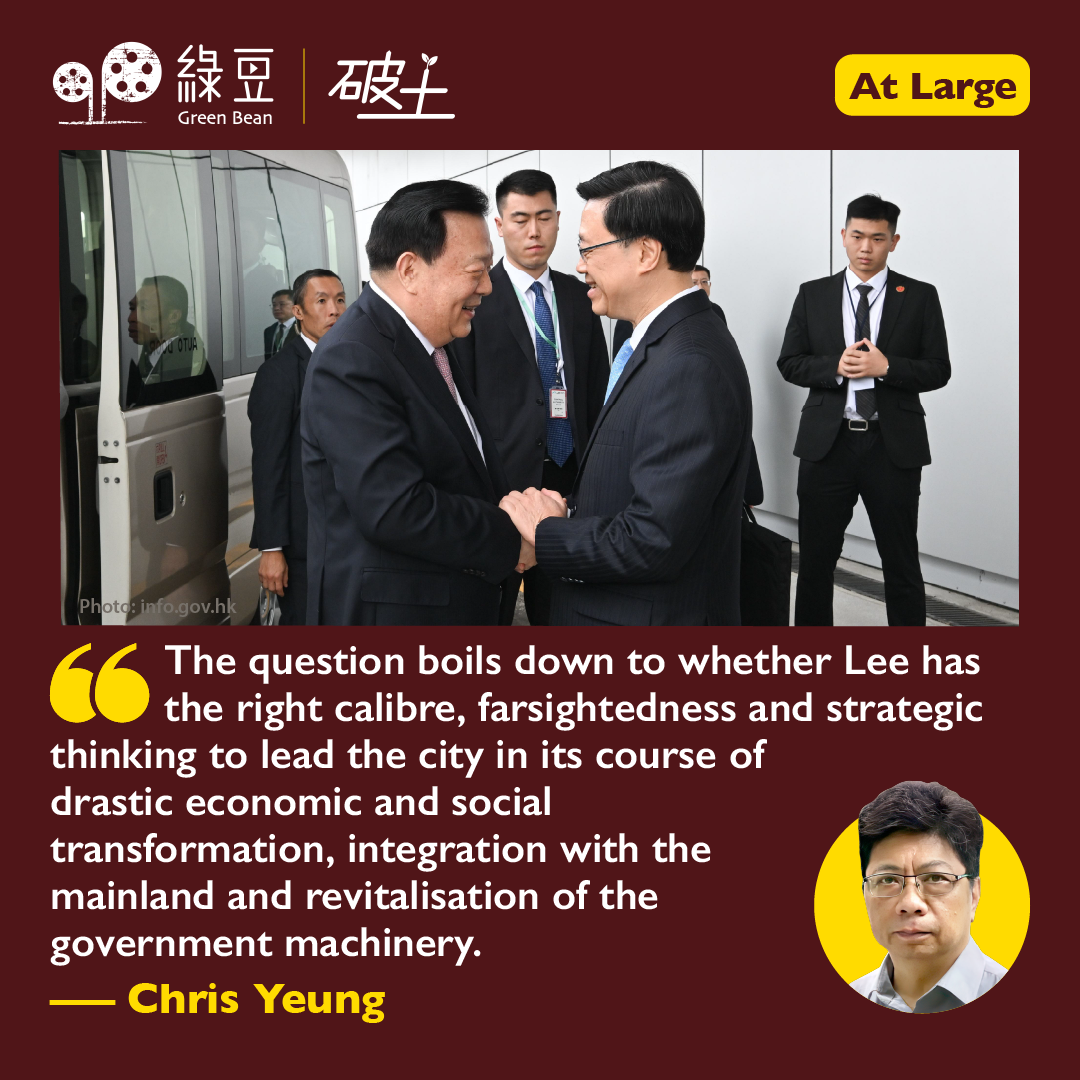
The question boils down to whether Lee has the right calibre, farsightedness and strategic thinking to lead the city in its course of drastic economic and social transformation, integration with the mainland and revitalisation of the government machinery. Beijing’s answer is anybody’s guess. And if Lee is not the best person, who he or she would be is another guessing game – with no fun.
▌ [At Large] About the Author
Chris Yeung is a veteran journalist, a founder and chief writer of the now-disbanded CitizenNews; he now runs a daily news commentary channel on Youtube. He had formerly worked with the South China Morning Post and the Hong Kong Economic Journal.