Crackdown on bid-rigging toughens, finally
Hong Kong authorities on last Friday (Nov 6) claimed a ringing success in having cracked down on a syndicate and arrested 28 people allegedly involved in bid-rigging by a joint task force set up eight days ago.
The joint task force headed by security minister Chris Tang was one of the basket of measures announced by Chief Executive John Lee in response to a damning report on the devastating Wang Fuk Court fire compiled by an independent committee.
Among the 28 people arrested in the Friday operation were board members of contractors and consultancy firms. Authorities also arrested another 38 people in the two-day operation after raiding five illegal gambling dens and two vice establishments believed to have been financed by proceeds from the syndicate’s bid-rigging activities.
Tang, who chaired Friday’s press conference, told reporters the joint task force had earlier hunted down a bid-rigging syndicate with links with triads, which he said was attempting to “catch the last train” in reaping gains before measures aimed to eliminate bid-rigging were fully implemented.
Investigators found the syndicate had engaged in acts of bid-rigging, bribery, false documentation and intimidation that were related to the contracts of a total of 12 renovation projects in residential buildings in various districts. The total amount of the contracts hit the HK$100 million mark.
◾Concerns come to light since 2012
The syndicate, Tang said, has sophisticated operations with detailed division of work and long-term planning, including identifying old buildings with more elderly residents who lacked professional knowledge of building renovation.
Even before certain buildings received a mandatory renovation order from the authorities, he said the syndicate started purchasing units in those buildings and manipulating tendering results through its owners’ association.
The swift crackdown of a sizable syndicate in bid-rigging in 12 ongoing renovation projects should no doubt be applauded.
Members of the public, in particular the victims of bid-rigging, however, should be forgiven for being skeptical and unforgiving if they feel adamant the question of why it has taken so long for the government to act tough on bid-rigging remains unanswered.
This is because it had not taken long for complaints and concerns about bid-rigging to have come to light after the Mandatory Building Inspection Scheme was implemented in 2012.
Under the scheme, owners of buildings aged 30 years or above and served with statutory notices are required to appoint an registered inspector to carry out inspection and supervise repairs works found necessary.
A landmark bid-rigging case featuring Garden Vista in Sha Tin that involved a staggering HK$260 million renovation project in 2013 was put to a court. A judge found the defendants including contractors, property management staff and owners’ management association members guilty in a ruling in 2016.
In a statement on the court ruling in 2016, the Competition Commission said they will work closely with other relevant law enforcement agencies such as ICAC and the Police to ensure a coordinated and effective approach to tackling bid-rigging.
The Commission has warned of the problem of anti-competition including manipulation of tendering in a detailed report published in 2016.
◾How they should have done better?
Bid-rigging remained a subject of complaints by residents and concerned groups since then.
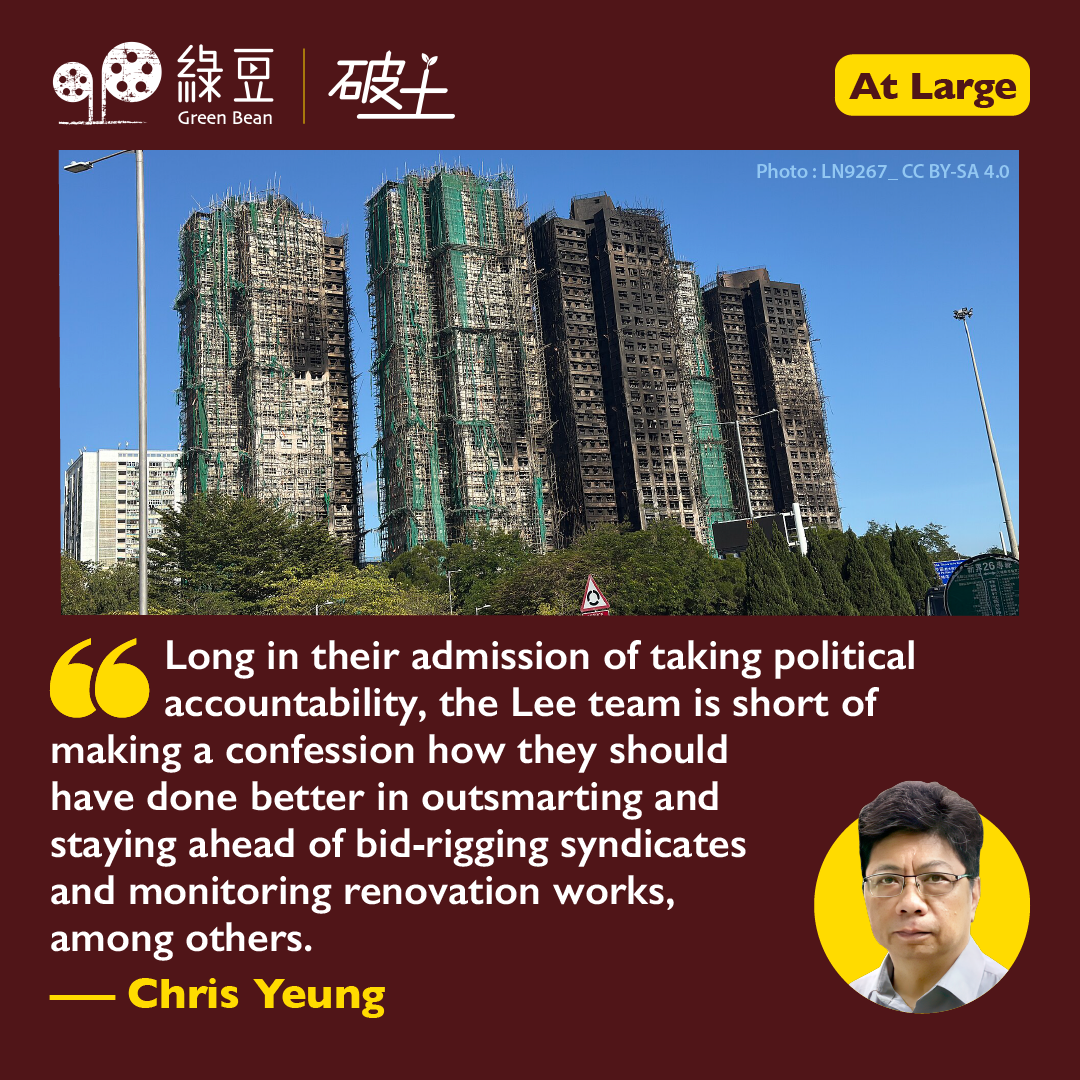
Then came the Tai Po deadly blaze that killed 168 people. Alleged bid-rigging in the awarding of the tender of the multi-million-dollar project was to blame, in part, for the tragedy.
Dozens of people were arrested for alleged bid-rigging and other offences related to the Wang Fuk Court fire. Crackdown against bid-rigging has been intensified, followed by a string of measures to criminalise bid-rigging with heavier penalties and beef up investigation and crackdown on the activities announced by John Lee.
Speaking at the conference chaired by Lee, Chris Tang said a three-thronged approach will be taken to eradicate bid-rigging syndicates at the roots. He vowed giving no room for their survival.
The pledge of Tang and the Lee administration was made more than one decade after bid-rigging cases in mandatory building renovation projects surfaced. Investigation by reporters found the average amount of money owners of buildings paid for mandatory renovations had risen sharply after the scheme was in place.
Bid-rigging and irregularities in building renovations projects emerged and had apparently worsened as the helm of the Development Bureau was handed by former Chief Executive Carrie Lam, who was the minister between 2007 and 2012, to former financial secretary Paul Chan (2012-2017), followed by Deputy Chief Secretary Michael Wong (2017-2022) before Bernadette Linn succeeded in 2022. The mandatory inspection scheme was initiated by Lam, who oversaw the Development Bureau after 2012 in her capacity as Chief Secretary.
Linn said at a press conference she had contemplated the idea of stepping down, adding, as a crew member, she followed the decision of the “captain,” referring to John Lee. Lee said the government took political accountability over the blaze. After much consideration, he said he decided that housing minister Winnie Ho should take political accountability. Ho tendered her resignation. Linn, as the current minister whose portfolio covers buildings and renovations, did not give an account of the dismal record in cracking down on bid-rigging.
Long in their admission of taking political accountability, the Lee team is short of making a confession how they should have done better in outsmarting and staying ahead of bid-rigging syndicates and monitoring renovation works, among others.