Curbs on media land search bad for right to know
The importance of access to information cannot be emphasised more; it is vitally important for upholding people’s right to know. With effective checks and balances lacking in the present governance system, the role of media, as the fourth power, in telling people what happened and why they should know needed to be protected for the media and society at large.
It is therefore deplorable that the government has shown no sign of reversing its tendency of tightening media’s access to information as evidently clear in the past few years.
◾ Restrictions on media access to land lease data
On Friday, the government submitted a total of eight subsidiary legislations to the Legislative Council. According to a Legco paper, media access to data relating to land leases will be restricted.
Under the proposed amendment, application for inspection of land leases needed to be justified for a list of nine specified purposes. One of which is public interest.
In a footnote on the Legco paper, the Development Bureau said a case that involved public interest is investigative news reporting of large-scale illegal structures and properties that do not have landlords. “(There’s) a need to apply for inspection of the records of the relevant land.
It added that the Land Registrar will assess the application of cases involving public interest case by case. He or she will take in account factors including the purpose of inspection, whether disclosure of interests outweighs privacy rights, how the records are used and whether the information will be used improperly. The four conditions outlined in the footnote are not written into the subsidiary legislation.
In a paper setting out the proposed changes published earlier, the bureau has said one of the specified purposes is “market research or reporting of the property market.”
In the newly-proposed legislation, it was rephrased as “for academic purpose or for research and general analysis for property market report.” In the English version, the word “reporting” was retained. But it was deleted in the Chinese version.
Election Committee legislator Andrew Lam Siu-lo urged the government not to stifle the need of the media for conducting reasonable land lease inspection work. Former legislator and lawyer Doreen Kong said tightening the rules of inspection will certainly cause inconvenience. She said she did not see the rationale of curbing the press. “Why are those who do market research allowed to find out more, but journalists are not?
◾ The Court of Final Appeal Judgement
Media search for land lease data has proved to be instrumental in revealing malpractices including property purchase by senior officials and transfer of land rights among rural indigenous residents.
Inspection of vehicle licences has also been a common tool for journalists to get a clue for them to find out the truth behind such controversial events as the 7.21 Yuen Long mob attack.
The government has moved to curb media access to data after the 2019 social movement.
In November 2020, Bao Choy, a freelance producer, was charged with two counts of making false statements to obtain vehicle records for a documentary for public broadcaster RTHK. The documentary uncovered details about the mob attack in Yuen Long on July 21, 2019. She was found guilty in 2021. A court fined her HK$6,000. She pleaded not guilty.
In 2023, the Court of Final Appeal overturned the ruling. It was hailed by journalists’ groups as a victory of press freedom.
The court ruled: “While rights such as freedom of speech and freedom of the press were “not absolute and may be restricted where necessary, there is no reason to proceed from a starting point that bona fide journalism should be excluded from the phrase ‘[o]ther traffic and transport related matters’.”
◾ Role of media in Hong Kong
Despite the ruling in backing bona fide journalism as a legitimate purpose for application for access to data, the government has not specified reporting as one of the purposes for journalists to apply for search as shown in the proposed amendments to the rules on land lease search.
The government has so far failed to give a convincing explanation of why media are not allowed to have access to information concerning land lease, vehicles, marriage and birth.
It boils down to the question of the role that the government is hoping the media to play in society.
For the media to function as a watchdog that can bark and bite, they ought to be given such tools as access to data.
Before and after a considerable period of time after 1997, the government helped facilitate the work of journalists as reflected in arrangements such as access to data policy.
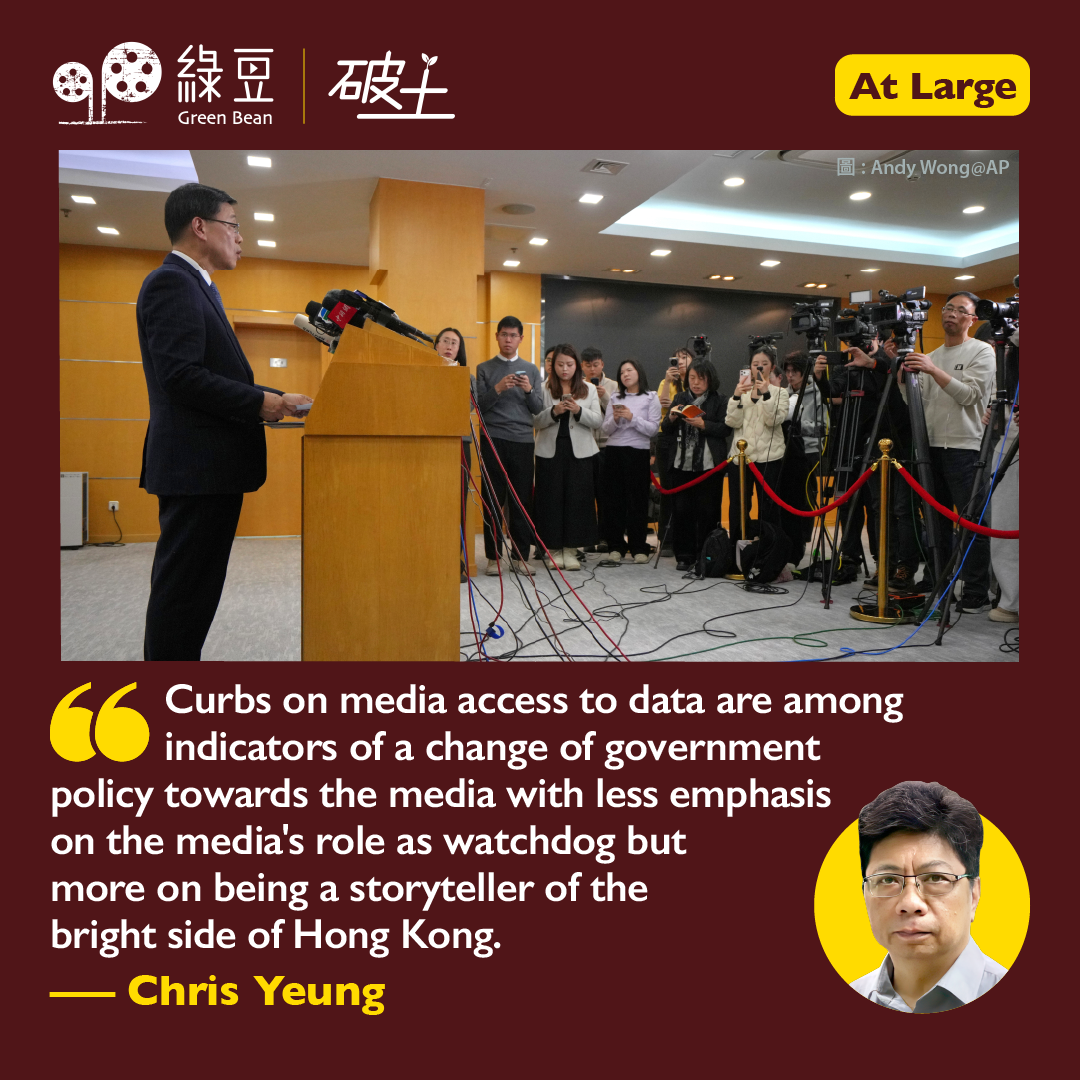
Curbs on media access to data are among indicators of a change of government policy towards the media with less emphasis on the media’s role as watchdog but more on being a storyteller of the bright side of Hong Kong.
▌ [At Large] About the Author
Chris Yeung is a veteran journalist, a founder and chief writer of the now-disbanded CitizenNews; he now runs a daily news commentary channel on Youtube. He had formerly worked with the South China Morning Post and the Hong Kong Economic Journal.