Academic Freedom: The Case of Benny Tai
Prologue
In April 2020, Associate Professor Benny Tai appeared before the Senate of the University of Hong Kong to face a disciplinary charge arising from his conviction for organising the Occupy Central movement. This was one of the rare moments when the academic community was forced to confront the meaning of academic freedom. I had the privilege of representing Benny at the hearing. In many ways, the hearing was more significant than the University Council’s later decision, because the Senate was composed largely of the University’s academic staff. In other words, he was being judged by his peers. His appeal against conviction and sentence was later dismissed by the Court of Appeal. While on bail pending that appeal, he helped to organise an unofficial primary election among the pan-democrats ahead of the 2020 LegCo election. The campaign aimed to secure a legislative majority and then use measures permitted under the Basic Law—most notably vetoing the budget, which could force the Chief Executive of the HKSAR to resign—to pressure the Government to accelerate democratic reform in Hong Kong. In the early hours of 6 January 2021, he was arrested and charged with conspiracy to commit subversion under the newly enacted National Security Law. He has remained in custody ever since. In 2024, he was convicted and received the heaviest sentence among the defendants: 10 years’ imprisonment. It is believed that he will not be released before 2032. This article is dedicated to Benny—my former student, colleague, and friend—for whom I have deep respect, even where I may not agree with everything he did.
Misconduct
THE SENATE ROOM was packed: the President and Vice-Presidents of the University, the Registrar, Deans, professors from different disciplines, elected faculty members, student representatives, the Librarian, and senior administrators. In short, the entire academic community was there. I had sat in this room many times as Dean of the Faculty of Law, but on this occasion I appeared for my colleague Benny Tai, who faced a disciplinary charge of good cause—that is, whether there was good cause to dismiss him from the University.
We were asked to wait in a small room next door. The legal team consisted of Randy Shek and Jason Kung, two able criminal barristers from my chambers, and Kristine Chan, then a trainee solicitor. Benny tried to appear relaxed, but his anxiety was palpable. After all, the meeting would determine the future of his academic career and his continuing place in the institution where he had studied and taught for more than 25 years.
A committed democrat, Benny had spent much of his life campaigning for greater democracy in Hong Kong. In the late 1980s, while still a student at HKU, he served as a student representative on the Basic Law Consultative Committee and took part in discussions on Hong Kong’s democratic future. Thirty years later, with grey hair and a son already at university, he was still campaigning for universal suffrage, as Hong Kong had made little progress towards democratisation.
In 2007, the Standing Committee of the National People’s Congress stated that the Chief Executive of the HKSAR could be elected by universal suffrage in 2017 and that the Legislature could follow thereafter. Yet by the early 2010s, it had become clear that the Central Government’s model of universal suffrage would allow the public to choose only among a small number of pre-approved candidates selected through a highly restrictive nomination process. This was not what the public understood by a free election. Many therefore campaigned to liberalize the nomination process and allow meaningful public participation. When those calls were repeatedly ignored, Benny and his two colleagues—Professor Chan Kin Man and Reverend Chu Yiu Ming—decided to organize a peaceful demonstration in Central’s financial district, a movement known as Occupy Central, or the Love and Peace Movement. The original plan was to occupy Central for a few days. But the movement soon took on a life of its own: the occupation shifted to major roads around the Central Government Headquarters and lasted 79 days, far longer than intended. By and large, it remained peaceful and ended only by a court order. Benny and the other organizers were eventually convicted of conspiracy and incitement to commit public nuisance, and he was sentenced to 18 months’ imprisonment.
On the basis of that conviction and sentence, the University charged him with misconduct said to render him unfit to remain in office. The Committee of Enquiry found that the conviction and sentence amounted to misconduct but declined to express a view on whether that misconduct rendered him unfit to continue in office. It regarded that as a question of value judgment rather than fact, and therefore one for the academic community rather than for a fact-finding committee.
The Hearing
“The Senate is ready for you.”
The Senate was the University’s highest academic authority. Chaired by the President, it comprised senior management, the Deans, senior professors, elected academics, non-academic staff, and student representatives. It was one of the rare occasions on which it met in full strength, with many members in attendance who would not ordinarily be present.
As we entered, the room fell silent and every eye turned to Benny. The President opened the meeting. Chris Bonsall, the experienced solicitor acting as legal adviser to the University, explained the procedure in a dry, formal tone. “As members have read your written submissions, please keep your oral submissions to 20 minutes.” I thanked the President, but said that, given the importance of the decision for an academic colleague’s career, I would be concise, though I might need to go slightly beyond the allotted time.
I began with a brief introduction, explaining that Benny was appealing his conviction and that the Senate might wish to defer deliberation until the appeal was decided. Before turning to the substance of my submission, I asked Benny to say a few words, because it would matter for the audience to hear directly from him rather than only from his lawyer. He spoke briefly and sincerely, acknowledging what he had done and apologizing for the inconvenience and embarrassment caused to the University. It worked: his apology softened the tense atmosphere and appeared to win some sympathy.
I paused for a moment to let that atmosphere settle, then began my submission:
“Members of the Senate,
The disciplinary charge, as framed, rests entirely on his conviction and sentence.
There are two issues:
- Did the criminal conviction and sentence constitute misconduct for the purposes of the University’s good-cause proceedings?
- Even if it did, was it of sufficient gravity, or were there mitigating circumstances, such that it did not render Benny unfit to continue in office?
The Committee of Enquiry answered “yes” to the first question, but made no decision on the second. On the first question, we say that the enforcement of the general criminal law is a matter for the courts; whether it amounts to misconduct in the University depends on the circumstances of the conviction and must be related to his academic or professional fitness. On the second question, we say that, even if it were misconduct, it would not warrant dismissal in light of his role, the nature of the offences, and the mitigating circumstances.”
After taking members through the facts as found by the court and highlighting the salient features of Benny’s case, I continued:
“The Disciplinary Charges
Under the University Regulations, “good cause” means “inability to perform efficiently the duties of the office, neglect of duty, or such misconduct, whether in an official or a private capacity, as renders the holder unfit to continue in office.” The second part of the definition is circular, and we submit that the misconduct must be related to his academic or professional fitness.[1]
It is important to examine the context and purpose of “good cause”. This time-honoured phrase is intended to protect academic freedom, so that an academic is not dismissed because of his or her political views or participation in political affairs. In an increasingly complex world, the community increasingly looks to faculty members in higher institutions of learning for expert contributions to public discourse and policy debate. By reason of their expertise and objectivity, academic staff are in a unique position, and indeed under a special duty, to inform the public on matters of public importance. In doing so, they are increasingly and inevitably drawn into controversies over political ideology, religious doctrine, social or moral debate, corporate practices, public policy, and even public health, as we have recently witnessed. “Good cause” exists to protect an academic from political intrusion into his or her career when engaging in social debate on matters of public controversy, so that the academic need not fear dismissal because of the controversial views he or she may hold or advance.
Thus, “good cause” must be properly construed so that it is confined to the performance or neglect of academic duties, or to misconduct that casts doubt on one’s integrity, honesty, or morality and goes to one’s professional or academic fitness. It must also be of a very serious nature to warrant dismissal.
In The Dar es Salaam Declaration on Academic Freedom and Social Responsibility of Academics (1990), it was declared at §29:-
“29. Teaching and researching members of the academic community once confirmed in employment, shall have security of tenure. No teaching member or researcher shall be dismissed or removed from employment except for reasons of gross misconduct, proven incompetence or negligence incompatible with the academic profession…” [Emphasis added]
Along similar lines, in the United Nations Educational, Scientific and Cultural Organisation’s Recommendation concerning the Status of Higher-Education Teaching Personnel (1997), UNESCO made the following recommendation at §50, which is particularly pertinent in this case:
“50. Dismissal as a disciplinary measure should only be for just and sufficient cause related to professional conduct, for example: persistent neglect of duties, gross incompetence, fabrication or falsification of research results, serious financial irregularities, sexual or other misconduct with students, colleagues, or other members of the academic community or serious threats thereof, or corruption of the educational process such as by falsifying grades, diplomas or degrees in return for money, sexual or other favours or by demanding sexual, financial or other material favours from subordinate employees or colleagues in return for continuing employment.”
HKU’s definition of “good cause” applies to conduct in an official or private capacity. This must be approached with care. An academic is also a member of the community. He is entitled to his own political views, as well as to participate in political affairs. A distinction must be drawn between what an academic does within the University and his outside activities in his private capacity, albeit as a law teacher.
There is an obvious danger in restraining a professor from saying something unpalatable, or even offensive, to some quarters of the community, on the footing that the institution would thereby assume responsibility for what the academic said. There is no concept of a university being vicariously liable for the academic, political, or social views of an academic, at least not for views expressed outside the course of employment. Apart from academic freedom, a university does not hold any single position on social or political issues. Its members do, and more often than not they hold a wide range of views, sometimes diametrically opposed. This is what a university is for. A thriving academic community is a place where all kinds of unconventional, controversial, and even heretical ideas may be tested and debated. There was a time when the claim that the world was round rather than flat was regarded as heresy. Imagine where we would be today if such heresies had been restrained or penalised in an academic institution. Thus, academic institutions would do best to leave charges that may criminalise controversial speech or expression to the courts, and to confine institutional hearings to professional fitness.
Ladies and Gentlemen, there is no question here of dishonesty, lack of integrity, or moral failing. The court accepted that the offence was not motivated by greed, lust, anger, financial reward, or any private gain. There was no abuse of power or exploitation of his position as a teacher. All the acts were committed outside the University. He never used his position as a teacher to preach his political convictions on campus or in class. His conduct came nowhere near what is described in the UNESCO Recommendation. This is not about misconduct relating to his academic or professional fitness. It is about his political beliefs.
It concerns an important constitutional development in Hong Kong in which he honestly believed. It concerns the exercise of a fundamental right guaranteed by the Constitution. The occupation was pursued in accordance with the hallmarks of civil disobedience: a peaceful and non-violent demonstration. A striking feature of the movement was his repeated and consistent advocacy of peace and non-violence.
It was kept within proportion. In his original design, the occupation was to be carried out at a time that would cause the least disturbance to the public, with four of the five planned days falling on public holidays; it was to be confined to a section of Chater Road designated as a pedestrian zone on public holidays; and it was to be limited to a short duration.
The movement was soon taken over by the student leaders. The time, place, modus operandi, and even the demands were changed. When the occupation began at Tim Mei Avenue, he negotiated with the occupiers to reopen the footbridges leading to the Central Government Offices. He maintained channels of communication with Government officials with a view to bringing the occupation to an early end. He discussed withdrawal from the occupation a few days after it had started, and remained there only to facilitate a dialogue between the Government and the student leaders, a meeting that eventually took place. He adopted a low profile soon after the occupation began and tried various means to bring it to an early end. While his role changed, he accepted responsibility. While the demands expanded, the movement remained peaceful. It was a classic act of civil disobedience in pursuit of the greater good.
Civil disobedience is a controversial subject throughout the world, but it is a well-recognised concept. In A Theory of Justice (revised edition, 1999), at p. 320, John Rawls defined civil disobedience “as a public, non-violent, conscientious yet political act contrary to law usually done with the aim of bringing about a change in the law or policies of the government”. The concept of civil disobedience has long been recognised and accepted by the highest courts in England as well as in Hong Kong. As Lord Hoffmann, one of the most distinguished judges in the common law world and an overseas judge of our Court of Final Appeal, observed: “Civil disobedience on conscientious grounds has a long and honourable history in this country.”[2] It involved four basic steps: public deliberation, public authorisation, dialogue and negotiation, and civil disobedience as a last resort. An “offence” involving a peaceful, non-violent act undertaken in pursuit of the greater good, coupled with a readiness to accept the legal consequences, is of a completely different character and nature from an offence involving dishonesty, moral depravity, or conduct negating one’s integrity. In any event, one must not lose sight of the fact that what he incited others to do, despite attracting criminal sanction, was to take part in an entirely peaceful assembly on perhaps the most important political question in Hong Kong. The strong support from the academic world is powerful testimony that what Benny Tai did ought not to amount to misconduct rendering him unfit to continue in office.
We fully respect that people may take different views on this subject, and that to some it may be unpalatable, or even immoral, to speak of non-compliance with the law in a law school. But it is a respectable subject, studied, debated, argued, and researched in every leading university. Precisely because it is so controversial, it is all the more important for the University to protect its staff in holding such views. This is not to ask the University to endorse civil disobedience. The University should be a place where controversial, or even shocking, ideas may be expected to find refuge. Demanding conformity to conventional values should not be the shackle imposed by a respectable university, still less should it ground a finding of academic unfitness merely because he advanced a controversial idea and acted upon it, all in the honest pursuit of the betterment of society.
Let me say a few words about his academic fitness. It is important to consider his record as a whole. He has a strong record in teaching, research, and service. Document 6 provides a list of his academic activities. He has remained academically active throughout. He has served the University for over two decades, and even after his conviction he continued to receive frequent invitations from leading overseas institutions of higher learning, including Yale, Stanford, and Tokyo. He was recently offered a visiting researcher position by the Dickson Poon School of Law at King’s College London. He continued to participate in academic events and to publish. Neither his academic reputation nor the reputation of the University has suffered. Quite the contrary. In short, there is nothing to show that he is unfit to continue in office in terms of his academic and professional performance.
He has received over 800 letters of support from leading academics around the world, including many from distinguished institutions such as Harvard, Yale, Princeton, Columbia, Cambridge, Oxford, UCL, LSE, KCL, Toronto, McGill, NUS, Seoul National University, and Tokyo. Such strong support from the international academic community is unprecedented. It is also powerful evidence of the shared values of leading universities around the world. It shows that Benny’s conduct is not incompatible with the values held by many universities with which HKU would be proud to be associated. Whatever the outcome of his appeal, he has already served the equivalent of six months’ imprisonment, as he was then on bail pending appeal, and may have to serve the balance of his 18-month sentence if his appeal is unsuccessful. He has paid a price. You have heard his apology for the inconvenience caused to the University. He may be naïve; he may be mistaken; he may even be foolish; but he is well-intentioned. He is true to his beliefs and teaching, and he has taken steps to minimise disruption to the public. Would a world-class university like ours have no place for such an academic? Should he be additionally punished by losing his academic position?
The Committee of Enquiry has pointed out that whether the misconduct renders him unfit to remain in office is a question of value judgment. At the end of the day, ladies and gentlemen, you must ask yourselves this question: what values does this University stand for? Creative and honest ideas are bound to be controversial. Would an academic with a long record of strong performance be found unfit to continue in office merely because he was found to have broken the law by advocating entirely peaceful acts of civil disobedience and acting on his beliefs with intellectual honesty?
We submit that this is not misconduct for the purposes of “good cause”. If it were misconduct, it is not of a kind that calls for dismissal. Alternatively, there are sufficient mitigating circumstances to prevent it from rendering him unfit to continue in office. At the end of the day, it rests on the good conscience of what we academics stand for, what we believe, and why we are here. On those grounds, ladies and gentlemen, I rest my case.”
The submission lasted about 40 minutes. I was pleased to have held the audience’s full attention, with even a few brave hands clapping at the end.
“Thank you, Professor Chan. The Senate will now deliberate.” The President concluded the hearing.
The Hardest Moment
We returned to the waiting room. For lawyers and clients alike, waiting for the jury’s verdict is always the hardest moment in any case. The hands of the clock seemed to move unusually slowly. A colleague was kind enough to bring us tea and biscuits. I told Benny that we had done all we could and tried to lighten the mood with a few jokes. As a devout Christian, he was prepared to leave his fate to God’s will.
The Senate found that, although Benny had committed misconduct, there were insufficient grounds to dismiss him.[3]
The Rest is History
The Senate’s recommendation then had to go to the University Council, the University’s highest decision-making body, on which non-University members formed a majority. It was chaired by Professor Arthur Lee, former Vice-Chancellor of the Chinese University of Hong Kong and former Secretary for Education and Manpower Planning, who had acquired the nickname “King Arthur” during his time at the Chinese University. The hearing was scheduled for that summer while I was out of town, and the Council refused to accommodate my diary even though there was no apparent urgency to conclude the case. It rejected the Senate’s recommendation and dismissed Benny. I do not think my presence before the Council would have made any difference. The dice had probably been cast before the game began.
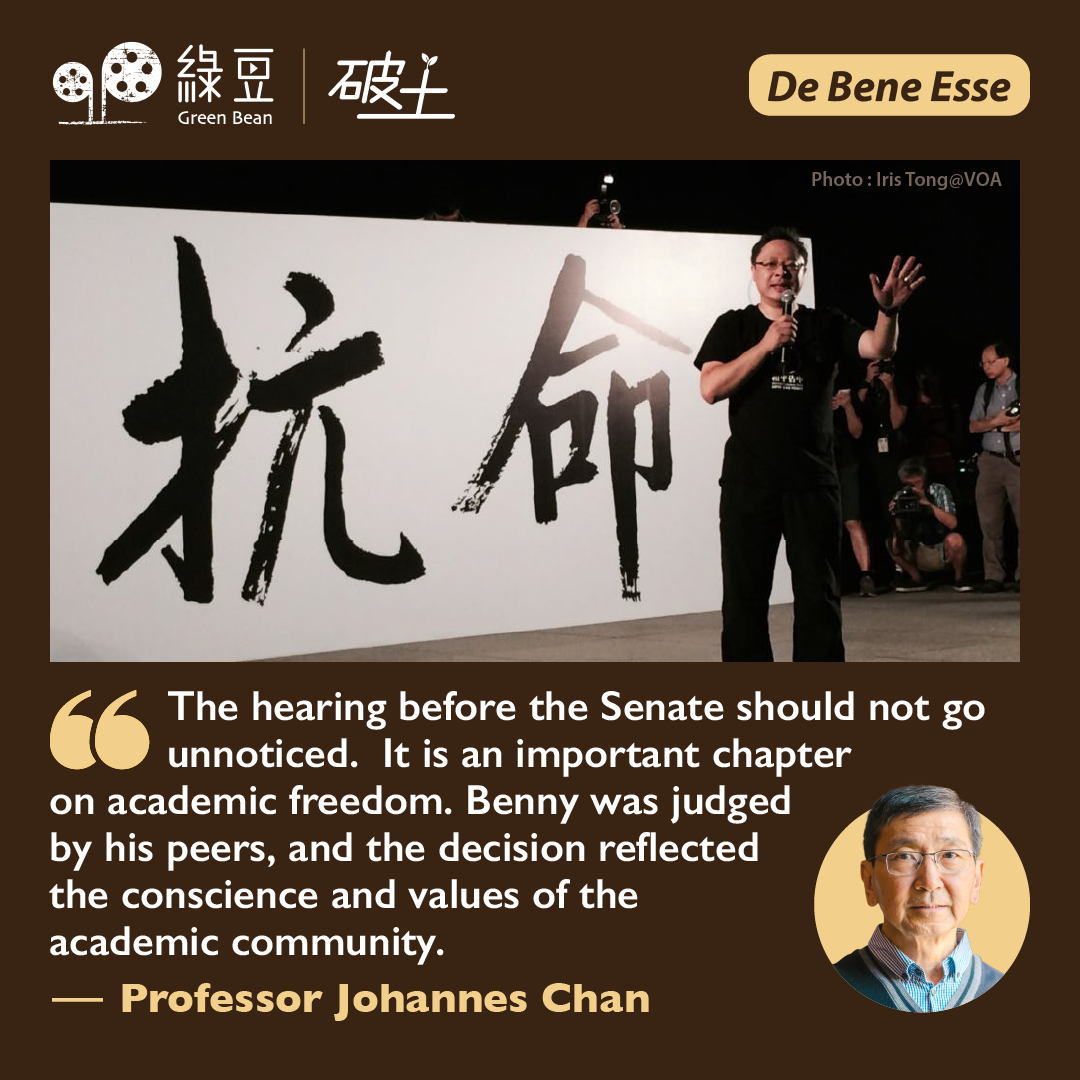
Nonetheless, the hearing before the Senate should not go unnoticed. It is an important chapter on academic freedom. Benny was judged by his peers, and the decision reflected the conscience and values of the academic community.
Notes:
[1] The meaning of “good cause” is defined in the University of Hong Kong Ordinance, Cap 1053. Section 2(2) provides that:-
“(2) For the purposes of this Ordinance, “good cause”, when used with reference to removal from office, membership or place and with reference to such of the members of the University and of the officers and teachers as shall be designated by the Ordinance and statutes, means inability to perform efficiently the duties of the office, neglect of duty, or such misconduct, whether in an official or a private capacity, as renders the holder unfit to continue in office. (Amended 66 of 1988 s. 2)”
[2] R v Jones (Margaret) [2007] 1 AC 136, at §89, per Lord Hoffmann, cited with approval by Lord Hoffmann NPJ in the Court of Final Appeal decision in Secretary for Justice v Wong Chi Fung (2018) 21 HKCFAR 35, at §72.
[3] “Benny Tai: Hong Kong university fires professor who led protests”, BBC News, 28 July 2020: https://www.bbc.co.uk/news/world-asia-china-53567333.
▌ [De Bene Esse] About the Author
Professor Johannes Chan is an Honorary Professor of University College London and the former Chair of Public Law, The University of Hong Kong.