Earned Settlement and the Hong Kong BN(O) 5+1 Route: A Legal Analysis | Professor Johannes Chan
In November 2025, the British Government published a consultation document on Earned Settlement, which proposed a revised framework for settlement in the UK.[1] The key message is that settlement must be earned through (1) meaningful contribution to and engagement with British society; (2) sustained and measurable economic contribution to the UK; and (3) a qualifying period of continuous residence. The default qualifying period of residence is to be changed from the current five years to ten years, whereas the current qualifying period of five years‘ residence under the British National Scheme for Hong Kong (“BN(O) Scheme”) will remain unchanged. However, migrants under the BN(O) Scheme will be subject to two new requirements, namely, (i) a heightened English language requirement (from B1 to B2 level) and (ii) a new income threshold (annual earnings above £12,570 per year for a minimum of 3-5 years).
While the retention of a five-year residence period for BN(O) migrants is to be welcomes, this article argues that the proposal has failed to distinguish the unique nature of the BN(O) Scheme from other categories of immigrants. The BN(O) pathway was established not as an economic migration route, but as a constitutional, humanitarian, and historical commitment under the Sino–British Joint Declaration. The introduction of a heightened English language requirement and a new income threshold represent a significant departure from the assurances originally given when the BN(O) Scheme was launched. The majority of migrants under this Scheme would be eligible for applying for settlement in 2026 and 2027, and any attempt to retroactively impose new criteria at this late stage raises serious concerns regarding legality, fairness, and public trust.
The Origin and Nature of the BN(O) Scheme
The British National (Overseas) (BN(O)) status, which is a form of British nationality, was created to maintain a connection between the UK and the people of Hong Kong after the handover to China in 1997, pursuant to the Sino–British Joint Declaration, under which about seven million people under British rule were returned to a Communist regime, on conditions, inter alia, that their fundamental rights and freedoms will be protected. Following the imposition of a new National Security Law by the PRC on Hong Kong in 2020 and the rapid erosion of civil society, the British Government concluded that there had been a serious breach of the Sino-British Joint Declaration. The BN(O) visa route, introduced in 2021, was a response intended to honour the British Government’s commitment to the people of Hong Kong under the Sino-British Joint Declaration.[2] It allows BN(O) status holders and certain family members to live, work and study in the UK (“the BN(O) Scheme”)
The BN(O) Scheme is self-contained and stands as a distinct route. Applicants are granted permission to enter on the condition that they have no recourse to public funds and possess sufficient financial means to support themselves.[3] Once granted, they may work full-time or part-time, paid or unpaid, without any additional permission from the Home Office. They are entitled to settlement after five years, provided they meet the requirements, which include English language proficiency at level BI and passing the Life in the UK Test.
Ministerial statements made throughout 2020–2021 repeatedly affirmed that BN(O) visa holders would be able to obtain settlement after five years without any income or economic activity requirements. The Immigration Rules reflected this understanding, requiring only residence, English at B1 level, and the Life in the UK Test.
The BN(O) Scheme opened on 31 January 2021. By the end of March 2025, about 184,478 applicants had been granted BNO visa, and 163,400 people have relocated to the UK.[4] The majority arrived in 2021 and 2022, with numbers declining thereafter. The total expected settlements by 2030 are estimated at around 195,000,[5] of whom approximately 75% will be eligible to apply for settlement in 2026 and 2027.[6] Government surveys confirm that BNO migrants are highly educated and financially self-sufficient.[7] 69% hold a university degree or above; 89% were managers, directors or senior officials, professionals and administrators; 90% have both partners living in the UK; and 60% have children with them, indicating migration as family units.[8]
The Law of Legitimate Expectation
The doctrine of legitimate expectation protects individuals against retroactive policy changes where clear and unambiguous governmental assurances have been given. The principle is grounded on fairness and good administration. As explained by Laws LJ in the leading judgment of Nadarajah and Abdi v Secretary of State for the Home Department,[9]
“The search for principle surely starts with the theme that is current through the legitimate expectation cases. It may be expressed thus. Where a public authority has issued a promise or adopted a practice which represents how it proposes to act in a given area, the law will require the promise or practice to be honoured unless there is good reason not to do so. What is the principle behind this proposition? It is not far to seek. It is said to be grounded in fairness, and no doubt in general terms that is so. I would prefer to express it rather more broadly as a requirement of good administration, by which public bodies ought to deal straightforwardly and consistently with the public.…. Accordingly a public body’s promise or practice as to future conduct may only be denied, and thus the standard I have expressed may only be departed from, in circumstances where to do so is the public body’s legal duty, or is otherwise, to use a now familiar vocabulary, a proportionate response (of which the court is the judge, or the last judge) having regard to a legitimate aim pursued by the public body in the public interest. The principle that good administration requires public authorities to be held to their promises would be undermined if the law did not insist that any failure or refusal to comply is objectively justified as a proportionate measure in the circumstances.” (emphasis added)
The doctrine of legitimate expectation necessarily allows judicial encroachment upon executive discretion and therefore imposes a rather high threshold before courts will intervene, particularly when the intervention may result in the enforcement of substantive benefits and not merely the observance of due process. Two elements must be satisfied:[10] first, a clear, precise and unambiguous representation. Not every representation of the Government will give rise to a legitimate expectation. The representation has to be clear, unequivocal and unambiguous. The circumstances of how the representation was made, the nature of the representation, and how it was reasonably understood by those to whom it was made are relevant considerations.[11] A vague, general policy statement is insufficient. Secondly, the government is allowed to depart from its clear promise or practice only if the departure is justified as a proportionate measure in the circumstances.[12]
The decision in R (HSMP Forum Ltd) v Secretary of State for the Home Department,[13] is instructive. In that case, retrospective extension of the qualifying period for settlement under the Highly Skilled Migrant Programme was held unlawful. The High Court found that there was a clear representation that once a migrant “had embarked on the scheme it was intended that he should carry the expectation of attaining settlement,” and “would enjoy the benefits of it according to the terms prevailing at the date he joined.”[14]
The judgment emphasized fairness, reliance, and the need for consistency in public administration, and held that individuals who have relied on government representations must not be disadvantaged by subsequent policy shifts. The Court distinguished Ooi v Secretary of State for the Home Department,[15] where no explicit assurance had been given. In that case, the claimants, who were permitted to enter the UK following the grant of a work permit, complained against the change of the qualifying period of residence from 4 years to 5 years continuous residence. As Laws LJ emphasized, in the Ooi case, the claimants relied on existing general provisions of law. This was insufficient to constitute an unequivocal representation.[16]
Regarding proportionality, the court considered the impact of the extension of the qualifying period on the private and professional lives of the claimants. It found no sufficient public interest to justify the retrospective change, emphasizing severe personal, financial, and professional hardship suffered by the claimants. The hardship described applies with equal force to the present case:
“75. At Mr Fordham’s request I have read all the witness statements in the bundle from members of the HSMP. They include senior academics, teachers and lecturers, doctors, engineers, managers and those with senior positions in the financial sector. They describe in clear terms the implications to them of the change in the rules and the requirement for an additional, fifth year of continuous residence. Quite apart from the psychological and emotional impact described, there are references, for example, to financial difficulties caused because of the inability to secure a competitive mortgage without indefinite leave to remain; a continuing lack of good employment or promotional opportunities without indefinite leave; an inability to comply with the travel requirements of employment, due to the scheme restrictions on travel abroad or the need for visas, with consequential career setbacks and affects on CVs; and the necessity now to pay overseas students’ fees for the entirety of the course, for children who were due to start their university courses here after 4 years’ continuous residence and the attainment of settlement.”
Application to the BN(O) Scheme
- An unambiguous representation giving rise to legitimate expectation
The circumstances of BN(O) migrants closely mirror those in the HSMP case. When the BN(O) Scheme is interpreted holistically and in its proper constitutional and historical context, it is clear that it constituted a clear and unequivocal representation that once a migrant had embarked upon the Scheme, he or she was on a defined and assured pathway to settlement, and would enjoy the benefits of the scheme according to the terms prevailing at the date of entry.
First, the BN(O) Scheme is a specific humanitarian and constitutional settlement route, introduced to honour the British Government’s obligations under the Sino-British Joint Declaration following the imposition of the National Security Law in Hong Kong. It was not framed, promoted, or understood as an economic migration route. Instead, the Scheme is intended to provide a settlement route for BNO in Hong Kong to settle in the UK in view of the deteriorating conditions of human rights and the rule of law in Hong Kong. The Home Office guidance expressly states that “The Hong Kong BN(O) route provides for permission to stay and to obtain settlement in the UK, as well as entry clearance from overseas.”[17] In explaining the BN(O) route, it further explains that “The Hong Kong BN(O) route allows BN(O) status holders and certain family members to live, work and study in the UK. After 5 years, applicants will be able to apply for settlement, and after a further year, British citizenship, providing they meet the requirements.”[18] The language is unequivocal and settlement focused.
Secondly, the Scheme sets out in comprehensive and exhaustive detail the conditions, requirements and procedures governing entry, stay, and settlement. It specifies eligibility requirements (including BNO status and eligible dependants), suitability requirements, financial sufficiency, ordinary residence, health requirements, and conditions of stay (including no recourse to public funds and unrestricted right to work and study). It then sets out, in a separate and self-contained section, the eligibility for settlement, namely: Five years’ continuous residence, Knowledge of Life in the UK, and English Language proficiency at B1 level. There is no requirement of gainful employment, no minimum income threshold, and no indication that these requirements are provisional or subject to later enhancement. The provisions are interlocking and inseparable, and are presented as a compete code governing the route from entry to settlement.
Thirdly, the Scheme expressly provides that “if the applicant meets all of the suitability and eligibility requirements, you must grant settlement.”[19] The use of mandatory language reinforces the exhaustive nature of the criteria and the binding character of the Government’s assurance. The Scheme is not framed as a discretionary or aspirational route, but as a guaranteed pathway to settlement upon satisfaction of defined conditions.
Fourthly, the Government’s decision not to extend the qualifying residence period from five to ten years for BNO migrants is itself an acknowledgment of the distinct and exceptional character of the Scheme. However, the introduction of new income and enhanced language requirement at this stage would undermine that commitment in substance, even if not in form. When approximately 75% of the BNO visa holders are due to become eligible for settlement within the next two years, there is no way that they could satisfy an income requirement for the past 3-5 years, it is impossible in practice for them to satisfy a retrospective income requirement for the preceding three to five years or to prepare for and complete a higher-level examination. Apart from the inherent unfairness of retrospective imposition of new requirements, these new requirements also amount to an extension of the residence qualifying period through the back door, which is contradictory to the commitment not to extend the residence qualifying period.
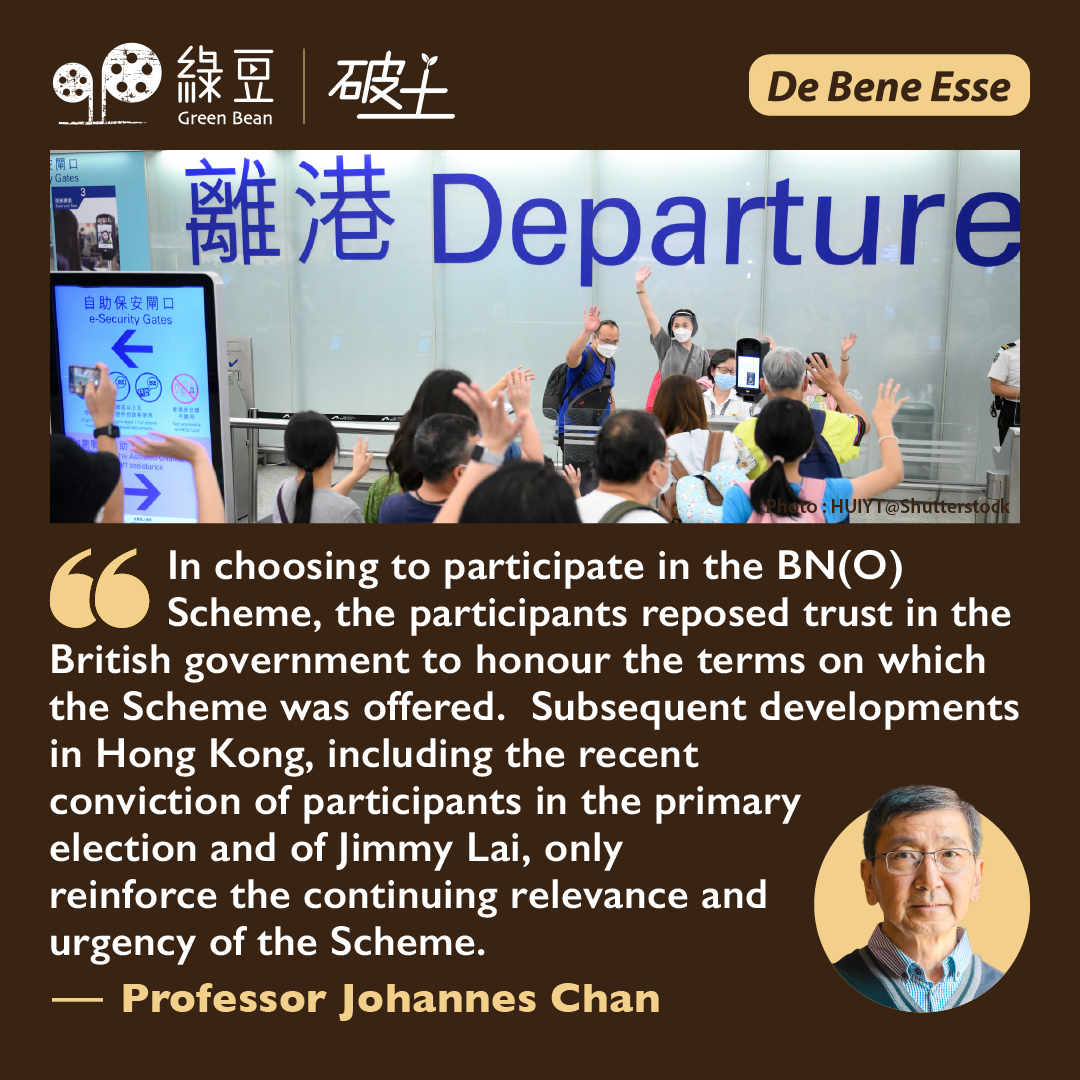
Fifthly, the Scheme was widely publicized, expressly promoted, and actively relied upon. Many participants made irreversible and life-changing decisions on the strength of the Government’s representations: relinquishing established careers, selling their property in Hong Kong, relocating young children into a new education system, separating themselves from parents, siblings, and wider family networks, and rebuilding their lives in an unfamiliar society. In choosing to participate in the BN(O) Scheme, the participants reposed trust in the British government to honour the terms on which the Scheme was offered. Subsequent developments in Hong Kong, including the recent conviction of participants in the primary election and of Jimmy Lai, only reinforce the continuing relevance and urgency of the Scheme. As Lord Sumption, a former non-permanent judge of the Hong Kong Court of Final Appeal, has observed, these developments confirm that Hong Kong is in the process of becoming an authoritarian regime.[20] The justification for the Scheme is therefore as compelling today as it was at its inception, and there is no principled basis for diluting the protection at this stage.
A further factor relevant to the court’s assessment is the sheer number of persons affected. The law of legitimate expectation requires a careful between , on the one hand, the desirability of upholding the Government to its promises as a matter of fairness and good administration, and on the one hand, the need to preserve executive flexibility in the field of immigration control ,which lies primarily within the expertise of the executive government rather than the judiciary. While courts may be reluctant to enforce substantive expectations where very large numbers are affected, [21] the BN(O) Scheme was designed to apply to a clearly identifiable and exceptional class of migrants, targeted precisely because of the UK’s constitutional and historical obligations under the Sino-British Joint Declaration. This group is readily distinguishable from ordinary economic migrants who seek improved financial prospects. Indeed, many BNO migrants have suffered financial disadvantage by participating in the Scheme. Once a migrant had embarked upon the scheme, it was plainly intended that he or she would carry a settled expectation of attaining settlement. The assurances given were pressing, focused, and specific,[22] and the proposed changes were introduced only at the final stage, when compliance is no longer realistically possible.
- Departure from the Scheme will cause disproportionate hardship
Even where a legitimate expectation is established, it may be frustrated if there are strong sufficiently strong countervailing public interests. In such circumstances, the court will adopt a proportionality test. It is submitted that the introduction of the proposed income and enhanced English language requirements would impose disproportionate and unjustifiable hardship on BNO migrants who have relied upon the Scheme and relocated to the UK.
The British Government made explicit, consistent and repeated assurances regarding the conditions for settlement. Tens of thousands of families relied upon those assurances in deciding to uproot themselves and emigrate. Many sold homes, withdrew Mandatory Provident Fund (MPF) savings, relocated children, and fundamentally reorganized family life around the expectation of settlement after five years. Compounding this hardship, the HKSAR Government has refused to recognize BNO visa holders as having left Hong Kong for settlement purposes, thereby preventing them from withdrawing MPF savings until settlement is granted in the UK. Any delay in settlement therefore has immediate and serious financial consequences.
Introducing income thresholds and enhanced language requirements at this late stage would impose conditions that cannot be satisfied retrospectively. The impact would fall most heavily on caregivers, part‑time workers, students, retirees, and families still in the process of establishing themselves. As in HSMP, these measures would also operate as a de facto extension of the qualifying residence period, producing hardship that is foreseeable, systemic, and severe, and which far outweighs any asserted policy benefit.
2.1 Income Requirement
The proposed income requirement is fundamentally inconsistent with the design and purpose of the BN(O) Scheme. It is unfair in that:
- It operates retrospectively;
- It focuses on a narrow conception of employment income whilst disregarding many other substantial forms of economic and financial contributions;
- It works on an individual basis and ignores the household-based nature of BNO migration; and
- It operates discriminatorily against students, retirees, caregivers, housewives, and part-time workers.
2.1.1 Retrospective Operation
There are many legitimate reasons why BNO visa holders do not immediately engage in full-time employment. As the BN(O) Scheme already requires proof of sufficient financial resources, applicants are not ordinarily under immediate financial pressure to seek employment. At the same time, there is often a serious mismatch between their professional qualifications and the UK labour market. Many are unable to practise in their professions without re-qualification, including lawyers, teachers, social workers, medical and health and medical professionals. Others change career entirely, proceed cautiously through part-time or transitional employment, or attempt self-employment or entrepreneurship.
Some highly qualified individuals deliberately accept downward occupational mobility – for example, experienced manages or journalists taking entry-level or manual work – to allow time to adapt, retrain, and stabilize family life. The absence of a permanent settlement status itself makes long-term employment more difficult to secure. All of these realities were foreseeable and entirely consistent with the Scheme as originally designed. Had an income requirement been disclosed at the outset, applicants would have planned their affairs differently. Imposing it only at the end of the qualifying period renders compliance impossible and is manifestly unfair.
2.1.2 Other Forms of Economic and Financial Contribution
The proposed income requirement focuses narrowly on employment income and fails to capture the broader economic contributions made by BNO migrants. A common migration pattern involves selling property in Hong Kong, relocating to the UK, and renting accommodation – often with substantial rent paid upfront for a year due to the absence of UK credit history. Many subsequently purchase property (typically within 1-2 years), thereby injecting capital into the UK economy, engaging professional services, and contributing to the housing market.
Unable to re-enter their former profession, many BNO migrants establish small businesses, become self-employed, or work as freelancers in diverse fields such as creative industry, marketing, trades, finances, online media, education, logistics, IT and construction and decoration industry. They pay taxes, create employment, and stimulate local economies.
There are also retirees who bring pensions, MPF savings, and substantial assets. There are senior academics, experienced managers and administrators in public institutions or private enterprises, professionals, businessmen and others working in the financial or media sectors. Many of them engage extensively in voluntary work, community organisations, churches, charities, and integration and cultural programmes. Some have even established charitable bodies. All of these contributions would be disregarded under a rigid employment-income test.
Then there are the carers and the housewives/ house-husbands. The Asian culture lays great emphasis on a closely knitted family. It is not uncommon to have three generations living under the same roof. In a typical BNO migrant family, one partner will stay at home to look after the young children and the elderly parents, hence sparing valuable public resources on childcare and home care for other needy members of the community. They also allow the other partners to engage in full-time work. Such domestic household services are long recognized in the matrimonial and family law, but would again be disregarded under the narrow employment-income test.
2.1.3 Ignoring Household Income
The proposed income requirement operates on an individualized basis, requiring each applicant for settlement to satisfy the threshold independently. This approach is fundamentally inconsistent with the family-based structure of the BN(O) Scheme, which clearly envisages the migration of the whole family, including spouses, children, dependent adults and carers. Financial sufficiency under the Scheme has always been assessed at the household level, taking into account income, savings, and support. An individualized income requirement therefore operates arbitrarily and unfairly, particularly where one or more household members – such as children, elderly dependants, or caregivers – are not in paid employment, even though the household is financially secure. It is estimated that there would be a large number of households that would have at least one member who would not have any income (60% of the household have at least one children).
2.1.4 Operating against those not in gainful employment
Young children, full-time students, retirees, and stay-at-home partners are not expected to engage in gainful employment. Yet they would all be adversely affected by the proposed income requirement. Caregivers and homemakers provide essential household management and caring services, enabling other household members to participate fully in the labour market and saving public expenditure on childcare and social care. Such contributions have long been recognized in other areas of law, including family and matrimonial law. To discount them entirely is unrealistic and unjust.
2.1.5 Additional hardship
As noted above, BN(O) visa holders are currently unable to withdraw MPF savings until settlement is granted. Any delay in settlement caused by the new requirements would therefore prolong financial uncertainty. Moreover, children who have completed four years’ residence but have not yet attained settlement would be required to pay overseas tuition fees for university education, replicating precisely the hardship recognised by the court in HSMP.
- Higher Language Proficiency Requirement
The objective of promoting integration of the migrants with the community is fully supported. In this regard, a baseline English language requirement is both reasonable and necessary. The issue is not whether English proficiency should be required, but whether it is proportionate to raise the standard from B1 to B2 retrospectively for BNO migrants.
It is also important to put the language requirement in perspective. It is to facilitate integration with the local community. It is not intended to be an academic achievement, still less a barrier for settlement. According to the official CEFR guidelines, a student at B1 level can “understand the main points of clear standard input on familiar matters regularly encountered in work, school, leisure, etc. Can deal with most situations likely to arise whilst travelling in an area where the language is spoken. Can produce simple connected text on topics which are familiar or of personal interest. Can describe experiences and events, dreams, hopes and ambitions and briefly give reasons and explanations for opinions and plans. B1 level English skills in detail.”
In contrast, a student at B2 level “will be able to: participate in meetings in their area of expertise if they have help understanding some points. discuss gender issues as they relate to perceptions of rudeness and cultural norms. talk about their personal finances and give advice to friends and colleagues about their finances. talk about their personal and professional lifestyle, including a description of their life at work. explain their education, experience, strengths and weaknesses, and discuss their career path. talk about mental processes and how they can use them to improve their effectiveness on the job. talk about what they like to read and make recommendations about good things to read. use appropriate language in social situations, including praising and expressing sympathy. discuss leadership qualities and talk about leaders whom they admire. deal with relatively complex awkward situations that arise in social and business contexts. discuss common political situations and the behaviour of politicians.”[23]
Thus, a B1 level already enables migrants to function effectively in daily life, engage with public services, and participate in the community. B2 proficiency, while desirable, is more closely aligned with professional and workplace contexts and approaches an advanced communicative standard. While the majority of BN(O) migrants are highly educated (69% having a university degree or above), it still comprises a rather wide spectrum. It is not self-evident that every migrant, regardless of age, role or circumstances, must operate at that level in order to integrate successfully.
In any event, insofar as the BN(O) Scheme is concerned, it is recommended that a higher requirement of English proficiency at B2 level should be achieved by advisory measures rather than a mandatory requirement for the following reasons:
First, it is wrong in principle to impose a new requirement retrospectively. It is unfair and create undue hardship to those who rely on attaining the B1 standard. Secondly, the B2 examinations are held only at fixed intervals and require preparation. With approximately 75% of BNO migrants due to apply for settlement within the next 20 months, there is insufficient time to prepare for, sit, and if necessary, re-sit the examinations. The resulting anxiety and psychological pressure would be signification. Thirdly, exemptions would in any case be required for students studying in the UK, the elderly (aged 60 or above) who may face difficulties in achieving a higher standard of language proficiency at their age, and degree holders (about 60%-70% of BNO visa holders hold a university degree or above). This would substantially limit the practical effect of the measure. The marginal benefit is therefore limited, while the burden imposed is disproportionate.
Applying a proportionality analysis, the proposed language requirement is not necessary, not tailored to any demonstrated problem, and imposes burdens far outweighing any asserted policy benefits. It should therefore be pursued, if at all, through supportive and advisory measures rather than mandatory settlement conditions.
Conclusion and Recommendations
The rationale underlying the concept of earned settlement is appreciated. This article does not challenge that concept as a matter of general policy. Rather, it demonstrates that the BN(O) Scheme is exceptional, sui generis, and constitutionally distinct. It was created to fulfill the UK’s historical and constitutional responsibilities under the Sino-British Joint Declaration and was presented as a complete and self-contained route to settlement.
The retrospective imposition of new income and language requirements would constitute an unfair alteration of the Scheme and a breach of legitimate expectation. Such measures are neither necessary nor proportionate and would impose foreseeable and disproportionate hardship on those who relied upon the Government’s assurances and made life-changing decisions for themselves and their families.
As the British Government is holding a public consultation, it is urged that the unique features of the BN(O) Scheme be taken into consideration. The BN(O) community has demonstrated strong social and cultural integration, high educational attainment, and enormous and valuable economic contribution in different forms. Maintaining the integrity of the original settlement pathway is essential to preserving fairness, public trust in the British Government, and the honour in her commitments in upholding its responsibilities under the Sino-British Joint Declaration.
It is therefore recommended that:
- Maintaining the current 5 years’ qualifying residence period for the BN(O) Scheme is welcome;
- All BN(O) holders currently in the UK be exempted from the proposed income and enhanced English requirements; English language enhancement be encouraged through advisory, not mandatory, measures.
- Any new requirements should be applied only prospectively. In this regard, a wider concept of financial and economic contribution should be adopted instead of a narrow employment-income test. Economic and financial contribution should be assessed on the basis of a family unit and not individually. Young children, full-time students and elderly should be exempted from any income or language requirement.
- English language enhancement be encouraged through advisory, not mandatory, measures.
Notes:
[1] Home Office, A Fairer Pathway to Settlement (Nov 2025) (“Consultation Paper”)
[2] Home Office, Hong Kong British National (Overseas) route, version 13.0 (11 Nov 2025) (“The BN(O) Scheme”).
[3] The BNO scheme, as part of the process of visa application, requires demonstration of self-sufficiency for the initial six months, with no fixed amount of money one is required to show. Of course, a good number of applicants have funding well beyond 6 months’ subsistence, and the understanding is that people will work as necessary and feasible once they have settled in UK.
[4] Home Office, How Many People Come to the UK via Safe and Legal (Humanitarian) Routes, 25 June 2025: https://www.gov.uk/government/statistics/immigration-system-statistics-year-ending-march-2025/how-many-people-come-to-the-uk-via-safe-and-legal-humanitarian-routes.
[5] Consultation Paper, p 31.
[6] 92,000 and 54,000 of the BNO visa holders are expected to apply for settlement respectively in 2026 and 2027: Consultation Paper, pp 13, 31.
[7] Hong Kong BN(O) Survey Results 2021 (Home Office, 31 January 2022): https://www.gov.uk/government/publications/survey-of-hong-kong-british-national-overseas-visa-holders-2021/hong-kong-bno-survey-results-accessible-version, The data includes main applicants to the BNO visa only. Dependants are excluded.
[8] Ibid, Tables 4, 5, 8 & 9.
[9] [2005] EWCA Civ 1363 at [68].
[10] See also R v North and East Devon Health Authority, ex parte Coughlan [2000] 2 WLR 622; Ng Siu Tung v Director of Immigration (2002) 5 HKCFAR 1.
[11] R (Association of British Civilian Internees: Far East Region) v Secretary of State for Defence [2003] QB 1397, [56], per Dyson LJ
[12] See also R (Niazi) v Home Secretary [2008] EWCA Civ 755, [62]; Abdi v Secretary of State for the Home Department [2005] EWCA 1363 [68]-[69]
[13] [2009] EWHC Admin 711.
[14] Ibid, [46]-[57].
[15] [2007] EWHC Admin 32.
[16] [2009] EWHC Admin 711, [72], [74].
[17] The BN(O) Scheme, p 12.
[18] Ibid, p 13.
[19] Ibid, p 55
[20] Jonathan Sumption, The West has abandoned Hong Kong to totalitarianism, The New Statesman, 20 December 2025: https://www.newstatesman.com/international-politics/2025/12/the-west-has-abandoned-hong-kong-to-totalitarianism.
[21] R v Secretary of State for Education and Employment, ex parte Begbie [2000] 1WLR 1115 (CA); Ng Siu Tung v Director of Immigration (2002) 5 HKCFAR 1, R (Niazi) v Home Secretary [2008] EWCA Civ 755. For a more cautious analysis which emphasizes the number of applicants, see “From historical promises to policy retraction: Is the BN(O) visa policy in breach of ‘substantive legitimate expectation”? (https://www.facebook.com/share/p/1CD4fkj39X/?mibextid).
[22] R (Niazi) v Home Secretary [2008] EWCA Civ 755, [41].
[23] https://lcps.org.uk/product/esol-english-for-speakers-of-other-languages-at-lcps/.
▌ [De Bene Esse] About the Author
Professor Johannes Chan is an Honorary Professor of University College London and the former Chair of Public Law, The University of Hong Kong.