Tung passes away with hopes unfulfilled
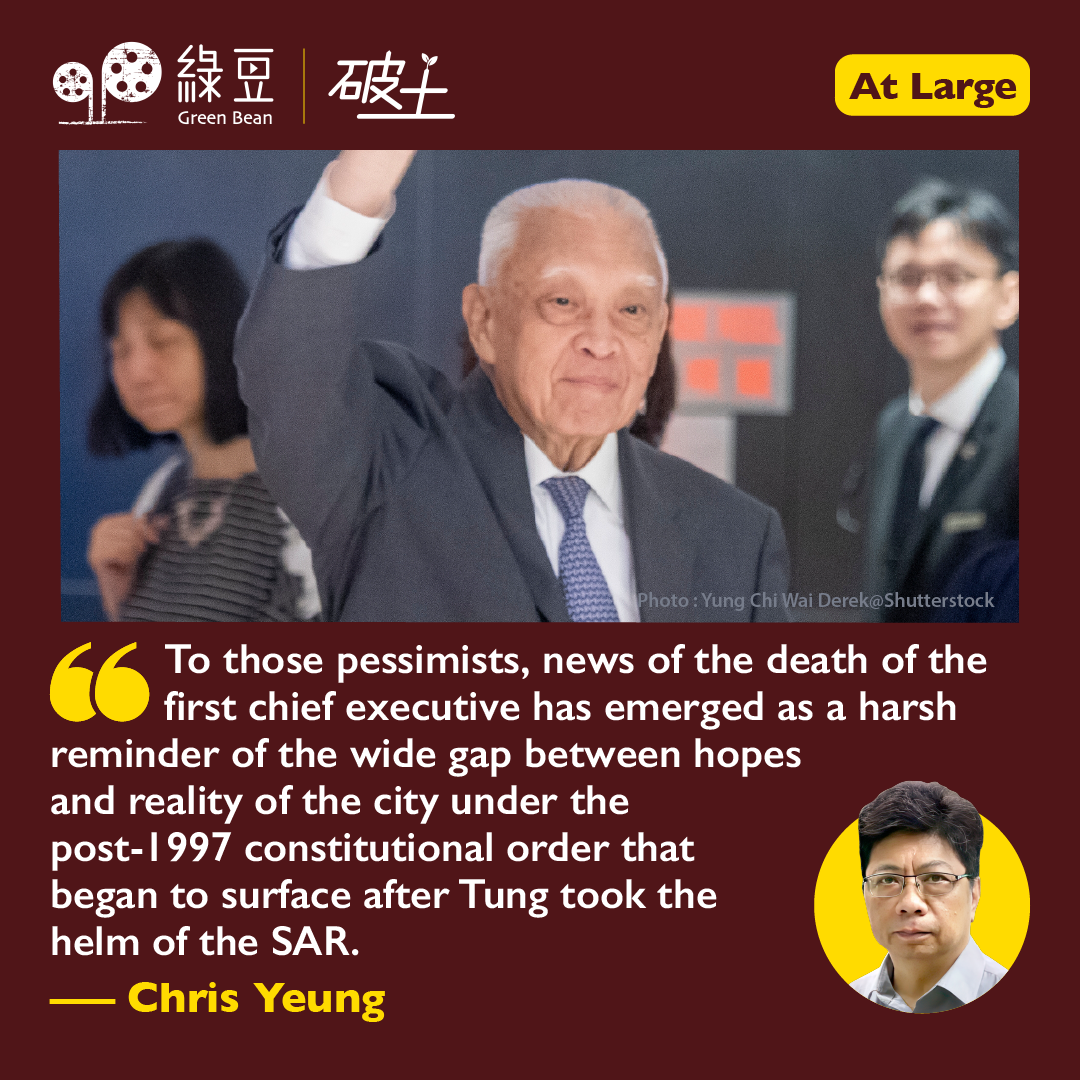
Widely known to have been seriously ill after he no longer appeared in public since mid-2021, the death of Hong Kong’s first chief executive Tung Chee-hwa last week did not come as a surprise. His death has drawn sharply different responses from the populace. There were both praises and curses. That is also not a surprise because of one simple reason.
29 years on after he took the helm of Hong Kong, the Special Administrative Region has not become better, at least in the eyes of the critics and cynics, the leavers and a lot of the stayers. To them, the opposite is more true.
Succeeded in keeping his debt-ridden family shipping business afloat in the 1980s, Tung dipped into the waters of politics when he was appointed as an unofficial member of the Executive Council by last governor Chris Patten, now Lord Patten. Following an eye-catching “hand-shake” initiated by late Chinese President Jiang Zemin in January 1996, Tung became the city’s first chief executive after an election by a 400-member committee in December that year.
An order for Tung
One of the memorable images of the 1997 handover saw Jiang presenting a calligraphy penned by Jiang to Tung at a July 1 ceremony, which read in Chinese, “ 香港明天更好”, “A Better Tomorrow for Hong Kong.”
Signifying hopes for a better Hong Kong after the end of the colonial rule, the calligraphy has been displayed in Government House, the official residence of the British governors and the Chief Executive, since then.
Called it hopes, it was more a task verging on an order that Tung ought to get it done, not just steering the Hong Kong ship out of the turbulent waters whipped up by the sovereignty changeover but towards a brighter future.
Put it plainly, Hong Kong under Chinese rule with high autonomous powers and being run by Hong Kong Chinese must do a better job than what the British colonial rulers had done. It did not take long for it to prove to be an arduous task, if not impossible job.
Despite the overwhelming sloganeering of the principle of keeping the then systems unchanged, Tung was aware of the vital importance of making changes to tackle a host of challenges facing the enclave.
He appointed three close aides to formulate a long-term strategy for housing, education and care for the elderly people even before he was sworn in. Soon after he took power, he rolled out a list of bold reforms aimed to improve livelihood, in particular housing, and boost the economy. They include the now-vanished yearly target of building 85,000 flats, innovation and technology development and education system.
In a major initiative to enhance governance and meet public expectation for greater accountability and, also importantly, pacify calls for more democracy, in his second term, Tung pioneered a principal officials accountability system in 2002.
Self-criticism and stood down
Citing sore legs, Tung stood down in May 2005, about two years after more than 500,000 people took to the streets to protest against the then Article 23 legislation and to vent out their grievances over governance issues including the handling of the Sars epidemic, known as severe acute respiratory syndrome, in 2003. The public health crisis caused 299 people dead.
The resignation of two ministers to show accountability for the Article 23 and Sars fiascos and the then financial secretary Antony Leung for the purchase of a luxurious car before he imposed a higher levy on purchase of those vehicles was proved to be too little too late to salvage dented confidence in his leadership.
In his 2005 policy address delivered in January, Tung made the toughest self-criticism of his seven years in the job. He admitted failing to deliver on his pledges of ‘people-based’ governance – an administration that was “thinking what people think” and “addressing people’s pressing needs”. His team lacked a sense of crisis, political sensitivity, experience and capability to cope with political and economic change, said Tung.
It was described by analysts as a “mea culpa” policy address, which turned out to be his parting words and a self-appraisal of his seven-year-long reign. He tendered his resignation two months later.
Mirrored the sharp divide
Following his death, praises poured in from the power and the rich. He was hailed as a visionary dedicated to his nation and Hong Kong. Donald Tsang, Tung’s successor, paid tribute to Tung’s “approachable, refined manner, as well as his broad mind and visionary outlook.”
Media reports said the Hong Kong authorities are coordinating a state funeral for Tung, honoring his legacy as a deputy national-level leader and his contributions to the “one country, two systems” policy.
The past few days saw a sea of praises for Tung from the authorities and the pro-establishment circle. In sharp contrast, netizens showered ridicule and scorn on him. Ordinary people reacted to his death with indifference.
The divergence of views on Tung’s legacy following his death has mirrored the sharp divide over the shape of Hong Kong 29 years after it was governed under the “one country, two systems” framework.
While the authorities and their supporters are confident of a brighter future after the city is back on the right track after 2020, a feeling of doom and gloom has prevailed among a sizable portion of the populace.
To those pessimists, news of the death of the first chief executive has emerged as a harsh reminder of the wide gap between hopes and reality of the city under the post-1997 constitutional order that began to surface after Tung took the helm of the SAR.
▌ [At Large] About the Author
Chris Yeung is a veteran journalist, a founder and chief writer of the now-disbanded CitizenNews; he now runs a daily news commentary channel on Youtube. He had formerly worked with the South China Morning Post and the Hong Kong Economic Journal.