
The ugly truth of Tai Po fire comes to light
One day after a government-appointed review committee investigating the Tai Po deadly fire began its public hearing, chairman Mr Justice David Lok was quick to call on people not to draw conclusions before they wrapped up their probe.
He said at the opening of the second-day hearing on last Friday (March 20)he felt “a little bit anxious” after reading the press reports of the first-day session, saying he was worried that people mistook their opening speech as the conclusion.
Though reasonable, his appeal may be futile.
This is not because the three-member committee’s efforts of finding out the truth behind the deadliest fire in decades in Tai Po’s Wang Fuk Court, which took away 168 lives and made more than 1,900 families homeless, are not respected, nor are their findings doubted by the citizens.
It is plainly because the evidence the committee presented on the first day of a series of public hearings is so shockingly compelling. The chain of human mistakes made by major stake-holders, in particular government departments, has largely answered the question of what happened and who had made the grave mistakes.
The questions of why all went wrong and who should be held responsibility for what remain to be answered, if they will ever be. Finding out the wrongdoings of individuals and systemic failures will lay the foundation for doing justice to the victims and those involved and, also importantly, fixing the failed and flawed systems.
Six “human factors”
In his opening speech on last Thursday, the committee’s legal senior counsel, Victor Dawes, revealed the fire started at the light well outside rooms 104 and 105 of Wang Cheong House, one of the eight buildings at Wang Fuk Court, most likely because of a worker smoking nearby.
Dawes outlined six initially identifiable causes of the disaster, including the use of combustible scaffolding mesh, the fire alarm system’s deactivation, removal of fireproof windows from emergency passages and fire hoses being turned off for months, exceeding the legal limit of 14 days.
The other failures were the use of polyfoam boards to block windows and workers’ smoking habits, an issue that residents had repeatedly raised but was ignored.
Six “human factors”, the hearing was told, led to the almost complete failure of fire safety measures at Wang Fuk Court before seven of its eight residential blocks were engulfed in a 43-hour inferno that broke out on November 26 last year.
Legislators kept mum
Dawes noted that the Labour Department, the Fire Services Department and the Housing Bureau’s Independent Checking Unit (ICU) all denied it was their responsibility to ensure the building materials used in the HK$336 million project met required fireproofing.
In a damning revelation, he said the bureau’s ICU – the body that oversees government-subsidised housing in Hong Kong – had told Will Powers Architects about upcoming inspections at the housing estate, which had been undergoing major renovation since 2024.
Will Powers Architects, the consultant firm overseeing the renovation, then allegedly alerted Prestige Construction, the main contractor. Executives from both firms were arrested on suspicion of corruption and manslaughter following the blaze that broke out on November 26. No government officials have been arrested.
Despite low expectations of the probe mainly because of the lack of statutory power of the committee, the documentation of the “six human mistakes” with unimaginable details still re-ignited the fury of Wang Fuk residents and ordinary citizens. Some residents who attended the hearing could not help vent out their anger, calling on Chief Executive John Lee to take a blow and say sorry.
In a sharp contrast, legislators kept mum. The government published a statement saying they have ceaselessly and speedily pushed forward various studies, system innovation, support and remedy work. It did not respond to specific findings, including suspected “tip-off” of building inspections and the “buck-passing” game of government departments.
Just two days into the committee’s public hearing, not just the complete failures of fire safety measures at Wang Fuk Court, but a host of bureaucratic inertia, “buck-passing culture” and suspected collusion between officials and certain industries have come to light.
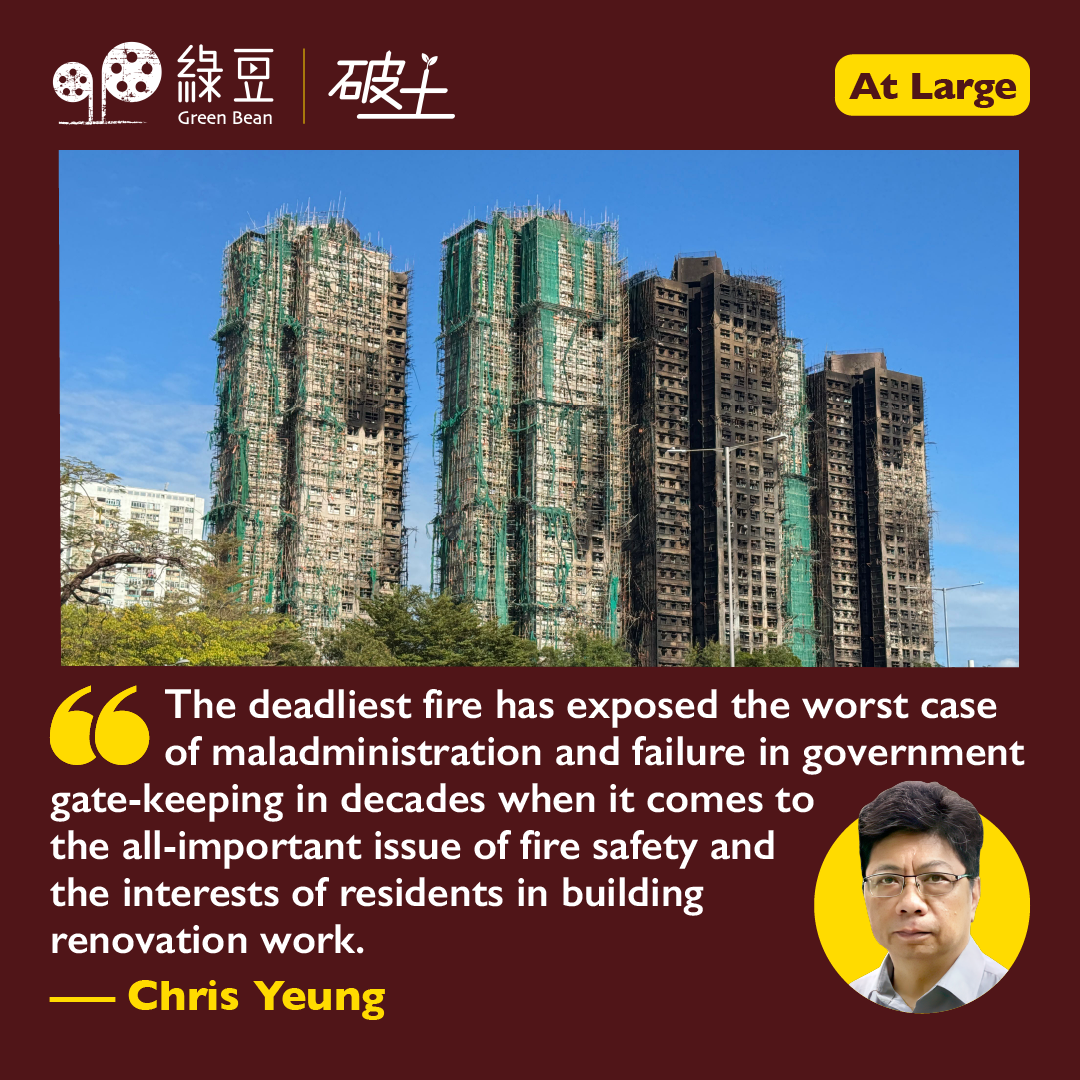
Put together, the deadliest fire has exposed the worst case of maladministration and failure in government gate-keeping in decades when it comes to the all-important issue of fire safety and the interests of residents in building renovation work.
It makes a mockery of the repeated and loud calls by President Xi Jinping and top Chinese officials for the government to show leadership in enhancing the standard of governance and their determination and commitment to taking responsibility.
▌ [At Large] About the Author
Chris Yeung is a veteran journalist, a founder and chief writer of the now-disbanded CitizenNews; he now runs a daily news commentary channel on Youtube. He had formerly worked with the South China Morning Post and the Hong Kong Economic Journal.
