Retrospective Forfeiture of Property: A Case of Ultra Vires?
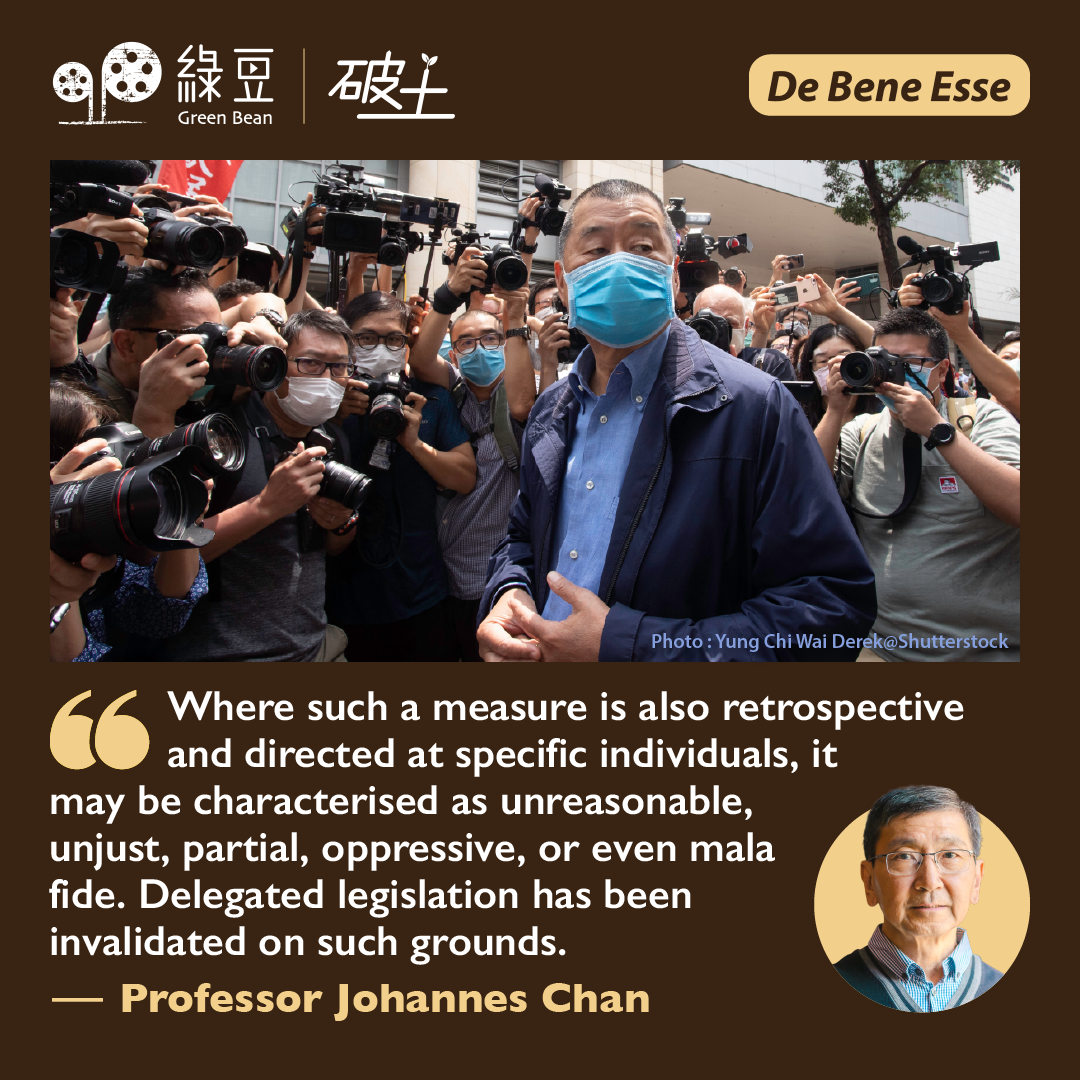
On 23 March 2026, the Chief Executive gazetted amendments to the Implementation Rules (“Implementation Rules”) made pursuant to Article 43 of the Hong Kong National Security Law (“NSL”). These amendments, which came into force on the same day, confer extensive powers on the police, including powers of search, seizure, restriction of movement, and forfeiture of property.[1]
Of particular significance is the introduction of section 13A, which empowers the Secretary for Justice to apply for a forfeiture order against the property of a convicted person where such property is reasonably suspected to have been used to finance, or otherwise assist, the commission of an offence endangering national security.[2] The provision applies to any person convicted of a national security offence and sentenced to imprisonment of 10 years or more. Crucially, it also applies to persons convicted or sentenced before the provision came into operation.[3]
In April 2026, the Secretary for Justice relied on this provision to seek forfeiture of property worth HK$1.3 billion belonging to Lai Chee-ying, who had been convicted of collusion offences under the NSL on 15 December 2025 and sentenced to 20 years’ imprisonment on 9 February 2026.
This article argues that the retrospective forfeiture regime introduced by the Implementation Rules is arguably ultra vires.
The Implementation Rules are a form of delegated legislation made by the Chief Executive pursuant to Article 43 of the NSL. While legislative in nature, delegated legislation does not confer plenary law-making power. Its purpose is to provide detailed provisions necessary for the implementation of primary legislation, often in areas requiring technical expertise or administrative flexibility.
A fundamental constraint is that delegated legislation must remain within the scope of the enabling statute and comply with applicable constitutional and legal limits. Where it exceeds those limits, it is ultra vires and liable to be declared invalid. The courts retain the power to review delegated legislation on established grounds, including illegality, procedural impropriety, and irrationality, notwithstanding legislative approval.[4]
The amended Implementation Rules raise three interrelated constitutional concerns: (i) retrospectivity, (ii) targeted forfeiture, and (iii) the imposition of quasi-penal consequences.
A. Absence of Power to Impose Retrospective Effects
A fundamental principle of the common law is the presumption against retrospective operation, particularly where penal consequences are involved. This principle forms part of Hong Kong law through the common law[5] preserved by the Basic Law and is reinforced by Article 39, which incorporates protections under the ICCPR. These protections are further reflected in Article 12 of the Bill of Rights and Articles 4 and 5 of the NSL.
The NSL itself does not provide for retrospective operation. Nevertheless, the amended Implementation Rules introduce retrospective consequences by enabling forfeiture in respect of convictions predating the amendments.
Absent clear statutory authorisation, delegated legislation cannot impose retrospective burdens of a penal or quasi-penal nature.[6] While it might be argued that the Rules merely regulate consequences arising after the NSL came into force, this is a formal distinction. The substantive reality is that the power of forfeiture did not exist at the time the relevant offences were committed or completed.
Clear legislative authority would be required before such a significant encroachment on individual rights could be justified.[7] In its absence, the retrospective operation of section 13A is strongly arguable to be ultra vires.
B. Targeted Forfeiture and Improper Purpose
The forfeiture regime applies to persons sentenced to 10 years’ imprisonment or more, including those whose convictions predate the amendments. In practice, this captures a small and identifiable class of individuals.
Since the enactment of the NSL, only a limited number of persons fall within this category, including Benny Tai (10 years) in the Primary case[8] and Jimmy Lai (20 years), together with three co-accused (who were sentenced to 10 year’s imprisonment because of the minimum sentence) in the Jimmy Lai case.[9] Of these, Jimmy Lai is the only individual of substantial means. Realistically, the retrospective aspect of the regime appears to operate primarily against him.
This raises several concerns.
First, the retrospective imposition of forfeiture constitutes a penal or quasi-penal consequence.[10] It is fundamentally unjust to subject a person to a heavier penalty than that applicable at the time of the offence or conviction. This engages Article 12 of the Hong Kong Bill of Rights, which prohibits the imposition of a heavier penalty than that in force at the time the offence was committed. No justification has been advanced for such retrospective application.
Secondly, where legislation is framed in general terms but, in substance, targets a small and identifiable group, it may constitute a colourable or improper exercise of power. Where such a measure is also retrospective and directed at specific individuals, it may be characterised as unreasonable, unjust, partial, oppressive, or even mala fide. Delegated legislation has been invalidated on such grounds.[11]
The objection here is not to the existence of forfeiture powers per se, but to their retrospective deployment in a manner that appears targeted.
Thirdly, the statutory threshold for forfeiture is notably low. Under section 13A(2), the Secretary for Justice may apply for forfeiture on two alternative bases:
- Actual use: the property has been used to finance or assist the commission of a national security offence; or
- Reasonable suspicion: there are reasonable grounds to suspect that the property may be used for such purposes.
While the first basis raises no inherent difficulty, the second permits forfeiture absent proof of intention. It is sufficient that there are “reasonable grounds to suspect” a future intention to use the property for unlawful purposes.
Once this threshold is met, the court is mandated to order forfeiture, subject only to the defence of disproportionality under section 13A(3). However, this defence addresses only the extent of forfeiture, not the propriety of forfeiture itself. The focus is on whether the scale of forfeiture exceeds what is necessary to achieve deterrence, rather than whether forfeiture should be ordered at all.
Accordingly, forfeiture of property on a potentially vast scale may be mandated on the basis of a relatively low evidential threshold. It is arguable that a delegated legislative scheme producing such drastic consequences is manifestly unjust and oppressive, and therefore ultra vires on grounds of unreasonableness.
Conclusion
Taken individually or cumulatively, these considerations provide a strong basis for arguing that the forfeiture provisions of the Implementation Rules are ultra vires.
The central objection is not to the existence of forfeiture as a legal mechanism, but to its retrospective application under section 13A(5). There is no clear statutory authority or principled justification for imposing such retrospective, quasi-penal consequences.
In the absence of such justification, the retrospective forfeiture regime represents a significant and arguably unlawful extension of delegated power.
Notes:
[1] 2026 Implementation Rules for Amending the Implementation Rules for Article 43 of the Law of the People’s Republic of China on Safeguarding National Security in the Hong Kong Special Administrative Region, LN 27 of 2026 (23 March 2026) (“The Amendment Rules”). For the sake of convenience, the reference to the number of the Rules refers to the number in the Implementation Rules with incorporation of the amendments.
[2] Rule 6 of the Amendment Rules, introducing s 13A to the Implementation Rules.
[3] Rule 13A(5) of the Implementation Rules.
[4] R (Asif Javed) v Secretary of State for the Home Department [2002] QB 129. This is so even when the delegated legislation was approved by an affirmative resolution of the Legislature.
[5] Phillips v Eyre (1870) LR 6 QB 1.
[6] R v Secretary of State for the Home Department, ex parte Pierson [1998] AC 539: Parliament is presumed not to intend to legislate with adverse retrospective effect.
[7] A v HM Treasury [2010] 2 AC 534 where the House of Lords struck down a power to allow the executive to make Orders in Council as were deemed “necessary or expedient” on the grounds that what was “necessary or expedient” was unacceptably broad and this could not be left to the uncontrolled judgment of the Executive. See also R v Secretary of State for the Home Department, ex parte Leech (No 2) [1994] QB 198; R v Lord Chancellor, ex parte Witham [1998] QB 575.
[8] HKSAR v Ng Gordon Ching-hang and others [2024] HKCFI 3298, at [338].
[9] HKSAR v Lai Chee Ying and others [2026] HKCFI 854, at [95]-[97]. The three co-accused were Law, Lam and Fong.
[10] Kafke v Cyprus (2008) 49 EHRR 35: the court will consider the substantive effect of a provision in considering whether it has penal consequences.
[11] Kruse v Johnson [1898] 2 QB 91; Monro v Watson (1887) 57 L T 366; Repton School Governors v Repton Rural DC [1918] 2 KB 133; Sparks v Edward Ash Ltd [1943] 2 KB 223.
▌ [De Bene Esse] About the Author
Professor Johannes Chan is an Honorary Professor of University College London and the former Chair of Public Law, The University of Hong Kong.