Propaganda offensive on security launched as leadership race nears
The impact of commentary articles written by a former head of the Hong Kong government’s thinktank in Chinese-language Ming Pao and an anonymous writer on Ta Kung Pao respectively concerning Hong Kong’s challenges ahead could not be more sharply different. Taken together, the intriguing phenomenon is indicative of the oddities of the city’s profoundly-changing political development.
Shiu Sin-por’s confrontation
Published on August 12 in Ming Pao, Shiu Sin-por, a former head of the Central Policy Unit, has identified six structural problems confronting the Hong Kong SAR. Shiu, now heads a non-governmental think-tank, was a top adviser and close aide to former Chief Executive Leung Chun-ying.
“With the change of government nearing,” he wrote, “it is time to do a clean-up of some of these (structural) problems. This is because it has to do with what kind of leadership and team we need in the next administration.” He was referring to the 2027 chief executive election.
The six structural problems are an ageing population; sea changes in the property sector with shortfall of land supply now history; soaring deficit; economic structural transformation; regional integration; government’s long-accumulated internal operational problems.
The article ended with a no-nonsense warning. “These problems must be addressed by the next administration. Otherwise, Hong Kong will not only be unable to coordinate with the nation’s development, but will become a burden for the nation. A gradual decline is the certain result.”
“Governed by the notion of ‘stability is above everything’ at the time of (1997) changeover, a litany of internal problems of the government have been left unresolved over a long period of time. The government’s governing capacity has drastically declined,” Shiu wrote.
The article was written at a time when the five-year reign of John Lee Ka-chiu has entered its fifth, or last, year and, importantly, the guessing game of the next chief executive has begun.
Although the structural deficiencies that he highlighted are hardly new, the picture of Hong Kong today and tomorrow that Shiu has illustrated, if nothing is done, is in sharp contrast with the “all-is-well” scene propagated by Lee and top officials, in particular Financial Secretary Paul Chan.
Shiu’s article has not caused a stir in the political circle, nevertheless, at least from the outset.
The commentary of Ta Kung Pao
In stark contrast were a series of three articles written by “Kung Chi Ping” and published in a row in Ta Kung Pao one day before the verdict of the Hong Kong Alliance in Support of Patriotic Democratic Movement in China (Alliance) case was handed down on August 21. “Kung Chi Ping” is understood to be a pen name, presumably meaning “the commentary of Ta Kung Pao.”
With “coordinating development and security” as the basic theme, the serial articles champion the notion of “security as the premise of development; development as the safeguard of security.”
Although the notion of development and security being complementary to each other is ostensibly clear in the serial commentary, the key political message is even clearer. The importance of the pursuit of security based on President Xi Jinping’s holistic security concept is overriding.
Put it in the context of post-2019 Hong Kong, it is a clear reaffirmation-cum-reminder of no laxity in the battle against threats to national security. This is despite the fact that seven years have lapsed and that three major court cases related to the 2019 social unrest have their verdicts given by courts respectively.
They included the Stand News case, the Jimmy Lai case and the Alliance case. After hearing from the three defendants of the Alliance case at the mitigation hearing on Friday, the panel of three national security judges said the sentencing will be delivered within two weeks.
Clearly timed with the handing down of the judgement of the Alliance case, the three “Kung Chi Ping” articles were all re-published on the website of the State Council’s Hong Kong and Macau Affairs Office. At the same time, a wave of follow-up news and opinion articles echoing the “Kung Chi Ping” articles flooded both Ta Kung Pao and its sister newspaper, Wen Wei Po.
Who is the right person
Hot on the heels of the re-posting of the articles on the HKMAO website, Chief Executive John Lee published an article on social media on Monday night joining the chorus of working hard on both economic development and national security fronts. He said “some people” have put ‘development and security’ on opposite sides,” saying it was wrong and unrealistic. Lee did not elaborate.
His three top aides, Chief Secretary, Financial Secretary, Secretary for Justice and three ministers published similar articles on social media, indicating their compliance with the approach of “coordinating” development and security expounded in the Beijing-backed serial commentary.
With political dissent significantly weakened and threats to national security lacking substantive evidence, it is understandable and only sensible for people to question whether the government should focus more on economic development, livelihood improvement and a list of chronic problems.
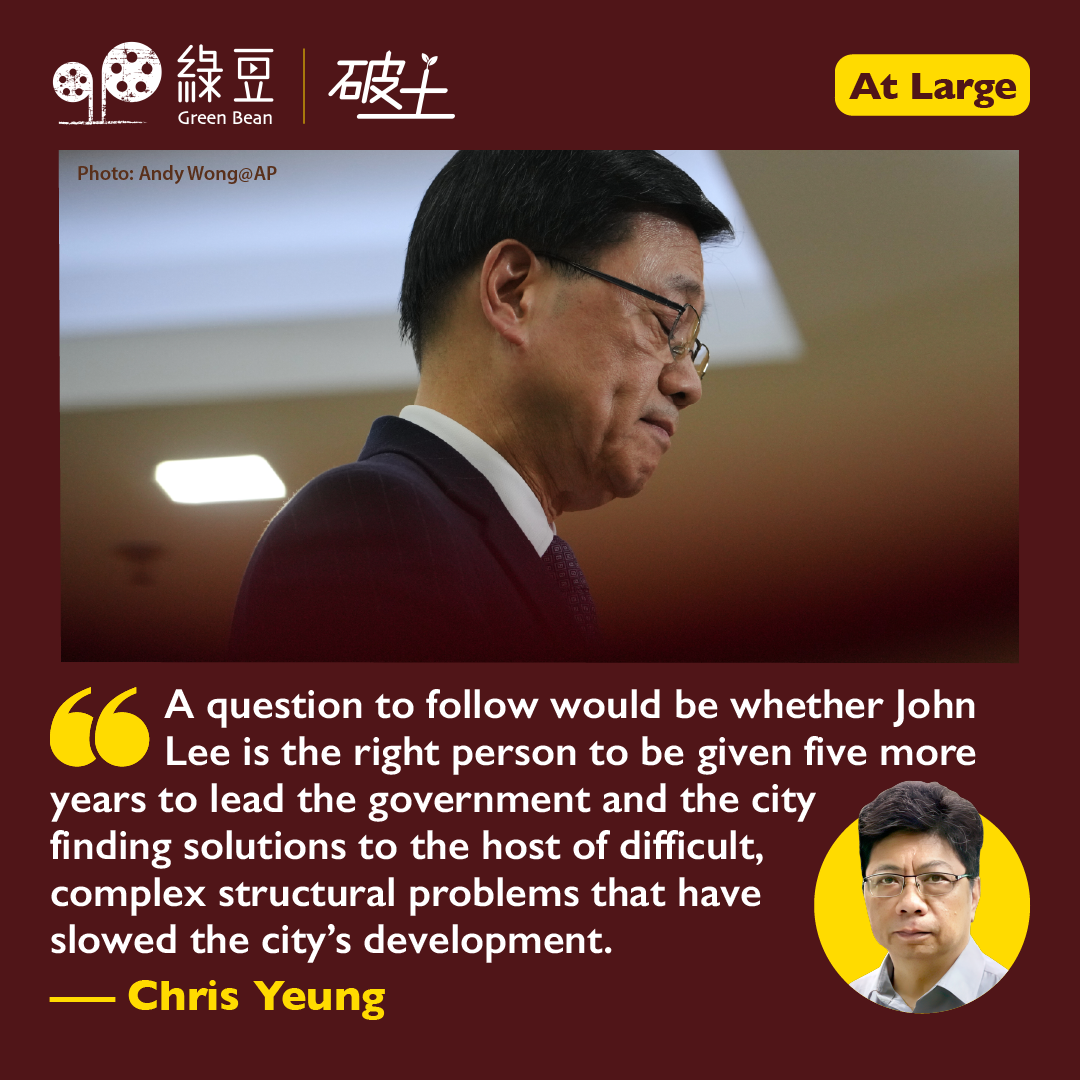
A question to follow would be whether John Lee is the right person to be given five more years to lead the government and the city finding solutions to the host of difficult, complex structural problems that have slowed the city’s development.
The blitz of reminders emanating from the Beijing-backed propaganda machine could be interpreted as a voice that calls for sticking to the present approach in “ensuring high-quality development with high-level security.”
Whether it could also mean “no change” to the helm of the Hong Kong SAR Lee is a question that only one person can answer.
▌ [At Large] About the Author
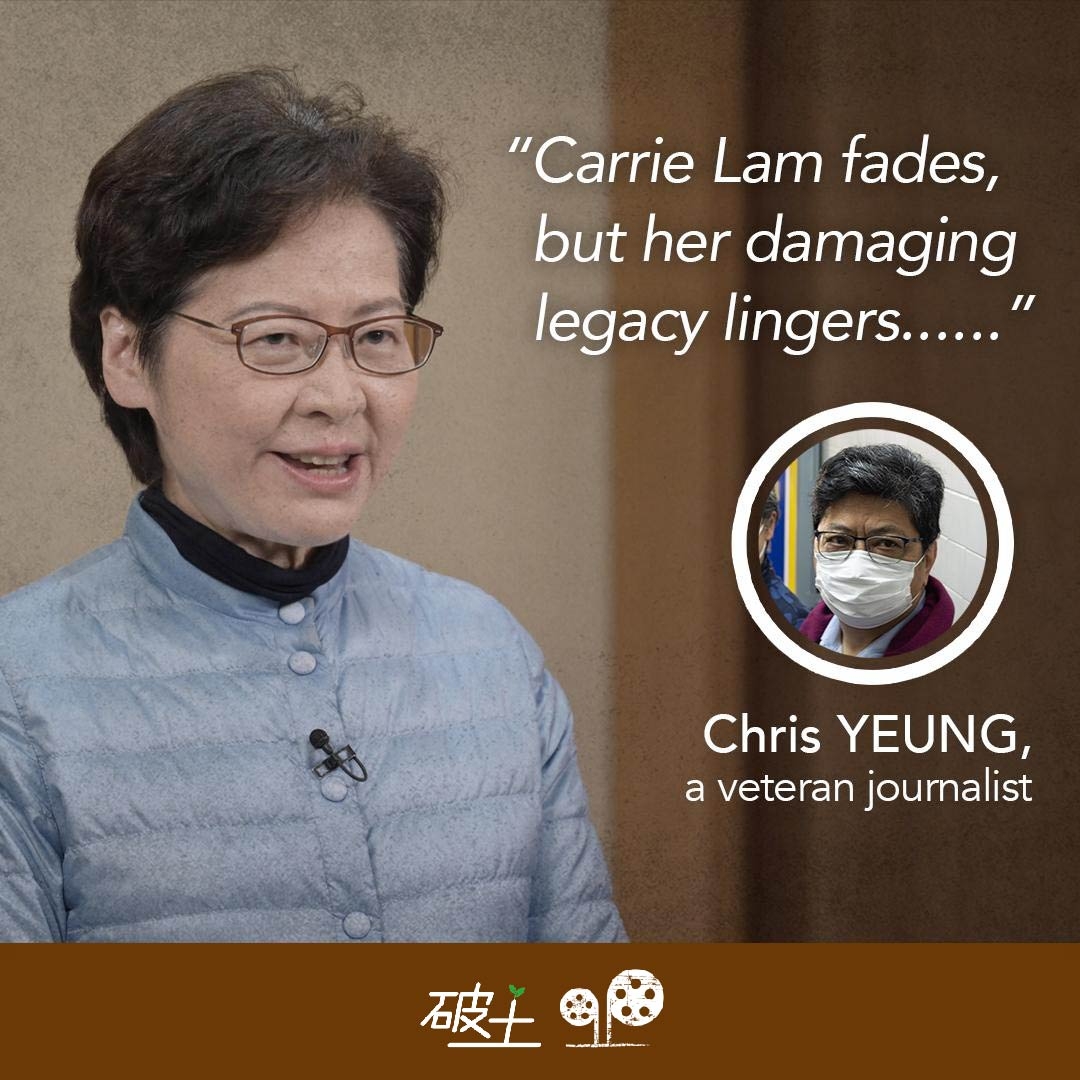
Chris Yeung is a veteran journalist, a founder and chief writer of the now-disbanded CitizenNews; he now runs a daily news commentary channel on Youtube. He had formerly worked with the South China Morning Post and the Hong Kong Economic Journal.