One Hong Kong, two stories
Breaking the Hong Kong government’s longstanding tradition of senior appointments, a righthand man of Chief Executive John Lee with police background was named to head the Government’s propaganda machine or, Information Services Department (ISD), to be accurate.
John Tse, who had acted as a spokesman of the Police during the anti-extradition bill protests in 2019, took up the post of the Director of Information Services on Tuesday after serving as Information Coordinator of Lee’s office since he took power.
Traditionally, the post had been taken up by administrative officers, who were hailed as the cream of the bureaucracy before the handover and thereafter for a long period of time.
Speaking highly of Tse in a statement, Secretary for the Civil Service Ingrid Yeung said she was confident that the ISD under his leadership will “strive to promote public understanding of government policies and positions, and tell the world about the good stories of Hong Kong.”
It is too early to say how Tse will tell the world about the good stories of Hong Kong.
Good story
Last week saw the government telling a good story of Hong Kong to the world as a London court ruling told of a bad story of the city.
Start with the good one, at least as far as the Hong Kong government is concerned. Hong Kong took another move to become an international mediation centre as the International Organisation for Mediation (IOMed) hosted the Global Mediation Summit in the city.
Saying more states joined the IOMed since its inauguration last October, John Lee told the summit on Thursday “Hong Kong is committed to becoming a global mediation capital. And we are well positioned to do this.”
The Global Mediation Summit is one of the initiatives, events and news that the government has trumpeted in recent months telling the world about the good stories of Hong Kong.
Last week, the government reported the fastest quarterly economic growth in nearly five years during the first three months of this year, hitting 5.9 per cent and outpacing the last quarter of 2025 at 4 per cent.
Late April, Financial Secretary Paul Chan said Hong Kong’s initial public offering market has raised more than HK$140 billion as of April, maintaining its global lead.
Bad story
If those good stories of Hong Kong could be attributed, at least in part, to the city’s “one country, two systems” policy, the unprecedented political framework has emerged as the source of increased controversies and frictions between Hong Kong and Western countries.
The case of two men linked to the Hong Kong Economic and Trade Office in London being found guilty of spying on Hong Kong pro-democracy activists living in the U.K. on Thursday is a case in point. It has tarnished the image of Hong Kong and cast more doubts about the “one country, two systems” framework.
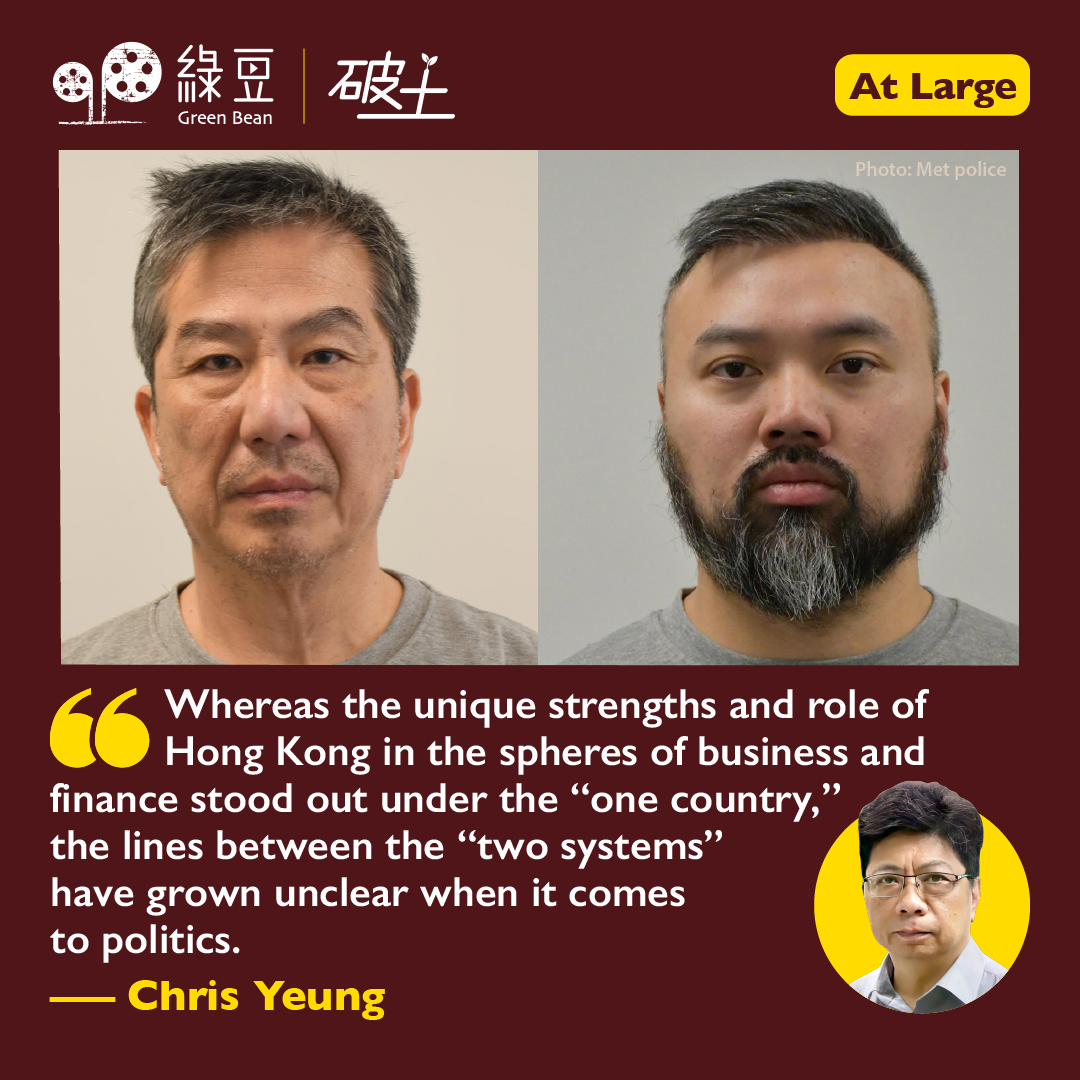
Bill Yuen Chung-biu, the London office’s manager, and Peter Wai Chi-leung, who ran a security firm, were found guilty of assisting a foreign intelligence service, two years after their arrests thrust Hong Kong’s overseas promotion offices into the global spotlight.
The Chinese Embassy has denounced their arrests as a “malicious fabrication.” The case sheds light on the lengths that the Chinese state goes to keep tabs on critics and dissidents abroad.
The Hong Kong government has denied any link with the case. “We firmly oppose any unfounded allegations against the HKSAR Government and the London ETO.”
It could not be more ironic that the London ETO, whose function is to tell the British citizens the good stories of Hong Kong, has emerged as the subject of a bad story of Hong Kong.
The bad Hong Kong story featuring the conflict between the government and the political dissent erupted in the 2019 protests has spilled overseas although it has long come to an end in the city.
It has added more heat to the controversy over claims about Chinese spying activities in Western countries. This is despite the repeated denials of the Chinese government.
A more complex picture of Hong Kong
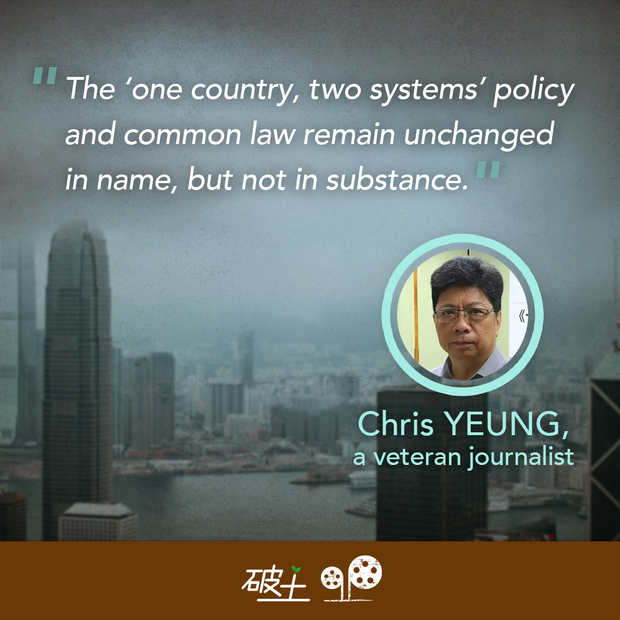
The contradictions featured in the various Hong Kong stories, of which some are sharply different, are indicative of a more complex picture of Hong Kong under “one country, two systems” 28 years after it was implemented.
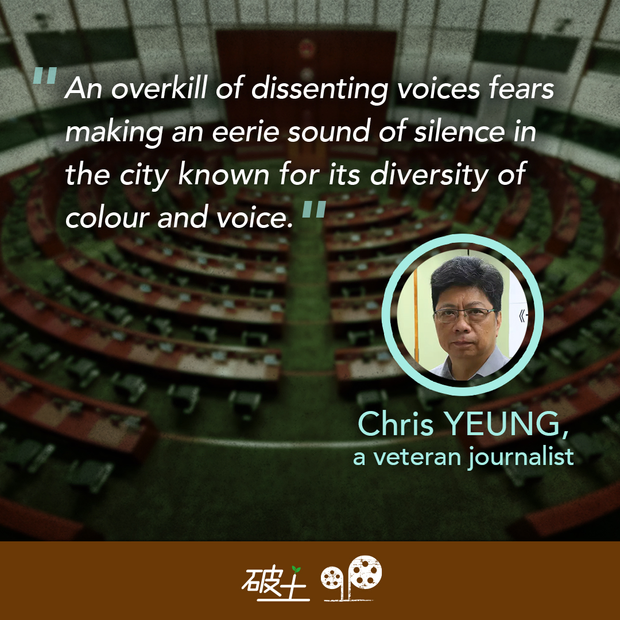
Whereas the unique strengths and role of Hong Kong in the spheres of business and finance stood out under the “one country,” the lines between the “two systems” have grown unclear when it comes to politics.
Whether it is good or bad is in the eyes of beholders, but there is no doubt it’s a fascinating story to keep following and reading.
▌ [At Large] About the Author
Chris Yeung is a veteran journalist, a founder and chief writer of the now-disbanded CitizenNews; he now runs a daily news commentary channel on Youtube. He had formerly worked with the South China Morning Post and the Hong Kong Economic Journal.