
Let the truth of deadly fire helps heal the wound
(This article was first published on Monday and had been updated with the Hong Kong government announcement of the establishment of an independent committee and a rewrite of the last few paragraphs.)
Flashed back to 20 November 1996, a blaze broke out at the then Garley Building in Yaumatei in Hong Kong took away 41 lives. The city was rocked and shocked by the devastating fire, and was soon engulfed by sadness and bewilderment. Questions were asked. What went wrong?
The bitter memories of the Garley fire
In his memoir, The Hong Kong Diaries, published in 2023, the then governor Lord Patten recalled his visit to the site on the same day: “I am black with depression. Hong Kong has a First World economy but we stagger from one Third World horror to another.”
He lamented the difficulty in beefing up the safety regulations for buildings through the Legislative Council since he took up the hot seat in 1992 as the moves were questioned by lawmakers about the additional costs the government was imposing on commerce.
“No wonder some people argue that this is a city grown rich on tragedy,” Lord Patten wrote.
One month after the tragedy, he set up an independent inquiry committee led by Justice Woo Kwok-hing, a then appeal court judge. The report was completed in August 1997.
In an article published in the Hong Kong edition of China Daily in December 2011 headlined “A lesson not learned,” Lam Kin-keung, a retired police sergeant who took part in police’s probe into the Garley blaze, wrote, “For a calamity as grave as this, one of the most important jobs for police was to assist the commission of inquiry into the Garley Building fire.” He was referring to Justice Woo’s investigation.
Lam wrote, “The committee played a role as a third party to inquire deeply and extensively (about) the origin and course of the fire disaster. Also on the agenda was a review of the crisis management performance of the administration. The objective was to discover what lessons to be learned from the fire.”
The Garley Building was demolished in 2003. As soon as the tragic blaze at Wang Fuk Court in Tai Po on Wednesday afternoon unfolded, the bitter memories of the Garley fire re-surfaced from the history book about the city’s tragedies.
Misleading the community by blaming bamboo
As the government and community pulled out all stops to save lives and come to the aid of the victims, a host of questions was raised. In one line, what went wrong?
Speaking on Friday, security minister Chris Tang has sought to clear the air over the netting of the building, which was under renovation, saying initial tests showed they were fire-resistant.
Authorities were blaming highly flammable styrofoam materials as the primary cause for the “unusually fast” and devastating spread of the fire. Tang said the ignited foam panels caused glass to shatter, leading to a swift spreading of the fire into interior spaces. The fire services chief said failure of fire alarms could have delayed rescue, cost lives.
In a controversial move, Chief Secretary Eric Chan announced that the city would be switching from bamboo to steel scaffolding “as soon as possible”.
Despite a government denial, disgruntled citizens accused the government of misleading the community – and the world – by blaming bamboo. It fuelled a conspiracy theory that the government was diverting public attention on their failure to regulate renovation works at building sites.
Call for an independent inquiry
On Friday night, a university student has launched a petition urging the government to respond to “four demands”, including setting up of an independent inquiry and reviewing construction supervision procedures. Miles Kwan and two friends handed out flyers with a link to a Change.org petition outside Tai Po MTR station. Media reports said on Saturday night he was arrested by the Police. The website was closed.
His lone call for an independent inquiry, among others, was largely ignored by local media. Only one Chinese-language media Hong Kong In-media, and the English-language Hong Kong Free Press has carried the story with a picture of him.
This is despite the fact that voices calling for an independent investigation into the tragedy have resonated on social media and within the society.
Former housing and transport minister Anthony Cheung Bing-leung wrote on his social media platform: “It is a disaster made by human beings, a disaster of the systems. Thorough investigation is a must.” In another post, he said an independent inquiry must be set up.
His call was echoed by at least one former senior government official privately, who said that would only help regain the government’s depleting credibility.
Opportunity to heal the wounds set to be missed
With the Legislative Council election less than one week to go, the current legislature is in a state of hypernation. Those who are seeking re-election have suspended their campaign. Most were silent on the blaze. Those who have decided to bow out were invisible.
A call for an urgent adjournment debate by outgoing lawmaker Tik Chi-yuen on the fire was rejected by President Andrew Leung. Citing Legco’s rules, Leung said only the Chief Executive could call for such a meeting when Legco has terminated its meetings.
Lee had initially showed no interest in doing so; nor he seems to be keen to set up an independent inquiry.
On 2 December Tuesday, Lee announced the setting up of an independent committee led by a judge to “conduct a comprehensive and in-depth review, to reform the building works system and prevent similar tragedies from occurring in the future.”
The committee is significantly different from an independent commission of inquiry set up under the law with such powers as the summoning of witnesses to testify at a court-like hearing.
Whether the aspirations of the people for getting the whole truth will be met by the review committee remains unclear.
There were no independent inquiries into the 2014 Occupy Central movement and the 2019 social unrest, leaving many crucial questions unanswered and, worse, public grievances and discontent unresolved.
Whether an opportunity of healing the wounds inflicted by the Tai Po inferno by digging up all the facts and evidence, piecing them together to help find out what went wrong and, most importantly, telling people what went wrong will be missed again is in the balance.
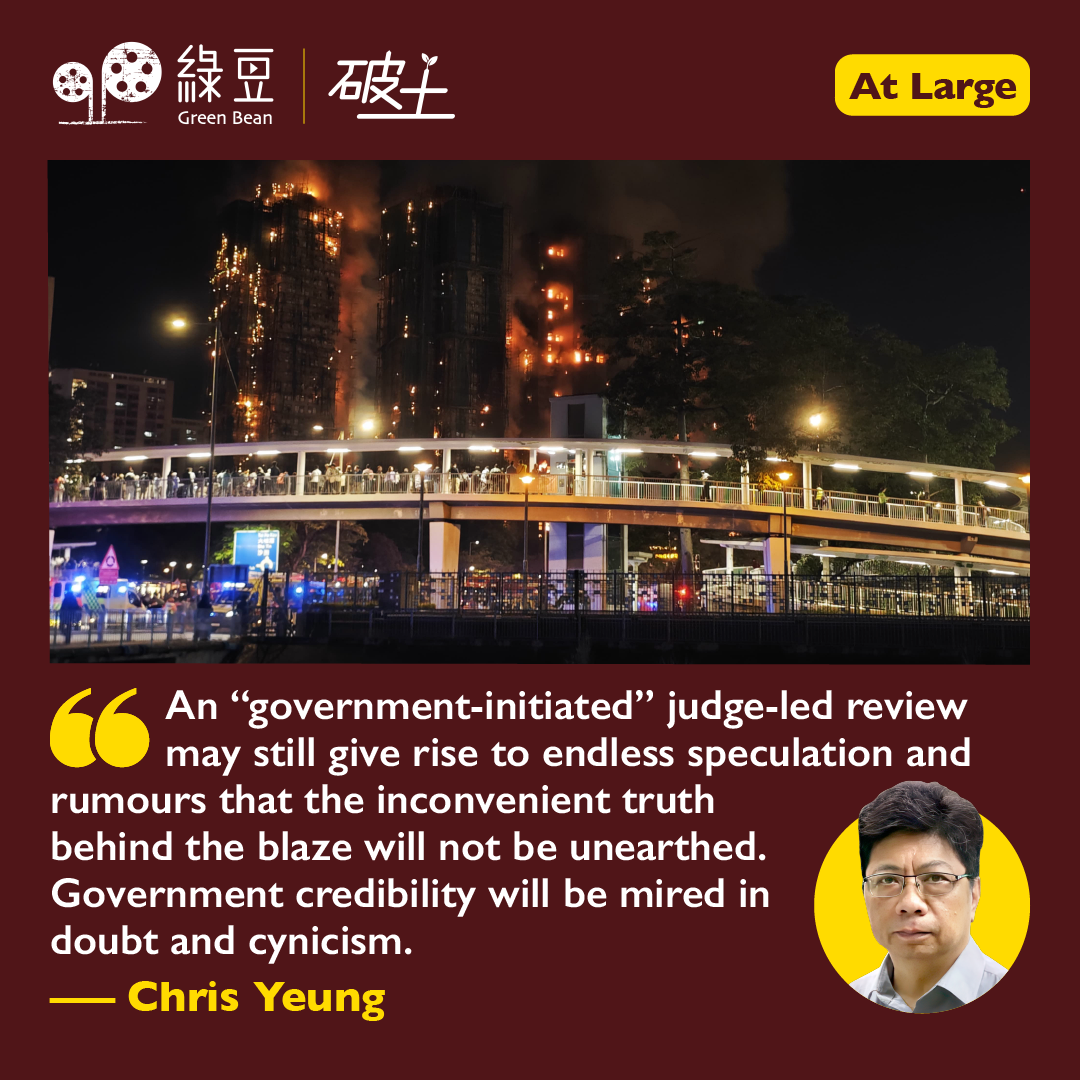
An “government-initiated” judge-led review may still give rise to endless speculation and rumours that the inconvenient truth behind the blaze will not be unearthed. Government credibility will be mired in doubt and cynicism.
That could not be more deplorable and damaging, not just to the Wang Fuk Court victims but all Hong Kong citizens.
▌ [At Large] About the Author
Chris Yeung is a veteran journalist, a founder and chief writer of the now-disbanded CitizenNews; he now runs a daily news commentary channel on Youtube. He had formerly worked with the South China Morning Post and the Hong Kong Economic Journal.
