
Jockey Club riding on bumpy path
Flashed back to the 1980s, the promise of keeping horse-racing unchanged after 1997 was made by the Chinese Communist Party leaders aimed to assure the jittery community that Beijing will not kill the goose that lays golden eggs. More importantly, it showcases the “one country, two systems” policy, or more specifically, the city’s capitalist lifestyles will be preserved. Horse-racing betting is banned in the mainland.
More than four decades on, the 1884-founded Hong Kong Jockey Club (HKJC), which holds a government-granted monopoly on betting on horse-racing and football in the city, has not just survived the communist takeover. It has continued to thrive, in particular in recent years, largely due to the China factor. Uncertainty, however, is looming, also because of the China factor.
Pause for regulated basketball betting
On Wednesday, the club reported wagering and lottery turnover rose by 3.6 per cent over the previous financial year to a record HK$331.7 billion. Total revenue from gaming and non-gaming sources rose 3.1 percent to HK$50.8 billion.
It posted HK$39.3 billion contribution to the community, comprising HK$29.3 billion in betting duty and profits tax, HK$1.4 billion to the Lotteries Fund and HK$8.6 billion in donations approved by the club’s Charities Trust.
Racecourses received a record 401,259 tourist visits during the season, a 105 percent increase on 2024/25 and four times the 2023/24 figure. The racecourse has emerged as a popular destination of mainland visitors in recent years.
Described the environment as “challenging and fast-changing,” the club said its biggest challenge remained competing with a huge and growing illegal gambling market. It is also “managing” the special football betting duty of HK$2.4 billion a year and the government’s unexpected pause in granting a license for regulated basketball betting, a service it had invested substantially in ahead of a planned 2026 launch.
The club said it respects that decision but warned the illegal basketball market will keep expanding, and with it the social and criminal damage to the community.
Delay the Conghua Racecourse racing
In a surprise announcement, it said the launch of official racing at the Conghua Racecourse, originally set for October, will be delayed following the “latest risk assessment from the relevant Mainland departments.” It added both sides are now working on “appropriate mitigation measures.” No new date has been set.
Speaking in an interview in November last year, HKJC CEO Winfried Engelbrecht-Bresges said the club would stage a world-class horse racing event at its Conghua Racecourse in Guangzhou, which is situated 150 km north of Hong Kong. The meeting had been scheduled for October 31, and was expected to feature five to six races.
Engelbrecht-Bresges said the inaugural meeting would only be attended by officials and invited guests.
The report described the would-be-debut as “a new dawn for racing in Asia.”
Local media reports said the delay came as a shock to HKJC members.
The unexpected twist of the club’s first racecourse in the mainland came five months after the government announced it would suspend plans to legalise basket betting. HKJC, which was given the right to run the new betting, had set up a huge team to prepare its launch. It is understood that the team has been disbanded.
The government cited concerns about the rapid growth of prediction markets without elaboration. Speculation was rife that cross-border financial risks had prompted the Hong Kong SAR government to put a brake on the plan.
Whether the government was ordered to do so is anybody’s guess. There was no sign whatsoever of a further pursuit of the plan since then. Whether it is dead, half-dead, is uncertain.
Unpredictability of mainland policies
While coping with the five-year special football betting duty of HK$2.4 billion a year beginning from 2023-24 until 2028/29, the club has suffered two major setbacks in its basketball betting and Conghua racecourse plan.
Following an agreement with the Guangdong authorities five years ago, the club is believed to have spent billions of dollars on the Conghua plan. Taken together, the double blows have posed difficulties to the operation of the club in the near term, in particular its funding for charities.
Coming months after the “game over” of the basketball betting plan, at least for now, the delay of the Conghua racecourse launch and, importantly, the secrecy behind it, have exposed the unpredictability of mainland policies.
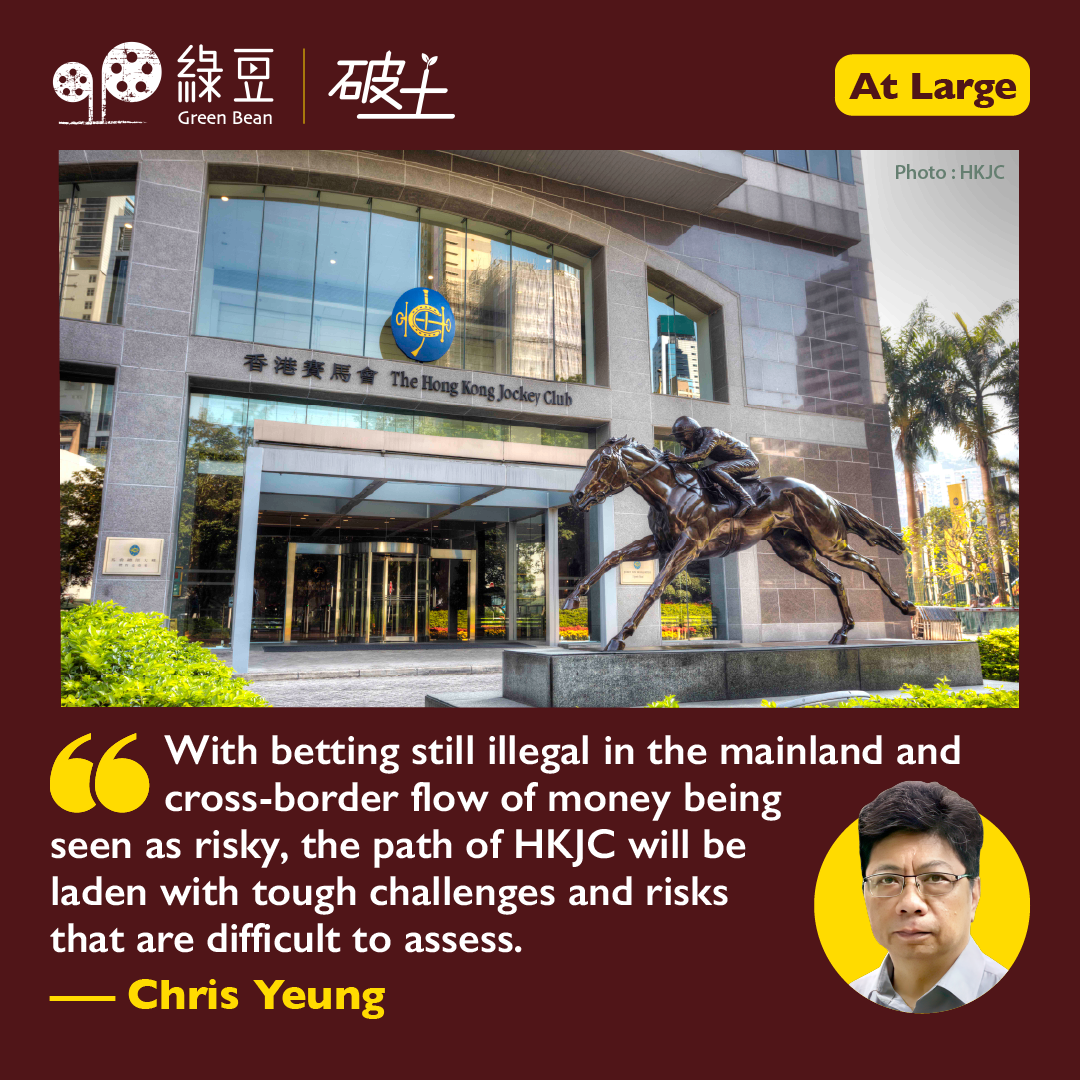
With betting still illegal in the mainland and cross-border flow of money being seen as risky, the path of HKJC will be laden with tough challenges and risks that are difficult to assess.
Both the Conghua racecourse and the regulated basketball betting are clearly among the long-term initiatives on HKJC’s development strategy. The fact both are now mired in uncertainties is a stark reminder of the complex political and policy environment facing the club.
▌ [At Large] About the Author
Chris Yeung is a veteran journalist, a founder and chief writer of the now-disbanded CitizenNews; he now runs a daily news commentary channel on Youtube. He had formerly worked with the South China Morning Post and the Hong Kong Economic Journal.
