To be or not to be accountable
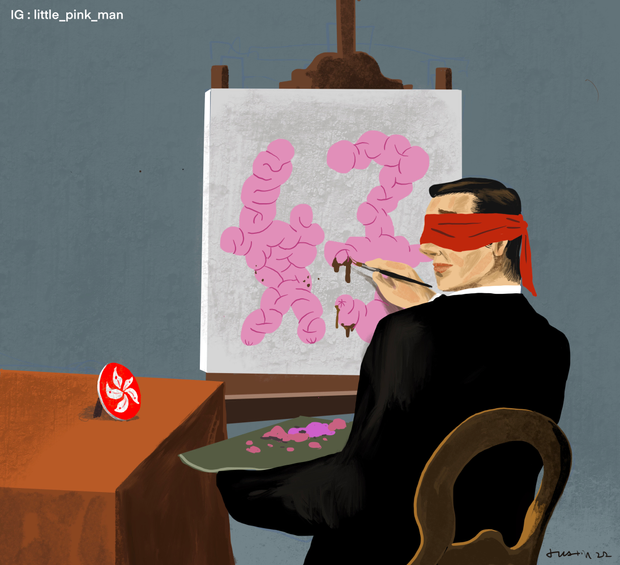
Chief Executive John Lee is caught between a rock and a hard place as he weighs on ways to show accountability or, more precisely, to decide who should be axed to be held responsible for the deadly Tai Po fire that killed 168 people.
With an independent panel he named due to announce its findings this month, he is confronted with a tough decision on whether principal officials in charge of policy bureaus and those at a more senior position should be penalised for their roles in the devastating fire. They include the Chief Secretary, the Financial Secretary, the Secretary for Justice and their deputies.
And importantly, whether Lee himself, as the Number One person at the helm of the Hong Kong SAR, should be held responsible and, if yes, how he should demonstrate accountability. Taking a bow and saying sorry, though belated, by him to Wang Fuk Court victims and residents and citizens is never too late.
Lee and his team have given no hints of whether the politically-appointed principal officials will be targeted for taking political responsibility for a host of failures and deficiencies of various departments that are likely to be documented in the panel’s report. And if so, who they should be.
◾Political accountability
The question of political accountability in the Tai Po fire, which has been described as a “man-made disaster”, has been markedly left untouched by Lee since the tragedy unfolded on November 26 last year.
Meanwhile, dozens of people including the contractors of the renovation project of Wang Fuk Court were arrested for alleged criminal offences. The relevant judicial proceedings are still underway.
Speaking on Tuesday, Lee said the government has geared up preparing for the implementation of reforms and the pursuit of responsibility within the bureaucracy “as soon as possible” following the release of the final report of the inquiry panel.
Media reports said the government has established a dedicated task force under the Public Service Commission, led by former deputy secretary for security Benjamin Mok Kwan-yu and former commissioner for sports George Tsoi Kin-pan, to investigate alleged official failings linked to the deadly fire.
The Tai Po blaze will be the first major case that involved work failures and deficiencies of civil servants from frontline staff to departmental heads following the implementation of the Heads of Departments Accountability System this year.
◾Accountability system in the past
The system, initiated by Lee, is in tandem with the principle of accountability behind the principal officials’ accountability system initiated by late first chief executive Tung Chee-hwa, which was launched in 2002.
One year after Tung’s accountability system was launched, former financial secretary Antony Leung, one of the close aides of Tung, resigned amid a controversy over his purchase of a luxurious vehicle ahead of the announcement of his Budget in March 2003. In his budget, he announced a hike of vehicle first registration tax.
Shortly after more than 500,000 people took to the streets on July 1, 2003 to protest against a Basic Law Article 23 bill, former security minister Regina Ip Lau Suk-yee resigned. One year later, health minister Yeoh Eng-kiong stood down for his responsibility in the government’s handling of the deadly Severe Acute Respiratory Syndrome crisis in 2003.
Though details of their cases were different, Antony Leung, Regina Ip and Yeoh stepped down for the same reason; they acted to demonstrate the spirit of accountability to citizens for having caused a loss of public confidence and a surge of discontent towards the whole team.
◾Not re-appointed rather than axed?
The magnitude and severity of government systemic flaws and work deficiencies that are to blame, at least partly, for the Tai Po fire have dealt a body blow to public confidence and trust in the government. It has and will inflict damages to government-citizens’ relations.
Given the seriousness and number of departments that were alleged of administrative failures in the Tai Po fire case, Professor Lau Siu-kai, a consultant to the Chinese Association of Hong Kong and Macao Studies, a quasi-official Beijing think tank, said “it would be difficult to say” the government should take no political responsibility for it.
He said the government should focus on fairness and justice in handling the aftermath of the case to help rebuild public trust and respect towards the authorities.
Speculation is rife within the political circle that a handful of ministers in charge of buildings, housing, labour, security and home affairs are the obvious targets to be axed if, a big if, Lee is eagerly keen to walk the talk of political accountability.
An anonymous “political heavyweight” figure was quoted in an article published on the Chinese-language Ming Pao as saying it would be “meaningless” to boot out ministers whose term has less than nine months to go.
The political figure reportedly argued that it would be a show of accountability if those principal officials are not re-appointed after they finish their term.
That could not be a more silly and counterproductive idea.
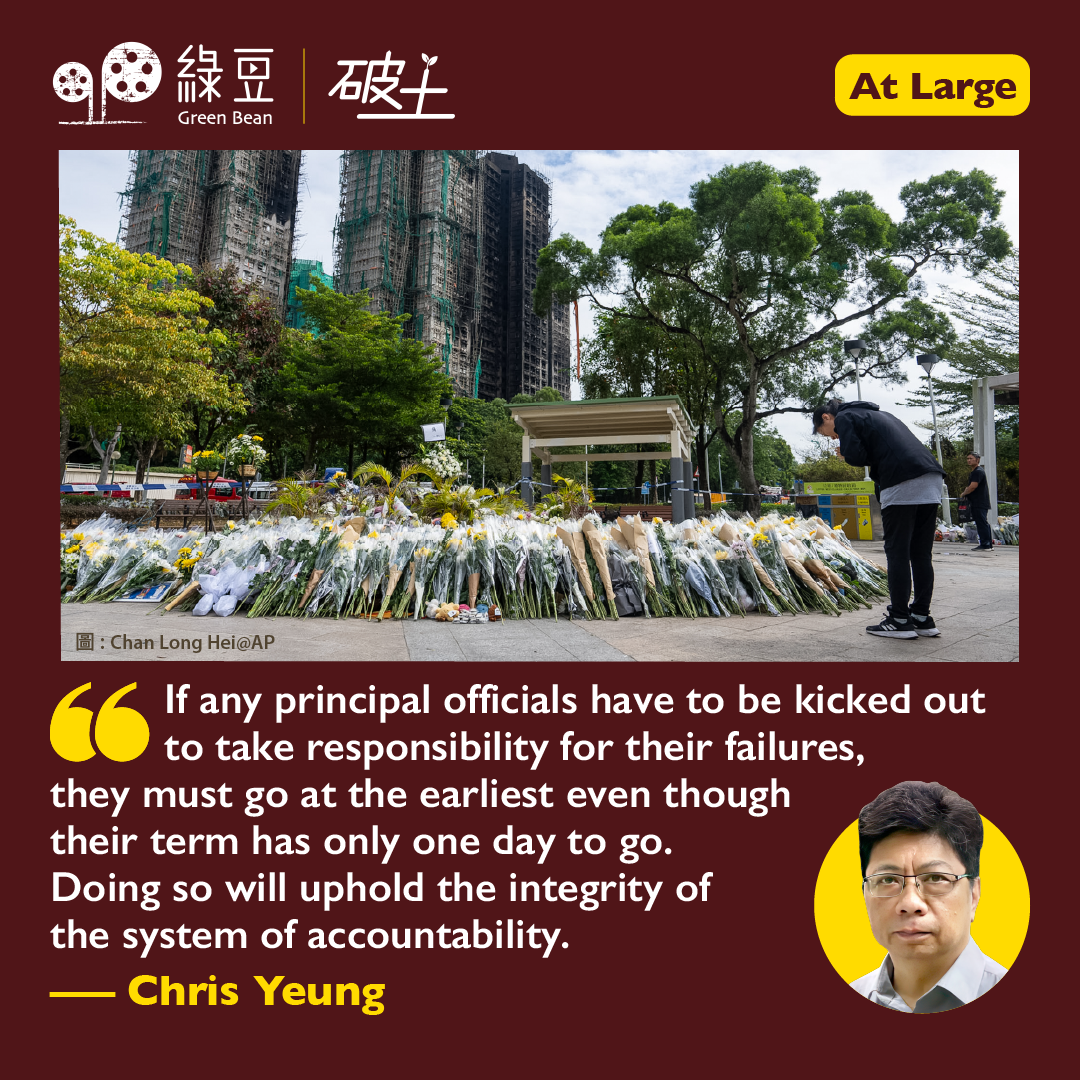
If any principal officials have to be kicked out to take responsibility for their failures, they must go at the earliest even though their term has only one day to go. Doing so will uphold the integrity of the system of accountability. When it comes to being accountable, it is never too late. Being late is better than never.
▌ [At Large] About the Author
Chris Yeung is a veteran journalist, a founder and chief writer of the now-disbanded CitizenNews; he now runs a daily news commentary channel on Youtube. He had formerly worked with the South China Morning Post and the Hong Kong Economic Journal.