A Mark Six-type bet on having children is no fun
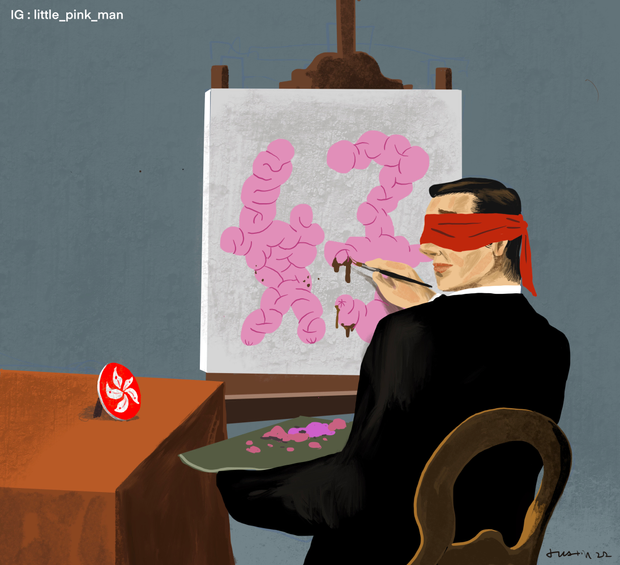
Mark Six is a 6 out of 49 lotto game conducted by the Hong Kong Jockey Club. The draw is held three times a week. The unit stake amount for each Mark Six entry is HK$10. The cost of betting on luck for wealth is peanuts.
The Mark Six lottery has been so successful that it has inspired a Legislative Council member, a former police officer, to propose a new type of Mark Six lotto game only for those who have newborns, presumably within a certain period of time, to boost birth rate.
Speaking at a Legco meeting last week, Joe Chan urged the Government to collaborate with the Jockey Club to launch the new game with awards ranging from HK$1 million to HK$4 million.
In response, Deputy Chief Secretary Cheuk Wing-hing said awards ranging from tens of thousands to millions of dollars would be a driving force. But he cautioned that the commitments of either the Government or the Jockey Club would be an astronomical figure.
Cheuk did not give any figures. Neither Chan or other legislators had sought more details from Cheuk. Out of the box though it is, Chan’s proposed “Mark Six-type” game aimed to encourage couples to boost fertility rate is a betting game nobody seems to have taken seriously – for obvious reasons.
Any sensible couple will not take a bet on having a child in order to enter a “newborns” lotto game with awards up to HK$4 millions simply because of the enormous obligations of being parents for their children.
John Lee’s policies on encourage childbirth
Chan’s idea to stimulate the desire of couples in raising children did not cause a stir, similar to the second host of measures rolled out by Chief Executive John Lee to boost fertility rate, or more realistically, stop the free fall of the number of births each year, in his latest annual policy address.
It came after the first basket of initiatives Lee has taken in his 2023 Policy Address aimed to convey a strong message to the populace that the Government encourages childbearing.
Under the three-year-long 2023 scheme, families of newborn children will be granted HK$20,000 each. Other measures include priority in applications for public housing.
Giving it another go with a renewed three-year scheme in the 2026 Policy Address delivered in mid-September, HK$20,000 will continue to be awarded for firstborns, while second and subsequent children will earn families HK$30,000.
The baby bonus scheme also includes larger tax breaks and priority in the public rental housing queue. Families with newborns would also be able to borrow 95 per cent of a residential property’s value for a mortgage, and pay less stamp duty.
In a paper submitted to lawmakers, the Government said the policy was renewed “to create a conducive environment for childbearing” as the fertility rate remains low at 0.73 in 2025.
Worse, fewer than 30,000 babies were born in Hong Kong from July 2025 to the end of June this year, marking a record low for the city. Ten years ago, the number of births was more than double this figure.
To put it bluntly, Lee’s first strike to shoot up the city’s fertility rate has proved to be a failure. Worse, his second strike featuring a slight increase of direct one-off subsidies and benefits and further enhancement of childbearing environment is too similar to the first basket of measures to stand a good chance of success.
Singapore’s new strategy
Officials may be aware of the bleak demographic picture. They have already lowered expectations, stopped short of talking about boosting fertility rate but maintained the importance of trying to stop a further decline.
Forget about the much-uttered rhetoric of leading a “can-do”, or “capable” government, the administration is caught in a policy conundrum in coping with the low fertility crisis, which has become more embarrassingly obvious in the wake of a new move by Singapore to keep a population stable without immigration.
Singapore’s fertility rate hit a new low, or 0.87% last year, down from 0.97% in 2024, which is still higher than Hong Kong’s.
In late August, Singapore Prime Minister Lawrence Wong announced an overhaul of child payment and parental leave during his annual National Day Rally speech. The government will provide almost 70,000 Singapore dollars (about HK$44,000) in direct financial support to families for each child, up to the age of 17.
“We want every family to know: if you choose to have children, the government will stand with you… We will provide more support and over more years.”
Singapore’s new strategy focuses on long-term financial support for families, rather than incentives to encourage more babies. Other measures include subsidised child care and flexible-work arrangements for parents of young children. A similar strategy has proved to work in South Korea.
Wong believes it should improve life for families in Singapore. “I may not get more babies,” he said in June. “But it’s still worth doing.”
No long-term support for families
No political parties in Hong Kong have proposed a similar overhaul of financial support for childbearing. The government has repeatedly highlighted the financial deficit problem, cautioning on governing spending. But it has embarked on massive public spending in areas ranging from infrastructure to security.
There are signs, nevertheless, that the government is becoming more aggressive in boosting immigration to cope with the need for talent and manpower.
Given the city’s fiscal strengths, it sounds inconceivable that the city cannot afford long-term spending on childbearing to improve the life for families. It seems to be more a case of lack of political will or mental block at the policy-making echelon. That has resulted in risk aversion when trying to avert a low fertility crisis.
Equally importantly, the likelihood of families having more children is shaped by their overall assessment on the future of the place they live.
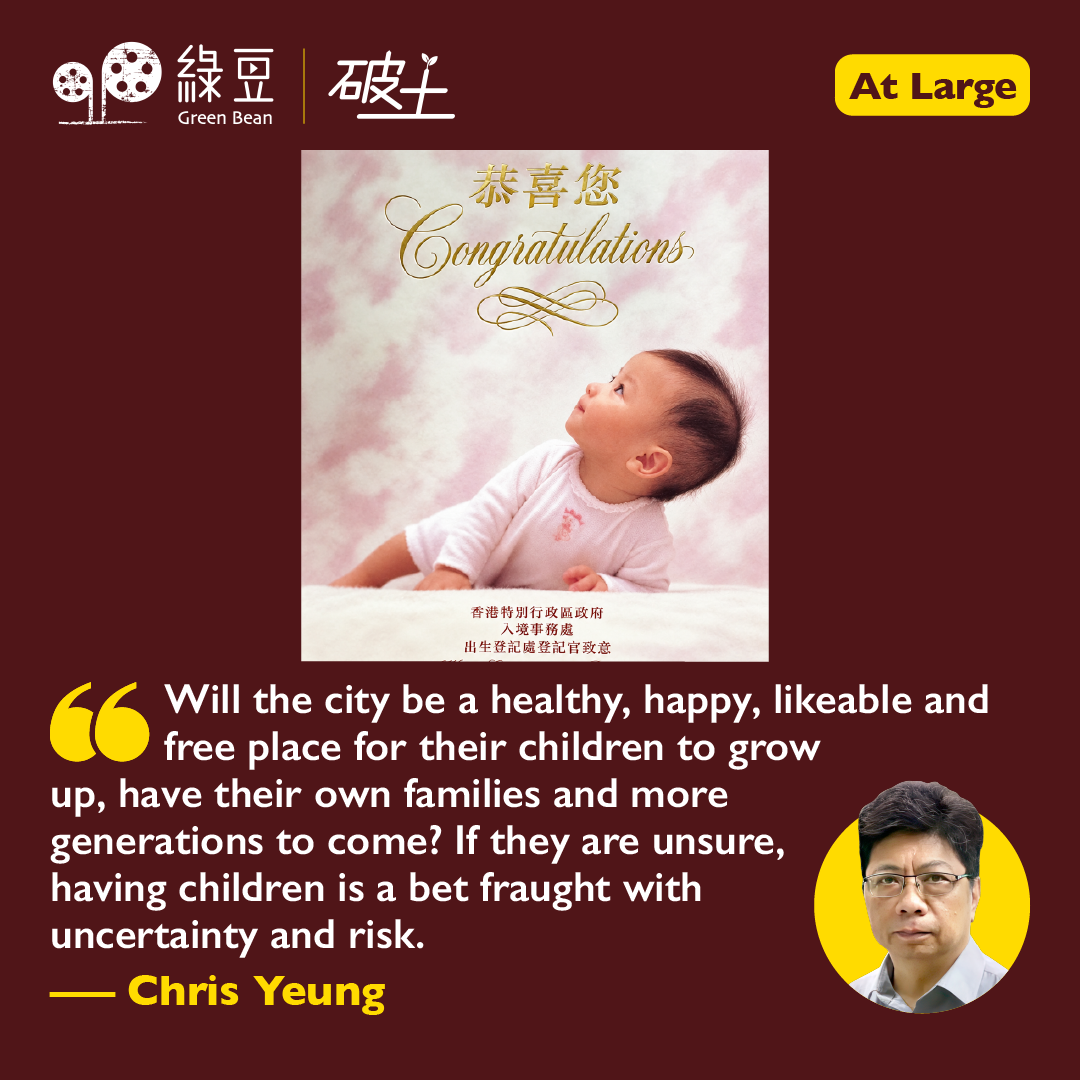
Will the city be a healthy, happy, likeable and free place for their children to grow up, have their own families and more generations to come? If they are unsure, having children is a bet fraught with uncertainty and risk.
▌ [At Large] About the Author
Chris Yeung is a veteran journalist, a founder and chief writer of the now-disbanded CitizenNews; he now runs a daily news commentary channel on Youtube. He had formerly worked with the South China Morning Post and the Hong Kong Economic Journal.