
Promises of a bright future a deja vu
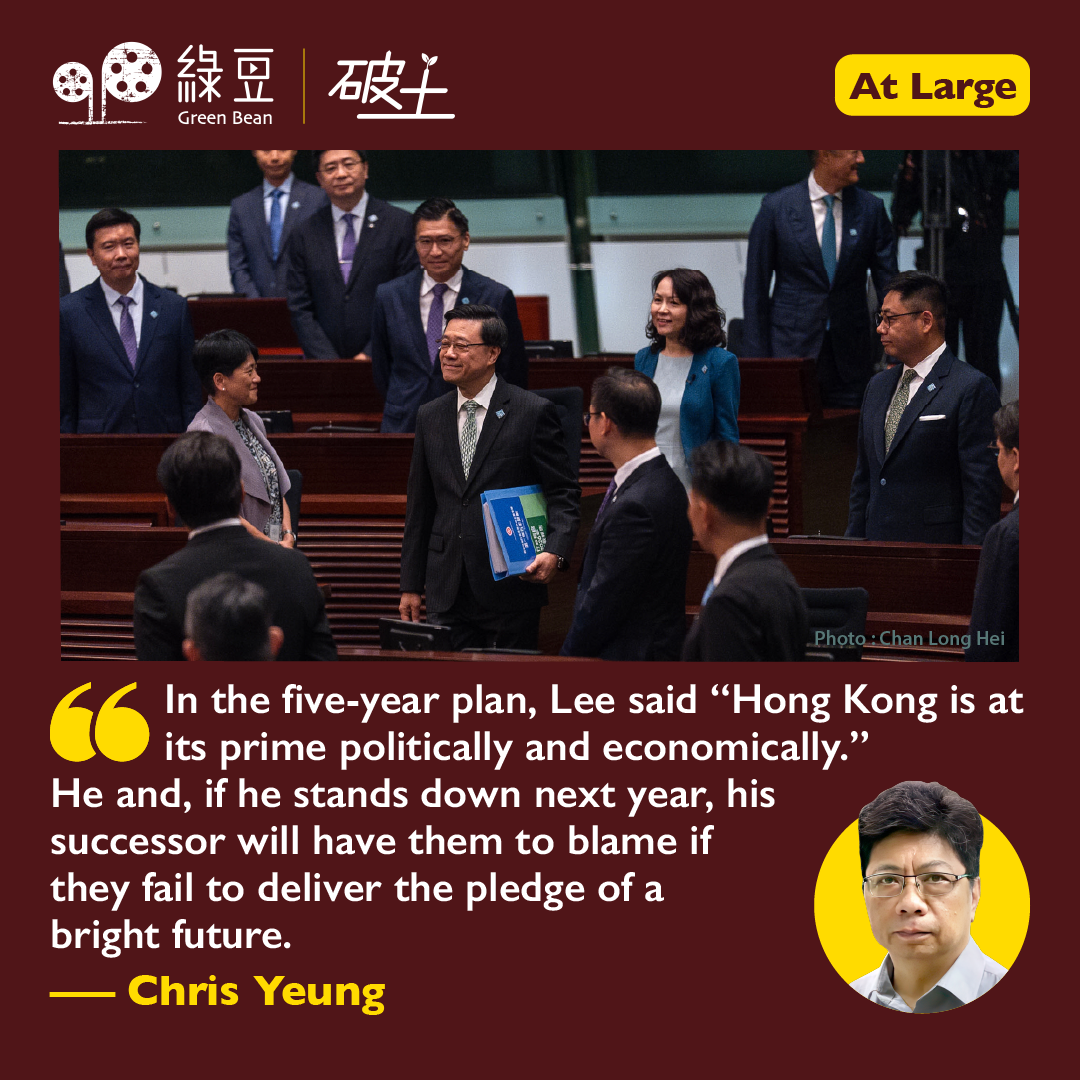
The timing of the launch of Hong Kong’s first five-year plan, a belated move to align with China’s 15th national Five-Year Plan, could not be more intriguing.
Coming eight days after the death of first chief executive Tung Chee-hwa, the pioneering move by Chief Executive John Lee Ka-chiu to outline a visionary blueprint for the city in the next five years, mapping out plans and setting a list of targets, is reminiscent of the reign of Tung.
Taking the helm of Hong Kong from July 1, 1997, Tung stepped down in March 2005, with his visions unfulfilled. He did not live to see the attempt of Lee, one of his successors, envisioning the SAR in the next five years.
That it is now a job to be done by Lee, who joined the government as a police inspector, or by his successor if he is not given five more years next year, has added irony to the journey of Hong Kong under the untried policy of “one country, two systems.”
Lee’s current five-year term will end in less than 10 months. His chance of re-election is anybody’s guess.
“Hong Kong has a bright future.”
Though an unknown in politics, Tung’s business background with international outlook and a strong sense of nationhood had impressed late President Jiang Zemin. With the blessing of Jiang in a famous handshake, Tung was given the task of steering the Hong Kong SAR after the end of British rule.
In his maiden policy address delivered on October 8, 1997, he promised a “better tomorrow for Hong Kong.” Better housing, Better education. Better care for the elderly people. Stronger economy…
In his concluding remarks, he asked himself a list of searching questions. “Is our outlook broad enough? Is our thinking down to earth?… Are we making promises to our citizens we cannot realistically achieve? Have we ensured the development of democracy by proceeding in an orderly fashion and in accordance with the principle of steady progress? ” He ended his speech saying “Hong Kong has a bright future.”
Almost 29 years on, Lee unveiled the city’s first five-year blueprint on September 16. The headline of a South China Morning Post story read: “Lee unveils plans for bright future.”
The Five-Year Plan
Marking a major difference from Tung’s visionary blueprint, the city’s first five-year plan was formulated to align with China’s national development strategy laid down in the 15th Five-Year Plan. Setting out a set of binding and anticipatory or aspirational longer-term targets, the Hong Kong blueprint contains a section under the heading “Strengthen the Institutional Safeguards for Effective Implementation of the Five-Year Plan.”
It says, “We will strive to enhance governance efficacy of the HKSAR to ensure the effective implementation of Hong Kong’s Five‑Year Plan. By further refining our governance philosophy, adopting a more proactive and pragmatic approach, enhancing the coordination mechanism within the HKSAR Government, and strengthening collaboration across bureaux and departments, we will more effectively take forward and implement major works projects and policies, while enhancing policy continuity.
“We will better leverage the two‑pronged approach of ‘effective market’ and ‘capable government’, while fully stimulating enthusiasm, initiative, and creativity from all walks of life in society to participate in and monitor the Five‑Year Plan, ensuring the effective implementation of various tasks thereunder.”
Without mentioning the visionary plans of his predecessors including Tung, Lee’s promise of enhancing governance efficacy in the blueprint could be seen as a veiled reply to doubters and cynics about the first five-year plan with a message saying the lessons of the setback of Tung’s reform programme have been learned.
Who can make a huge difference
The list of moves to enhance government efficacy such as better coordination and collaboration within the government and a “market-government” approach to drive developments cannot be wrong. How to do it is another matter – and crucial. And who leads the reform drive could make a huge difference.
If Tung failed because of a lack of political skill and personality weakness worsened by a maze-like bureaucracy and complex and entrenched vested interests in the society, the question is: will John Lee or his successor be able to break the barriers and remove the obstacles?
If there are doubts about government efficacy, this is because the decline of executive capability is nothing new. The deadly Tai Po blaze that killed 168 people has laid bare the buck-passing mentality and disjointed structure within the bureaucracy, among other system failures and work deficiencies such as the 999 hotline.
Among the action plans to improve governance in the latest policy address is to optimise the 1823 government hotline on public complaints.
Doubters and cynics could be forgiven for failing to see a bright future ahead if the executive authorities have not been able to do a good job in sorting out who does what promptly upon a public complaint related to public safety such as fire hazards.
Unlike Tung’s era, the government is no longer troubled by political dissent in and outside the Legislative Council. The mainstream media has been tamed. There are more tools to axe and penalise underperforming officials. Big businesses are aware of the imperatives of aligning their business plans with the government’s development blueprint.
In the five-year plan, Lee said “Hong Kong is at its prime politically and economically.” He and, if he stands down next year, his successor will have them to blame if they fail to deliver the pledge of a bright future.
▌ [At Large] About the Author
Chris Yeung is a veteran journalist, a founder and chief writer of the now-disbanded CitizenNews; he now runs a daily news commentary channel on Youtube. He had formerly worked with the South China Morning Post and the Hong Kong Economic Journal.
