
Verdict on June 4 vigil leaders questionable
37 years ago, Lee Cheuk-yan was a young unionist-cum-activist. He was 30, full of passion for civic activism and hopes for an open, democratic China. Lee hit headlines after he was taken away by mainland public security officials from a Hong Kong-bound flight at the Beijing airport tarmac one day after the June 4 crackdown.
Following secretive diplomatic talks between Beijing and London, he was allowed to return to the city on June 8. He was given a heroic, warm and tearful welcome by his family, friends and supporters at the now-relocated airport at Kai Tak.
Lee was among a group of activists, including university students, representing the then newly-formed Hong Kong Alliance in Support of Patriotic Democratic Movement in China. They flew to Beijing with donations collected locally for the student protesters at Tiananmen Square days before June 4.
The arrest and release of Lee was one of the June 4 stories in the city’s collective memory.
On Friday, a panel of three High Court national security judges found Lee and two former Alliance leaders guilty of inciting subversion under the national security law by advocating an end to “one-party dictatorship” on the mainland.
In a judgment delivered at West Kowloon Court, they ruled that any attempt to overthrow or undermine the Communist Party of China’s leadership could constitute a subversion offence because the country’s constitution did not permit Western-style democracy with rotation of ruling parties.
Now 67, Lee and the other two defendants could be jailed for up to 10 years.
A slogan embodying hopes for a democratic political system
Erupted in mid-April 1989, the students-led protests in Beijing had won support and sympathy from Hong Kong people. Pro-Beijing figures had joined condemnation of the violent crackdown on students and civilians.
In the aftermath of the Tiananmen crackdown, tens of thousands of them from different age groups had attended an annual candle light vigil organised by the Alliance at Victoria Park – until the implementation of the national security law in 2020.
Many of them reacted to the Friday verdict with a heavy heart – and mixed feelings filled with anger and sadness, disbelief and disillusionment, frustration and despair.
They were shocked and awed not so much by the ruling, but the arguments articulated by the judges in their 216-page judgment. They should be forgiven for feeling unreal as if they and the judges are a world apart.
Many of those who shared the causes of the Alliance would feel bewildered by the judges’ interpretation of the meaning of the six-word phrase “end of one-party dictatorship”. The slogan-style notion, which was one of the Alliance’s five “operational objectives,” was crucial in the ruling of the Alliance case. The other four include “building a democratic China,” “Vindicating the June 4 verdict.”
For many June 4 candle light rally participants, it was a slogan embodying hopes for a democratic political system featuring the principle of “rule of the people, for the people and by the people.” It sounds inconceivable to them that the way it was interpreted seems to imply they were involved in a plot to overthrow and undermine the Chinese Communist Party.
Slogan championed for more than three decades
Known for pragmatism and realism, few, if any, Hongkongers have fancied the idea of seeking to overthrow the ruling communist regime even before the national security law took effect. Reasonable-minded people could not possibly believe a ruling regime would be toppled by an annual commemorative gathering of mourners.
At a time when the June 4 commemoration was at a low ebb, the Victoria Park vigil had been ridiculed by young students as being held every year “in accordance with rites” without substance and was irrelevant to the city’s democratic development.
The judges see the Alliance activities differently. They ruled the Alliance’s objective of ending one-party dictatorship and their acts were attempts to topple the ruling party and alter the political system as laid down in the Chinese Constitution. Doing so is a breach of the national security law.
Article 1 of the Chinese constitution, which was amended in 2018, described the party’s leadership as the “defining feature of socialism with Chinese characteristics”. The judges noted that the article effectively required the country to be run solely by the party as a socialist state. Their interpretation of the article is questionable.
Controversial though it was, the city’s June 4 commemoration featuring the annual candle light vigil at Victoria Park had been seen as a sign of the city’s freedom of speech, freedom of assembly. For more than three decades since 1989, Hong Kong saw the largest public mournings of the June 4 victims in Chinese societies, which had been held peacefully.
It emerged that one of the five-point objectives, or slogans, championed by the Alliance for more than three decades, is being ruled as a breach of the national security law.
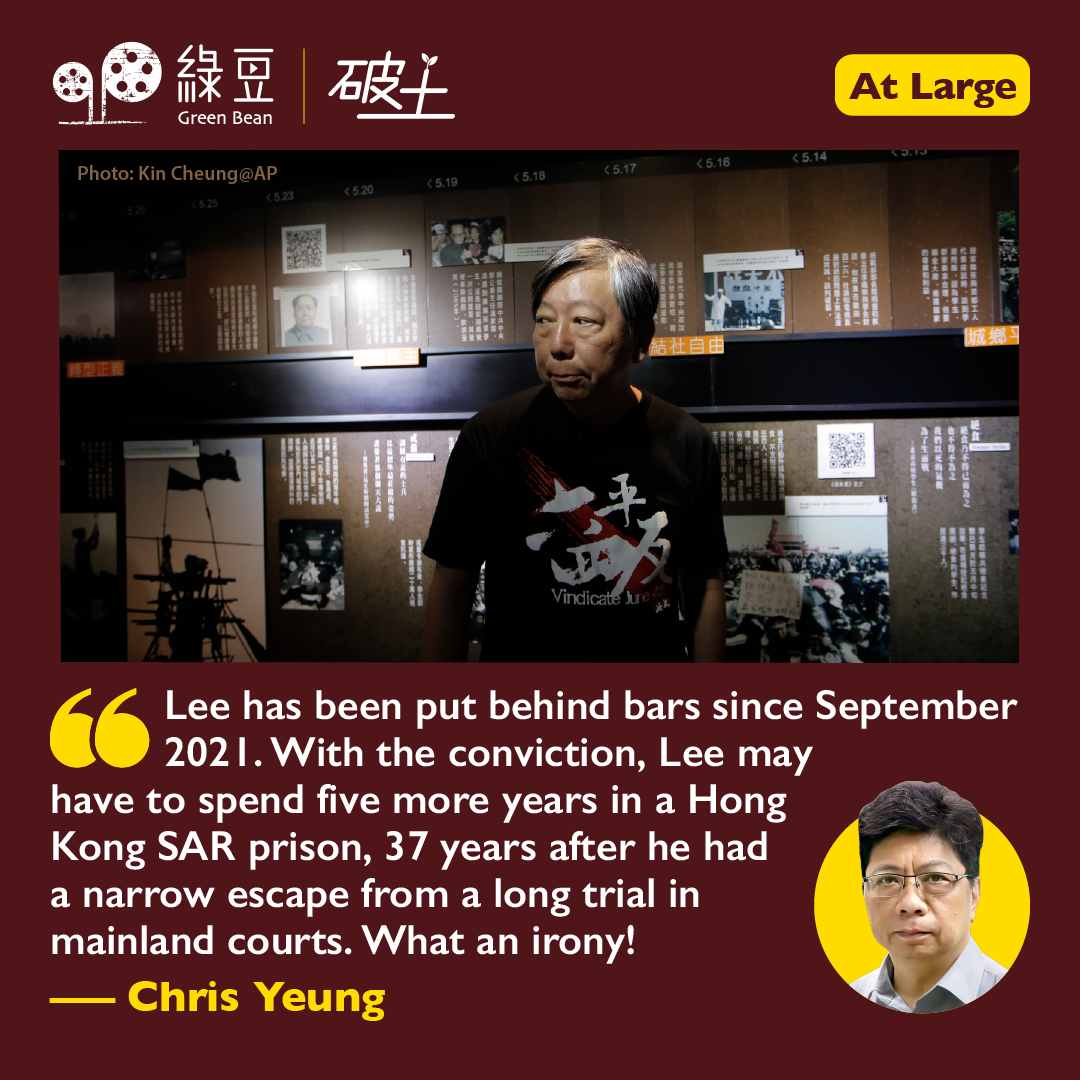
Lee has been put behind bars since September 2021. With the conviction, Lee may have to spend five more years in a Hong Kong SAR prison, 37 years after he had a narrow escape from a long trial in mainland courts. What an irony!
▌ [At Large] About the Author
Chris Yeung is a veteran journalist, a founder and chief writer of the now-disbanded CitizenNews; he now runs a daily news commentary channel on Youtube. He had formerly worked with the South China Morning Post and the Hong Kong Economic Journal.
