
Barrister group’s move to overturn Margaret Ng ruling may backfire
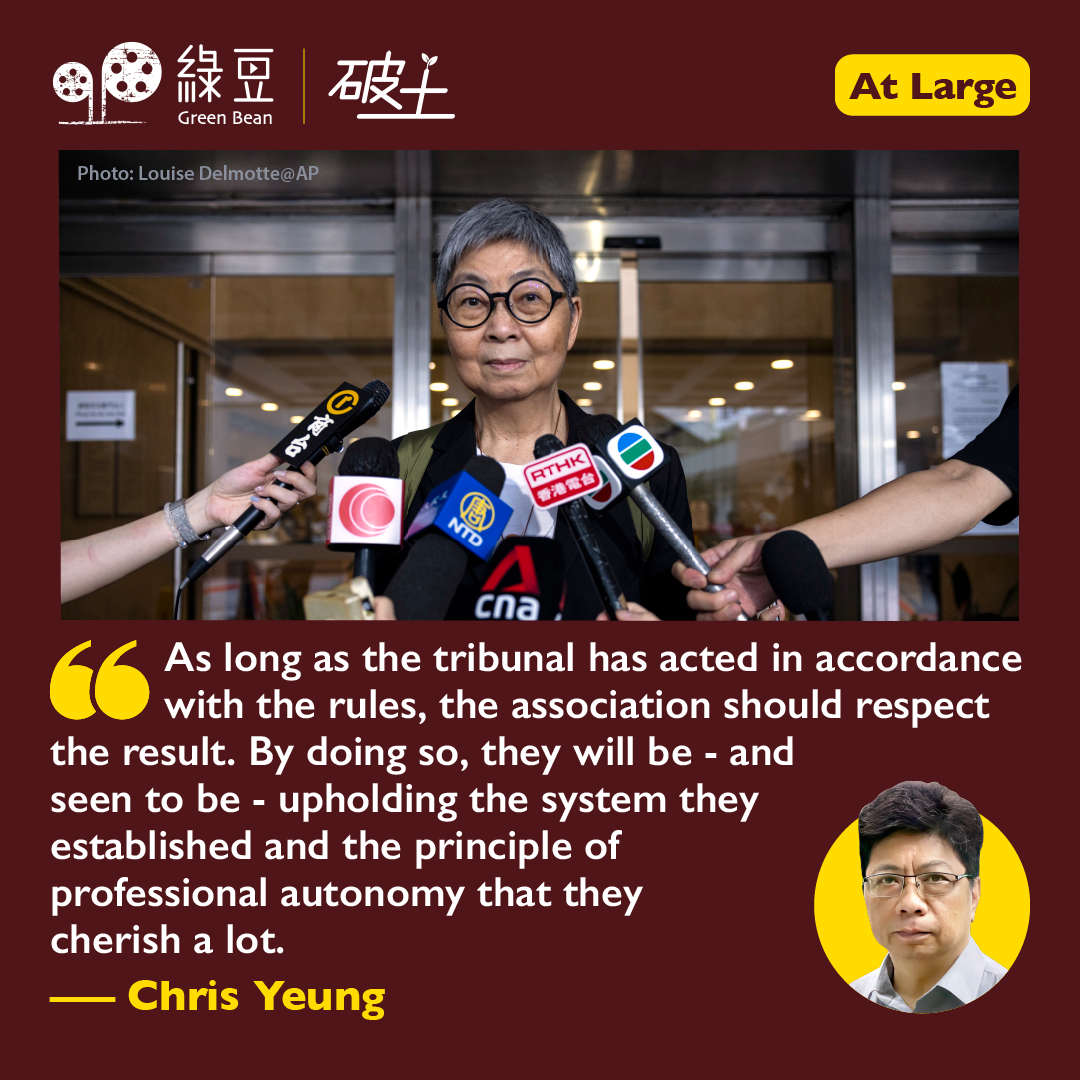
In a rare move last week, the Hong Kong Bar Association has asked a court to overturn a ruling by its own disciplinary tribunal clearing former pro-democracy legislator Margaret Ng Ngoi-yee of professional misconduct linked to her conviction of participation in an unauthorised assembly during the 2019 social unrest.
The Bar council has filed on August 14 a judicial review of the tribunal’s decision that Ng’s conviction for taking part in the illegal rally on August 18, 2019, was not so serious as “to bring the profession of barrister into disrepute or otherwise diminish public confidence in the profession of barrister.”
Their move to ask the judiciary to step in to rule a ruling by its appointed tribunal has made a mockery of the cardinal principle of professional autonomy that it upholds. That could not be more ironic.
Furthermore, it may invite criticism that the council has acted as a bad loser playing the “heads I win, tails you lose” game as a former Bar chairman Ronny Tong Ka-wah has cautioned in a commentary on social media.
That could not be more damaging to the reputation of the barristers’ group and their professional image.
The Bar council: public interest to correct the fundamental legal error
Ng, a founding member of the now-disbanded Civic Party and former legislator representing the legal constituency, was among nine democrats convicted of organising and taking part in the unauthorised assembly that began as a lawful gathering at Victoria Park about this time seven years ago.
Ng later won an appeal against her conviction for organising the assembly, but her conviction for participation was upheld. She was handed a suspended nine-month jail sentence.
Said to be acting on complaints, the association initiated a disciplinary inquiry into Ng and Martin Lee Chu-ming SC, founding chairman of the defunct Democratic Party, who was also convicted in the same case and was given a suspended jail sentence.
Media reports said a three-member panel of the tribunal ruled by a majority on June 8 this year that the complaint against Ng was unsubstantiated.
The majority concluded that Ng’s criminality in the case was not so “morally culpable, disgraceful or dishonourable” as to warrant professional sanction.
Noting that Ng had retired from legal practice at the end of 2025, the association’s lawyers said that even if the present challenge succeeded, the organisation would not seek further punishment against her, apart from issuing a private letter of admonishment.
“Nevertheless, it remains important in the public interest to correct the fundamental legal error committed by the [tribunal] in order to [instil] and maintain public confidence in the profession of barrister,” the court filing said.
The applicant’s lawyers further contended that the panel erred in finding that Ng’s alleged misconduct had little connection with her professional status as a barrister because she had dedicated most of her time to political causes.
Judging from the council’s court document, they and the majority of tribunal members sharply differed over the severity of Ng’s offence and its connection with her status as a barrister.
the Bar council is already a loser
In view of the background of the August 18 rally and the months-long city-wide social unrest, their divergent views are hardly surprising.
Just as students in law and public administration would have learned from their first lesson, procedures are often equally, if not more, important than outcome. Getting the procedures right and adhering to the rules could minimise disputes over the results. The reason is simple: fairness.
Ostensibly, the association is not happy with the result, i.e. complaint of misconduct unsubstantiated, and also the argument. But as long as the tribunal has acted in accordance with the rules, the association should respect the result. By doing so, they will be – and seen to be – upholding the system they established and the principle of professional autonomy that they cherish a lot.
Whether Ng’s offence has inflicted wounds to the reputation of the professional is in the eyes of beholders. With her retirement from the legal profession and being invisible in the city’s political game since 2020, the impact of her case, if any, on society is immaterial.
That the council seems to pursue relentlessly for an admonishment of Ng fears inflicting more wounds on the image of the leading legal body.
By taking a controversial move to take the case to court, the council may try to win a case of law and make a legal point that they deem to be correct, not necessarily to humiliate Ng.
The ruling of the courts is anybody’s guess. But the Bar council is already a loser with doubts cast over its controversial attempt to overturn a result they don’t like at the expense of the system – and questions raised over whether there are unspoken reasons behind their “relentless pursuit and fierce attack” on a pro-democracy figure.
▌ [At Large] About the Author
Chris Yeung is a veteran journalist, a founder and chief writer of the now-disbanded CitizenNews; he now runs a daily news commentary channel on Youtube. He had formerly worked with the South China Morning Post and the Hong Kong Economic Journal.
