The blame game heats up as Tai Po hearing ends
Smoke was in the air at Tamar, where the Hong Kong government headquarters are located, as the legal team of a government-appointed committee investigating the Tai Po deadly blaze gave a damning report that sums up a list of government regulatory deficiencies, if not failures, among others.
The 627-page report, delivered by senior counsel Victor Dawes, representing the independent committee, concludes its six rounds of public hearing and fact-finding work. It will be followed by a final report by the three-member committee headed by Justice David Lok, due to be completed by September.
Strong defense by the government
To add insult to injury, a strong defence of the authorities by the legal counsel representing the government, aimed to shift the blame onto the renovation contractor and other individuals, met a swift rebuttal by Dawes.
In a veiled reference to the claim by senior counsel Jenkin Suen, who represents the government, on last Thursday saying it was unfair to blame the government for the blaze, Dawes was quick to set the record straight on Friday.
Dawes said: “We are not suggesting that the government should bear the ultimate responsibility, but it’s only reasonable that the public expects them to perform… [I]t seems there was a major shortfall.”
Without naming any publication, Suen claimed on last Thursday “some media reports” were “unfounded” and “unfair” to suggest the government was to blame due to the shortcomings of its regulatory regime.
“Deliberate cheating” by renovation contractors and professionals with oversight authority caused the fire and its rapid spread, he argued. Suen urged the committee and the public to differentiate the “direct cause” of the fire and the “regulatory responsibilities” of the authorities.
“The government had an unshirkable responsibility”
In his legal team’s closing submissions, Dawes gave details of a long list of wrongdoings of the contractor and the consultancy.
He said Will Power Architects, the consultancy overseeing the HK$330 million renovation at Wang Fuk Court, and Prestige Construction & Engineering, the main contractor, should be “completely condemned” for their actions that led to the fire.
While thanking government witnesses for their cooperation and “frank admissions of shortcomings,” Dawes said that the government – in particular the Housing Bureau’s Independent Checking Unit (ICU), Fire Services Department, Buildings Department, and Labour Department – still bore a share of the responsibility for the fire.
The government, he said, had an “unshirkable responsibility to perform its regulatory role and protect the lives of residents.”
The fact Dawes was stating the obvious, reasoning the reasons and voicing out the voices of Wang Fuk Court residents – and the public – contrasts oddly with Jenkin Suen, who apparently spoke from a script prepared by the government.
John Lee lost the last opportunity
The voices of residents are loud and clear. They want the whole truth and a fair verdict on the responsibilities of the various parties, in particular the government. This is not so much because of any bias or hidden agenda against the government, but simply because, as Dawes said, it has the ultimate responsibility of protecting the lives of people.
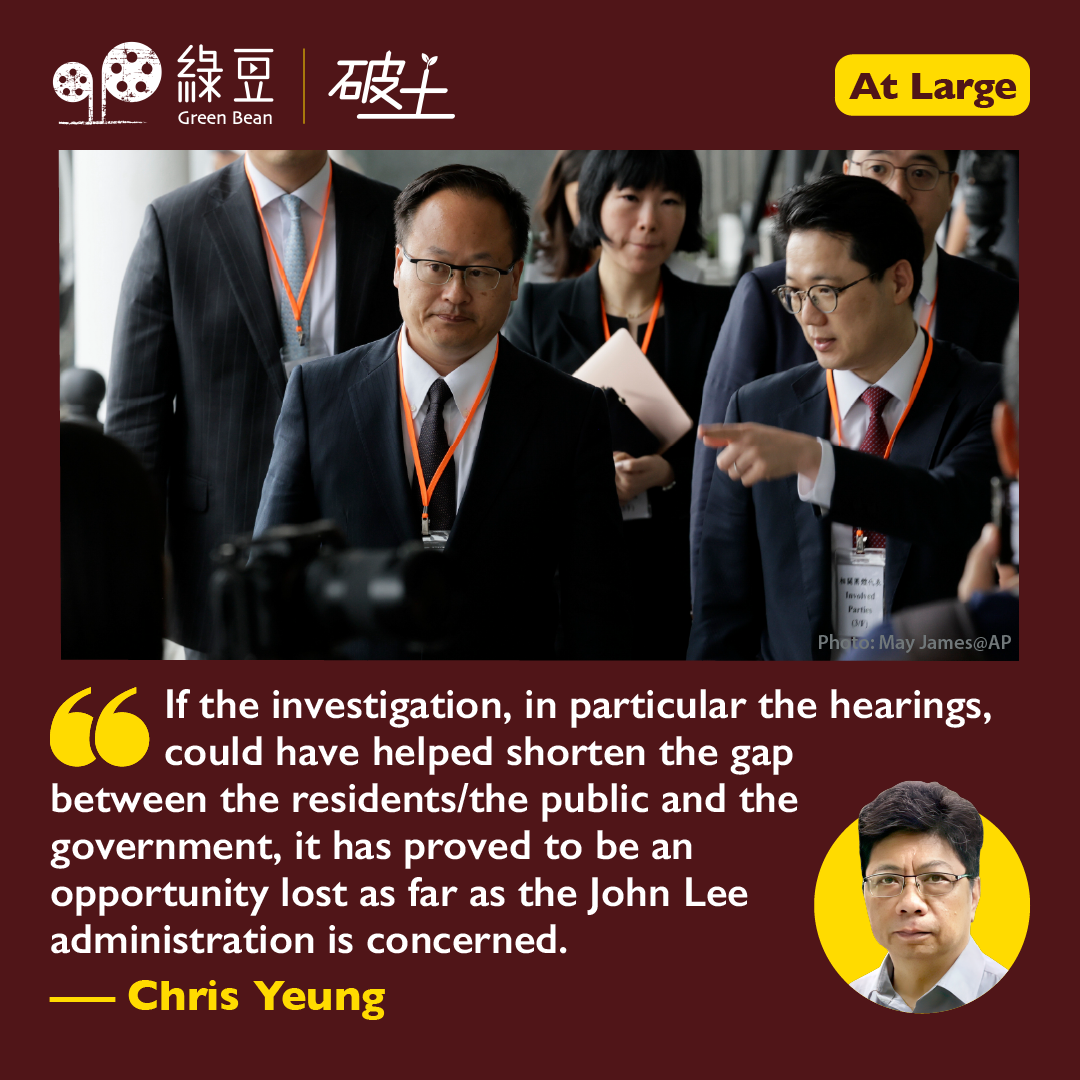
If the investigation, in particular the hearings, could have helped shorten the gap between the residents/the public and the government, it has proved to be an opportunity lost as far as the John Lee administration is concerned.
The government’s harsh criticism against the contractors and other parties is in ironical contrast to its kindness towards the departments that the independent committee is adamant they should bear a share of responsibility.
Residents have no qualms about the government fingering those who allegedly broke the law, cheated the regulators, and made fatal mistakes that led to the tragedy. They understandably were infuriated that the government has not admitted mistakes and said sorry almost nine months after the deadly fire.
The fire broke out on the low floors of a block at Wang Fuk Court in the mid-afternoon of November 26. It did not take long for clear signs to emerge showing that something in the regulatory system for renovation of buildings and fire safety facilities had gone seriously wrong.
Worse still, the grim fact that a total of 168 people lost their lives has ignited public anger towards the government for its failure to protect the lives of people. Fairly or unfairly.
It would have significantly helped ease the public fury if John Lee had taken a bow. Failure to do so has bred public anger. Anger deepened mistrust.
The last round of hearing last week is the last opportunity for the government to show humbleness and understanding of public sentiments by admitting they are also to blame for the deadly fire. The lack of a strong sense of self-reflection and self-critique at the closing of the hearing has sparked criticism that the government is bent on playing the blame game.
The depth of disappointment and anger of residents will double the difficulty for John Lee to walk his talk of “pursuing responsibility to the bottom” when he initiated the investigation.
Pressure for him to axe officials at a more senior level to show responsibility grew after the eight months of investigation.
▌ [At Large] About the Author
Chris Yeung is a veteran journalist, a founder and chief writer of the now-disbanded CitizenNews; he now runs a daily news commentary channel on Youtube. He had formerly worked with the South China Morning Post and the Hong Kong Economic Journal.