
A minor legislator traffic accident too damaging
To err is human. Lawmakers are no exception. But with Beijing keeping reminding members of the “patriots-only” legislature to do a better job and behave well, mistakes by one legislator after another will be costly and damaging.
Also importantly, the swift resignation of legislator William Wong Kam-fai on last Friday (July 3) after being arrested for drink-driving and a hit-and-run says something about the dilemma faced by Beijing and the loyalists in the reconstructed political landscape. The stakes of a bad mistake by a patriot legislator could be much higher than what it would suppose to be.
Drink-driving then hit and run
Quoting sources, media reported Wong lost control of his vehicle near a staff residence at the Chinese University in late evening on Monday, causing damages to two parked vehicles. He was said to have left the scene. A security guard reported the incident later. Wong later returned to the scene. He failed a breathalyser test.
Wong was arrested on suspicion of drink-driving, careless driving and failing to stop and report an accident. He has been released on bail.
The arrest only came to light on Wednesday afternoon, after Wong attended a flag-raising ceremony that morning marking the 29th anniversary of Hong Kong’s return to Chinese sovereignty. He tendered his resignation from the Legislative Council on Friday. He was re-elected through the 1,500-member Election Committee in the 2025 Legco election.
Wong, a member of the Chinese People’s Political Consultative Conference since 2018, is a renown computer scientist and associate dean of the Chinese University’s School of Engineering. He holds senior posts in a list of cross-border innovation and technology associations. In politics, he remains a novice although he sat on the Legco constituted after an electoral overhaul in 2021.
Embarrassment to HKSAR and Chinese government
The drink-driving scandal hit headlines on the handover anniversary day, which coincided with a meeting held by the Chinese Communist Party at the Great Hall of the People to celebrate the 105th anniversary of the founding of the party.
Superficially, it caused embarrassment to the Hong Kong SAR government and the ruling party. Reports of the scandal on mainstream media and social media have diverted public attention on the anniversary celebrations.
More damagingly, it has worsened the image of the “patriots-only” Legco and brought more ridicule to the high-profile calls by Beijing officials for the lawmakers to give backing to the executive authorities to achieve the shared goal of good governance.
Administrative error
Speaking at a symposium on executive-led governance in Beijing in mid-January, China’s point man on Hong Kong affairs Xia Baolong has called on the lawmakers to fully support the Government. Also importantly, he underlined the importance of the personal conduct of legislators. Xia reminded members, as public figures, to build a good image and set a good model for society.
Six months on, the administration led by Chief Executive John Lee showed no marked improvement in governance. Instead, it was hit by a blitz of negative publicity including a ridiculous mistake in a bill on compulsory wearing of seat-belt on public buses, which was passed into law. It was shelved less than a week after it took effect.
Amid lingering public discontent over maladministration that is widely seen as a factor behind the Tai Po deadly blaze, the government’s handling of its aftermath, in particular, the rehousing of Wang Fuk Court residents, has sparked fresh controversies.
Last month, a surprise decision by the Government to drop the setting of “poverty line”, which was a key component of its poverty alleviation policy since the Leung Chun-ying administration, has cast doubts on the Lee team’s commitment to lift people out of poverty.
The “blame-others” mentality
If ordinary people have found difficulty in tracing substance to the Government’s praises on its achievements in the past four years, they will feel even more perplexed about the role of the lawmakers in helping to boost governance.
Against the backdrop of a depth of discontent over the drastic reduction of democratic elements in the electoral systems in 2021, it has come as no surprise that scandals involving patriot lawmakers have made bigger headlines.
They include the wrong-way driving incident featuring Judy Chan Ka-pui earlier this year. The Legislative Council Supervisory Committee has issued a written warning to her, concluding that the misconduct did not reach a serious level. Then came the latest drink-driving scandal.
An editorial of a pro-Beijing Sing Tao Daily lauded the quick move of Wong to bow out, saying it has helped cut losses for the whole Legco. The editorial said those forces aiming to “oppose China, disrupt Hong Kong” would take advantage of such incidents to inflate the misconduct of individual lawmakers and to attack the whole Legco and political system.
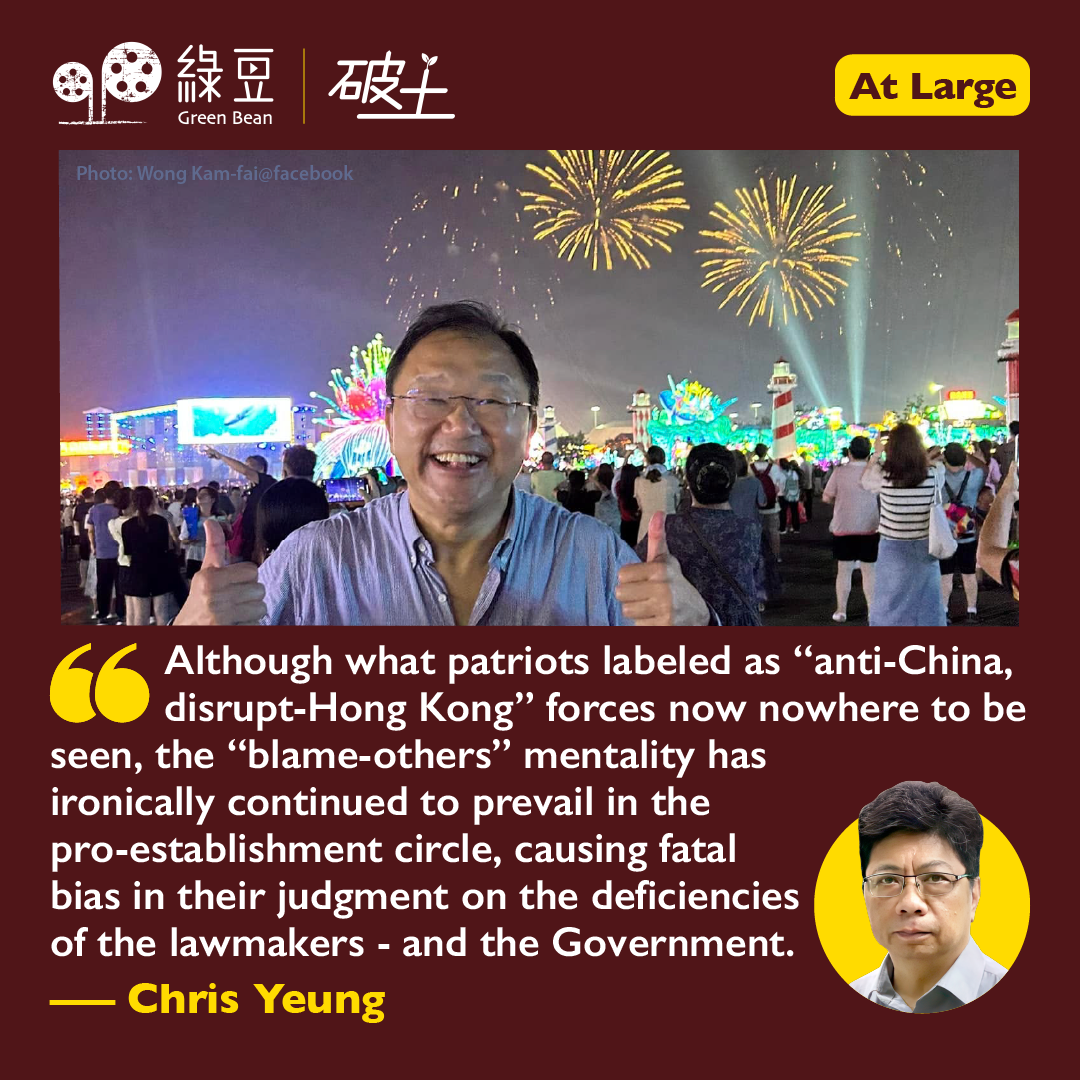
Although what patriots labeled as “anti-China, disrupt-Hong Kong” forces now nowhere to be seen, the “blame-others” mentality has ironically continued to prevail in the pro-establishment circle, causing fatal bias in their judgment on the deficiencies of the lawmakers – and the Government.
Suffered from a dearth of representativeness in the electoral system, the legislature will be more vulnerable to harsher-than-expected criticism when a lawmaker makes silly mistakes. Public frustration over the system and the feeling of helplessness will be mixed with their anger over members’ misconduct and stupid deeds and words. Like it or not.
▌ [At Large] About the Author
Chris Yeung is a veteran journalist, a founder and chief writer of the now-disbanded CitizenNews; he now runs a daily news commentary channel on Youtube. He had formerly worked with the South China Morning Post and the Hong Kong Economic Journal.
