
Two Hong Kongs in competitiveness and rule of law rankings
With the fourth anniversary of the current administration led by Chief Executive John Lee Ka-chiu nearing, he and his top aides were busy trumpeting their self-proclaimed success in the past four years.
Rule of law in Hong Kong
Tipped as a “dark horse” in the 2027 Chief Executive election game, Secretary for Justice Paul Lam said in an interview with the Chinese-language Sing Tao Daily News he has made a lot of efforts to promote rule of law since he took office. He said he has made some achievements, adding he was full of confidence in the city’s rule of law.
In another interview with the pro-Beijing Ta Kung Pao, he said multiple authoritative international rankings have testified to the solid foundation of Hong Kong’s rule of law and competitiveness.
Lam cited the latest ranking of the IMD’s World Competitiveness Rankings, which saw Hong Kong move from the third place in 2025 to the second this year. Singapore took the top ranking.
Pointing to the second ranking, he said in Chinese “(our) rule of law environment must be excellent. (This is) because without sound rule of law, there is no way you can talk about competitiveness.”
Lam went on to cite Hong Kong’s ranking in the 2025 World Justice Project (WJP) Rule of Law Index, which evaluates 143 countries and jurisdictions around the world. (The 2025 survey shows the rule of law has declined in most countries for the eighth year in a row.)
Hong Kong’s ranking at 24th, he said, was already a “quite high” position. Out of one, Hong Kong’s overall score was 0.72. He said Hong Kong was on level with France and Uruguay, followed by advanced economies including the United States, Italy and Portugal. “(It) fully demonstrates (Hong Kong’s) rule of law has received world recognition.”
Referring to one of the factors in the index, Lam said Hong Kong’s scores in “fundamental rights” did not reflect the real situation objectively, saying it was unfair. He said the Government needed to double their efforts to explain the city’s freedoms and rights overseas so that other people would make a “fairer and more comprehensive” judgment.
Citing the city’s high scores in factors including “order and security”, “civil justice” and “criminal justice”, Lam argued that has shown the city’s legal system has given protection to civil liberties.
Upward or downward?
A closer look at WJP’s Rule of Law Index’s findings on Hong Kong in the past 10 years, however, shows a bleaker picture.
Standing at 17th in 2015, the city’s overall index slipped to 19th ranking in 2021, 22nd in 2022 and 23rd in both 2023 and 2024. Hong Kong went down from 23rd to 24th in the latest index.
Hong Kong’s drop in the ranking of “fundamental rights” is more drastic, falling from 29th in 2015 to 58th (2023), 62nd (2024) and 67th in 2025.
On “open government”, the score ranking slipped from 15th in 2017 to 25th in 2022. The 2025 corresponding ranking was 28th. On “constraints on government powers”, the 2015 ranking was 25th, 31st in 2020, 45th in 2021. The relevant ranking in the 2025 index was 63rd.
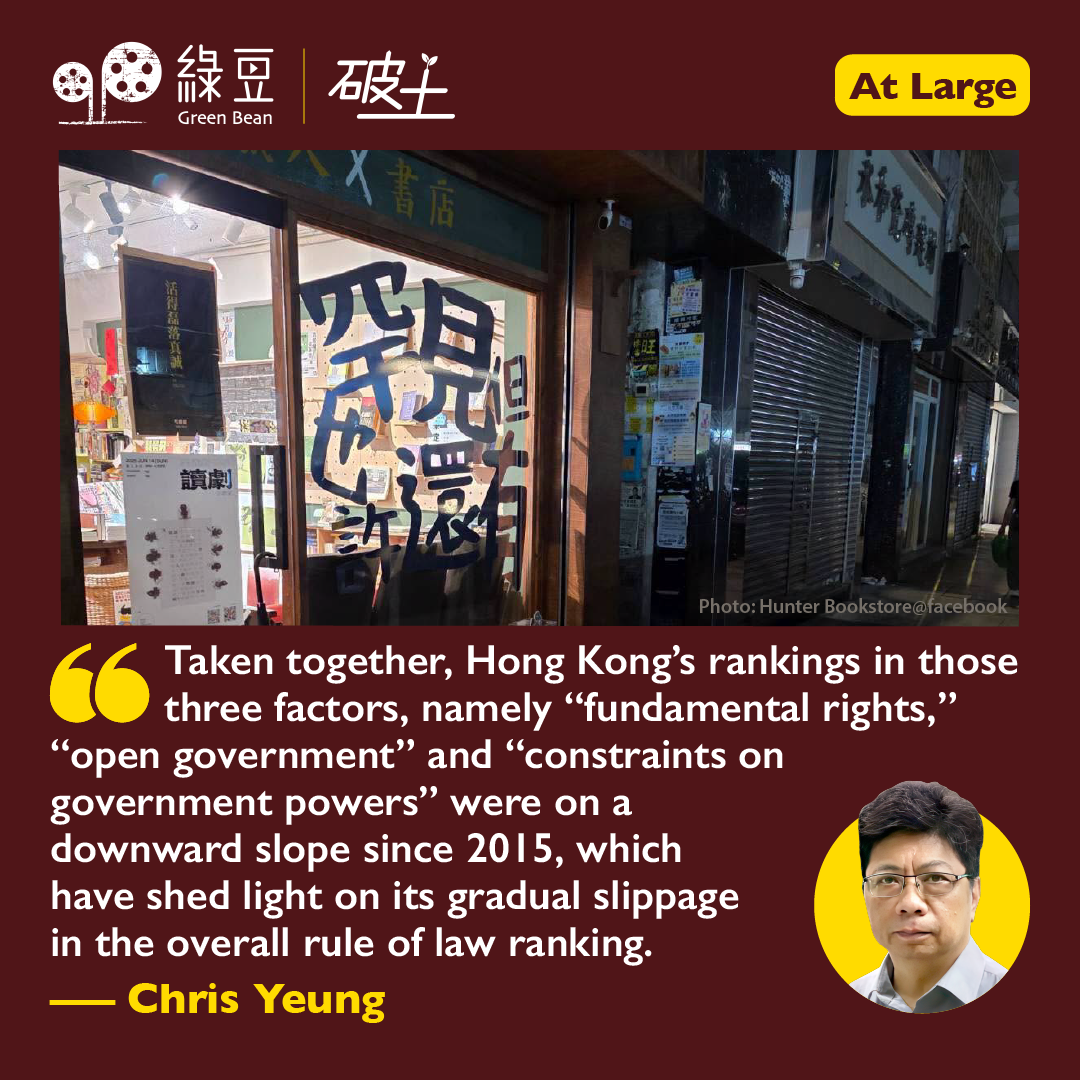
Taken together, Hong Kong’s rankings in those three factors, namely “fundamental rights,” “open government” and “constraints on government powers” were on a downward slope since 2015, which have shed light on its gradual slippage in the overall rule of law ranking.
The decline of Hong Kong in the WJP’s rule of law index is in ironic contrast with its rise in the IMD’s World Competitiveness Rankings.
It seems contradictory, but it is not after taking a closer look at the competitiveness survey.
According to the IMD website, the study evaluates the competitiveness of a country or a city by looking at four areas, namely economic performance, government efficiency, business efficiency and infrastructure, and a list of sub-factors including investment, tax policy, labour market and education. It does not measure factors such as fundamental rights and constraints on government powers.
Hunter Bookstore
If the justice chief is serious about what he called “unfair” ranking on fundamental rights in the rule of law survey, he may start with checking the details, then finding out the reasons why the rankings on civil rights and constraints on government powers were in decline.
It seems purely coincidental. But a piece of news last week has been illuminating.
On Wednesday, two owners of independent Hunter Bookstore were arrested by national security police on suspicion of sedition and money laundering. They were released on bail on Friday. Police took away some materials, including a book about the life of Apple Daily founder Jimmy Lai. Hunter Bookstore, co-founded by an ex-Civic Party district councillor, was the second independent bookstore being targeted by national security police this year.
▌ [At Large] About the Author
Chris Yeung is a veteran journalist, a founder and chief writer of the now-disbanded CitizenNews; he now runs a daily news commentary channel on Youtube. He had formerly worked with the South China Morning Post and the Hong Kong Economic Journal.
