New law to define national security offences may worsen self-censorship
Beijing and the Hong Kong government meant what they said time and again: the task of safeguarding national security will be done continuously; there will not be a mission accomplished. That is justifiable for obvious reasons. But national security legislation is a separate matter. A new law on national security will only be justifiable if it has good, strong reasons. And importantly, it should serve to boost security, but not breed more anxieties.
It should come as no surprise that a new subsidiary legislation on national security, which took effect immediately after its gazettal on last Tuesday (June 9), has added more jitters to some quarters of the society.
New power given to the Chief Executive
As if it has become an annual legislative task, the John Lee team has enacted another subsidiary legislation under the 2024-promulgated national security law last week. The legislation empowers the chief executive to certify any criminal case as a national security offence.
The classification mechanism for “other offences endangering national security” under the city’s national security law has sparked concerns about giving the power to the Chief Executive.
Dismissing the concerns, Chief Executive John Lee Ka-chiu has pledged to exercise prudence and seriousness when defining national security offences under the new legislation. He argued that the process of defining those cases often involved “state-level players” and highly sensitive information.
Secretary for Security Chris Tang Ping-keung stressed that the proposed law would not introduce any new offences, penalties or powers and would have no impact on residents’ daily lives or the normal operations of organisations.
It would allow all procedures applicable to national security offences – such as stricter bail conditions and trials by designated judges – to be applied to cases accompanied by a chief executive’s certificate.
Lee insisted that the legislation that empowers him to certify “other offences endangering national security” as national security offences is intended to “make the law clear.”
Make the law clear or unclear?
Ordinary citizens can be pardoned for a feeling of bewilderment, anxiety mingling fears about the subsidiary legislation, the second of its kind after the Safeguarding National Security Ordinance, commonly known as Article 23, took effect in 2024.
Article 23 says the Hong Kong SAR shall enact laws on its own to prohibit any act of treason, secession, sedition, subversion against the Central People’s Government, or theft of state secrets, to prohibit foreign political organisations or bodies from conducting political activities in the Region, and to prohibit political organisations or bodies of the Region from establishing ties with foreign political organisations or bodies.
Such offences as treason and sedition as specified in Article 23 have been defined in the two national security laws enacted by China’s national legislature in 2020 and by the Legislative Council in 2024.
In a paper to legislators, the Government said the “legislative intent” of the Beijing-imposed national security law, which came into effect on July 1, 2020, is that offences endangering national security include not only the four types of offences in the law but also “other offences endangering national security.”
Contrary to the government’s insistence that the new legislation would “make the law clearer,” the scope of national security offences has arguably become unclear with the new power given to the Chief Executive.
Self-censorship is likely to get worse
He or she can issue a certificate to define any acts of deeds as national security-related, which will not be subject to a challenge in courts.
Those suspects, who are presumably innocent until proved guilty, will face harsher treatment during investigation, including bail conditions. It looks certain anyone involved with cases with the CE’s national security-certification will be held in custody.
How “prudent” and “serious” John Lee will be when issuing those certificates is anybody’s guess.
But fears that the room for dissenting views will shrink further may not be unfounded in view of the repeated warnings given by officials against acts of “soft resistance” in the society.
“Soft resistance” has been identified by mainland and Hong Kong officials as one of the four major threats to national security facing the city. Societal and livelihood issues, including the Tai Po fire aftermath, and works of arts and culture have been cited as examples of “soft resistance.”
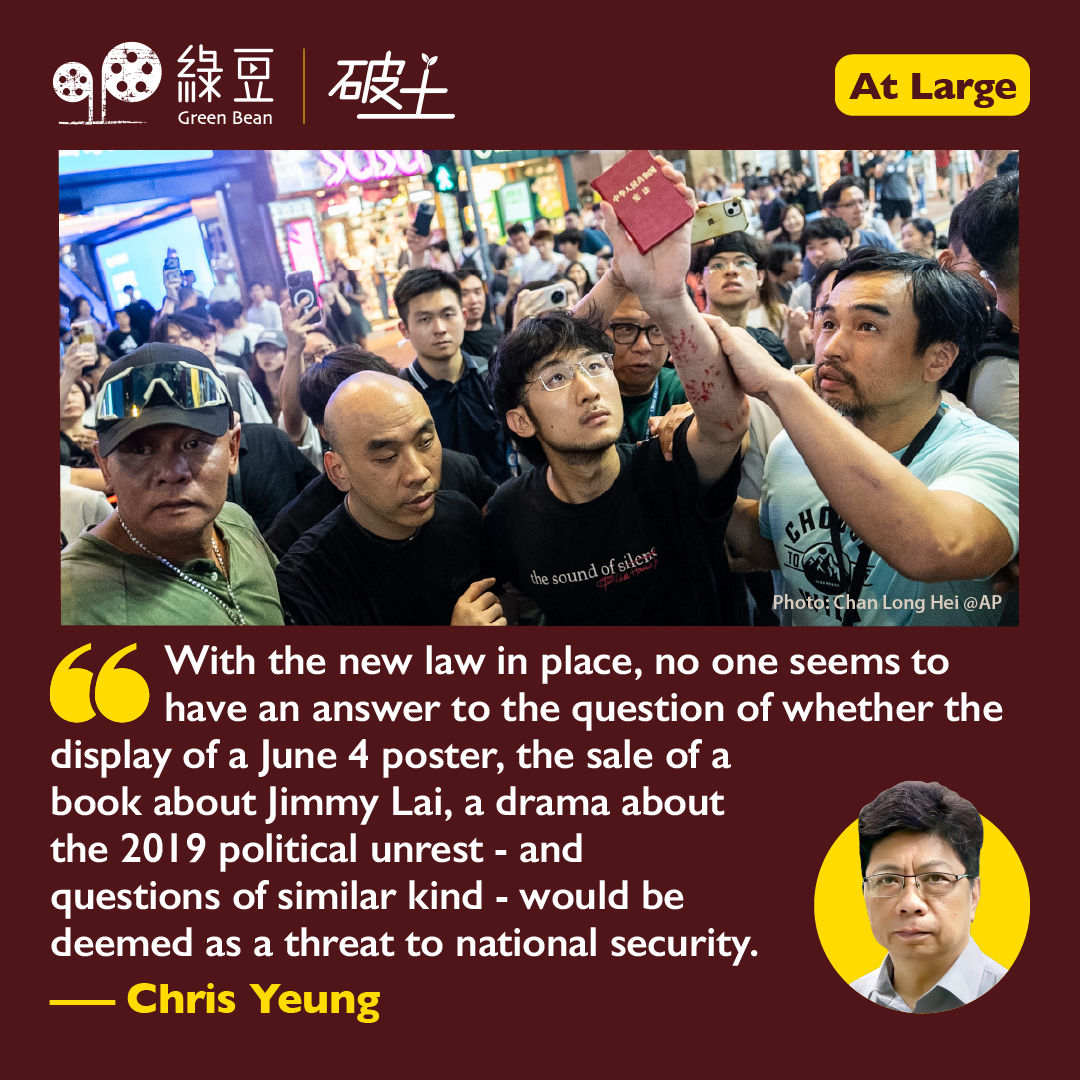
With the new law in place, no one seems to have an answer to the question of whether the display of a June 4 poster, the sale of a book about Jimmy Lai, a drama about the 2019 political unrest – and questions of similar kind – would be deemed as a threat to national security.
Only the Chief Executive has the answer.
The only certainty is uncertainty. With uncertainty over the protection of citizens’ rights to legal protection lingering, self-censorship is likely to get worse, at least in the foreseeable future.
▌ [At Large] About the Author
Chris Yeung is a veteran journalist, a founder and chief writer of the now-disbanded CitizenNews; he now runs a daily news commentary channel on Youtube. He had formerly worked with the South China Morning Post and the Hong Kong Economic Journal.