Civil service pay rise looks uncertain as fury over Tai Po fire lingers
Praising “significant improvement” in public finance, Financial Secretary Paul Chan raised expectations of a pay rise for the city’s civil servants this year following a wage freeze last year. He announced in the 2026-2027 Budget in February the government will resume its annual pay trend survey, which is seen as a move to pave the way for a pay rise.
Coming about three months after the deadly Tai Po blaze that killed 168 people, news of an imminent pay rise for civil servants has not caused a stir in the society. Pressure for another year of wage freeze has been immaterial, thanks to the return to fiscal balance, at least from the outset.
Seen as proactive moves to shape public opinion, there were calls from government-friendly figures for an end of the pay freeze. They cited the improvement in the city’s economic growth and fiscal health.
The Uncertainty
With results of the pay trend survey due to be available soon, uncertainty over pay adjustment of the 180,000-strong civil service has surfaced recently. It came against the backdrop of lingering public discontent over the deficiencies, verging on failures, of the civil service, which were seen as the underlying cause of the Tai Po fire.
Saddened by the tragic fire, the feeling of sadness and despair prevalent among the Wang Fuk Court residents and a sizable portion of the populace left unaddressed by the authorities have morphed into anger.
A host of laxity and deficiencies of a list of government departments exposed at the public hearings of an independent inquiry into the blaze in the past two months has added more salt onto the wound, denting public confidence in the civil service and the government as a whole.
This is despite the fact that there were no publicised opinion polls on government popularity in the past 12 months. The last survey of that kind was published in May last year by a Chinese University research institute.
As a decision on civil service pay adjustment drew near, the pro-government Chinese-language Sing Tao Daily News quoted an anonymous Executive Council member as saying recently they need to take into account the “strong public opinion” on the work culture of civil service when deciding the civil service pay rise this year.
The member said: “Even if there is a pay rise, the rate may not match (the corresponding figures in the pay trend survey). (We) may have to make some concessions.”
Based on the year-on-year pay movement of employees in a selected pool of companies in the private sector, the annual pay trend survey serves as an important factor in civil servants’ salary adjustments. Other factors including the economy, the government’s fiscal situation and civil service morale will also be taken into consideration.
Underperforming public servants
Without quoting the source of information, the Sing Tao report said middle- and senior-ranking civil servants could get a pay rise of more than 4 per cent and low-ranking 2 per cent based on the pay trend survey.
In view of the public sentiments caused by the Tai Po fire and economic uncertainty, the report said the government fears a public backlash if senior civil servants get a bigger pay rise.
Speaking on separate occasions, both Chief Executive John Lee and Executive Council Convenor Regina Ip did not categorically rule out the Wang Fuk Court fire factor in the upcoming adjustment of pay service wage.
They stuck to the same line saying the public should view the overall performance of civil servants, hinting that the underperforming public servants were individual cases and therefore should not adversely affect the pay adjustment of the fleet of civil servants.
The idea of delinking the fire from the pay adjustment may sound logical. But in reality, it ignores the reality that the overall image and authority of the civil service have been substantively tarnished by the Tai Po blaze given the scale of underperformance and laxity of officials as exposed in the fire probe.
New accountability system
In a related development, Lee has introduced in last year’s policy address a new system aimed to broaden the principal officials accountability system to enhance accountability of department heads, who are civil servants.
Under the Heads of Department Accountability System, the government-appointed Public Service Commission will be given new powers to probe serious problems involving civil servants.
With expectation of a more accountable civil service heightened by him, Lee is now faced with more pressure for being more responsive and accountable when making decisions such as civil service pay.
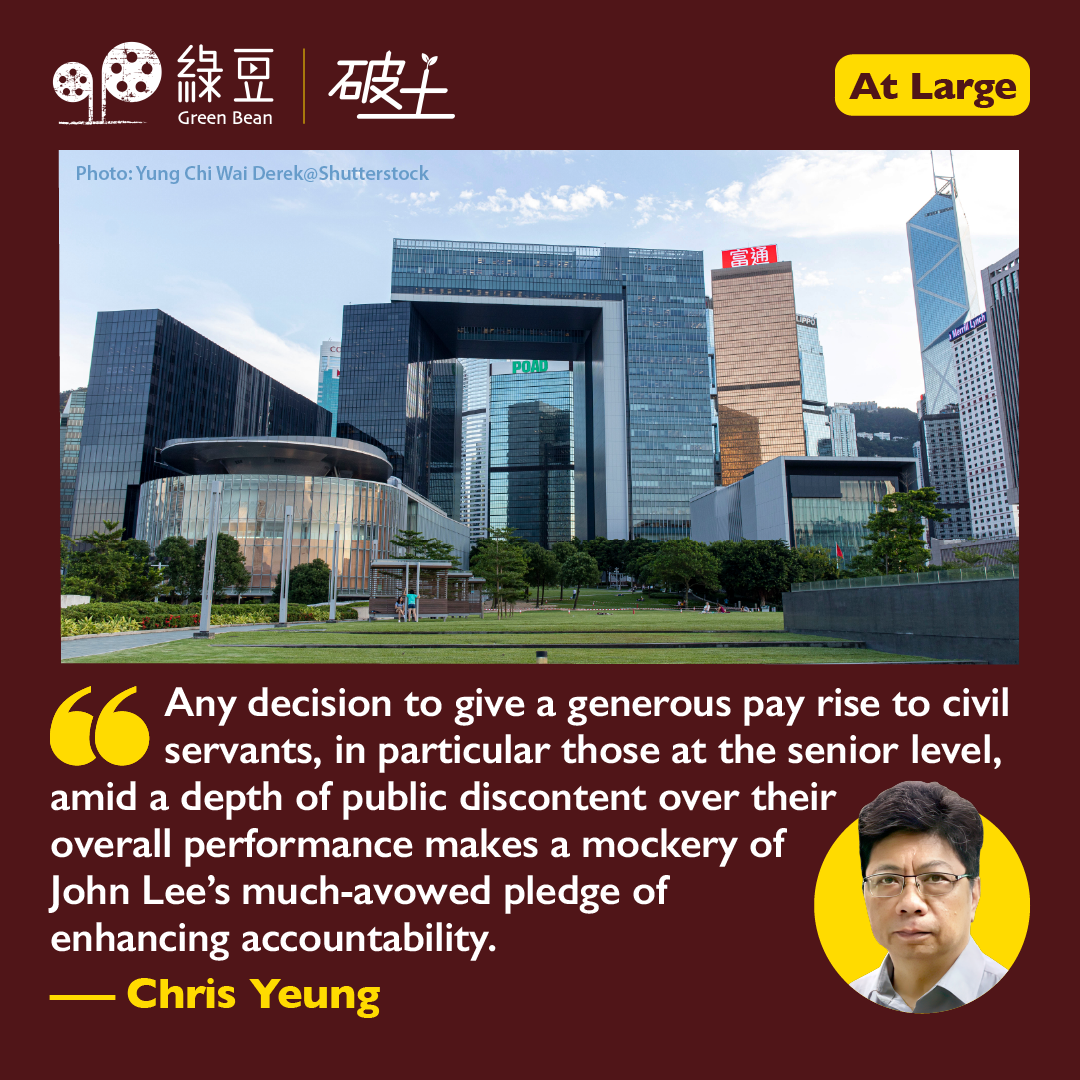
Any decision to give a generous pay rise to civil servants, in particular those at the senior level, amid a depth of public discontent over their overall performance makes a mockery of his much-avowed pledge of enhancing accountability.