
All losers in government buck-passing game
For the first time since the end of the British rule in 1997, the top post of the Hong Kong SAR went to a government official with a disciplinary forces background. John Lee joined the government as a probationary police inspector in 1977 before he made his way to the post of Chief Executive in 2022. With Lee taking the helm, pundits said the era of “rule by officials with discipline-trained forces” has begun.
Even before he was sworn in on July 1, 2022, Lee had acted to underline the importance of order, discipline and teamship. Flanked by all principal officials-designate in mid-June, he said his ruling team was a team with diversity, solidarity, loyalty and strong executive capability. He said he attached importance to the spirit of teamship, promising that he will lead his team in enhancing the efficiency and effectiveness of governance.
To walk the talk, Lee has ordered the setting up of a long list of working groups, task forces and the like led by top officials, including the chief secretary and financial secretary and their deputies, with an aim to upgrade teamship and strengthen coordination among policy bureaus to enhance governance.
In another show of solidarity and teamship, he introduced a new initiative to beef up the mobilisation of civil servants to cope with disasters such as floods.
At the district-level, hundreds of care teams under the Home Affairs Department have been set up to give helping hands to residents on daily life matters.
Hearing Highlights Departmental Disconnect
The talk of solidarity and teamship turned sour with more evidence of a disjointed government unfolding in the public hearing of an investigation into the deadly fire at Wang Fuk Court in Taipo.
Attending a hearing on last Friday (Apr 24),Director of Fire Services Andy Yeung Yan-kin has admitted that better communication with building authorities is needed.
Yeung spoke two days after one of his deputies told the three-member independent panel the handling of polyfoam boards on windows, temporary openings [at evacuation routes], flammable materials and workers smoking on site had nothing to do with their department.
Michael Yung, assistant director of fire safety, testified on Wednesday that his department is responsible only for “active” fire safety measures, such as alarm systems. Fire hazards like substandard scaffold netting, flammable foam boards and workers smoking on site fell outside the purview of the department, he said.
Kicking off the hearing last month, Victor Dawes, the lead lawyer for the committee, said the blaze was “most likely” caused by smoking, while flammable construction materials may have contributed to the rapid spread of fire and smoke.
Speaking after Yung’s testimony, Justice David Lok, who chairs the committee, said the blaze exposed a “grey zone” in government oversight of building renovations. Yung agreed.
In a damage-control move, Yeung, the fire services chief, sought to clear the confusion on Friday, saying “We’ll take action against polyfoam boards and temporary openings [at evacuation routes], but the work is divided.”
The building authorities, including the Buildings Department and the Housing Bureau’s Independent Checking Unit, he said, were responsible for overseeing building structural safety, whereas the Fire Services Department monitored the operation of fire installations.
“This is very clear. If we interfere, our roles may overlap,” he added.
Mr Justice Lok said that the Buildings Department might not be able to identify all fire hazards at construction sites. “This incident highlights the necessity for better communication,” the judge said, with Yeung agreeing.
The Price Is Too High
The confusing, if not contradictory, testimonies, given by Yeung and his top aide, Yung, within two days at separate hearings, spoke volume of the grey zones in the bureaucracy, which might be well-known within and outside the government. They were left untouched for many years, now laid bare in a probe into the deadly blaze. Thanks to the Chief Executive for making an investigation happen.
There is no denying buck-passing culture exists in many, if not all, bureaucracies. Admittedly, bureaucratic inertia and laxity of work are unavoidable. They are not unmanageable for the damages that may be incurred to be minimised, to say the least.
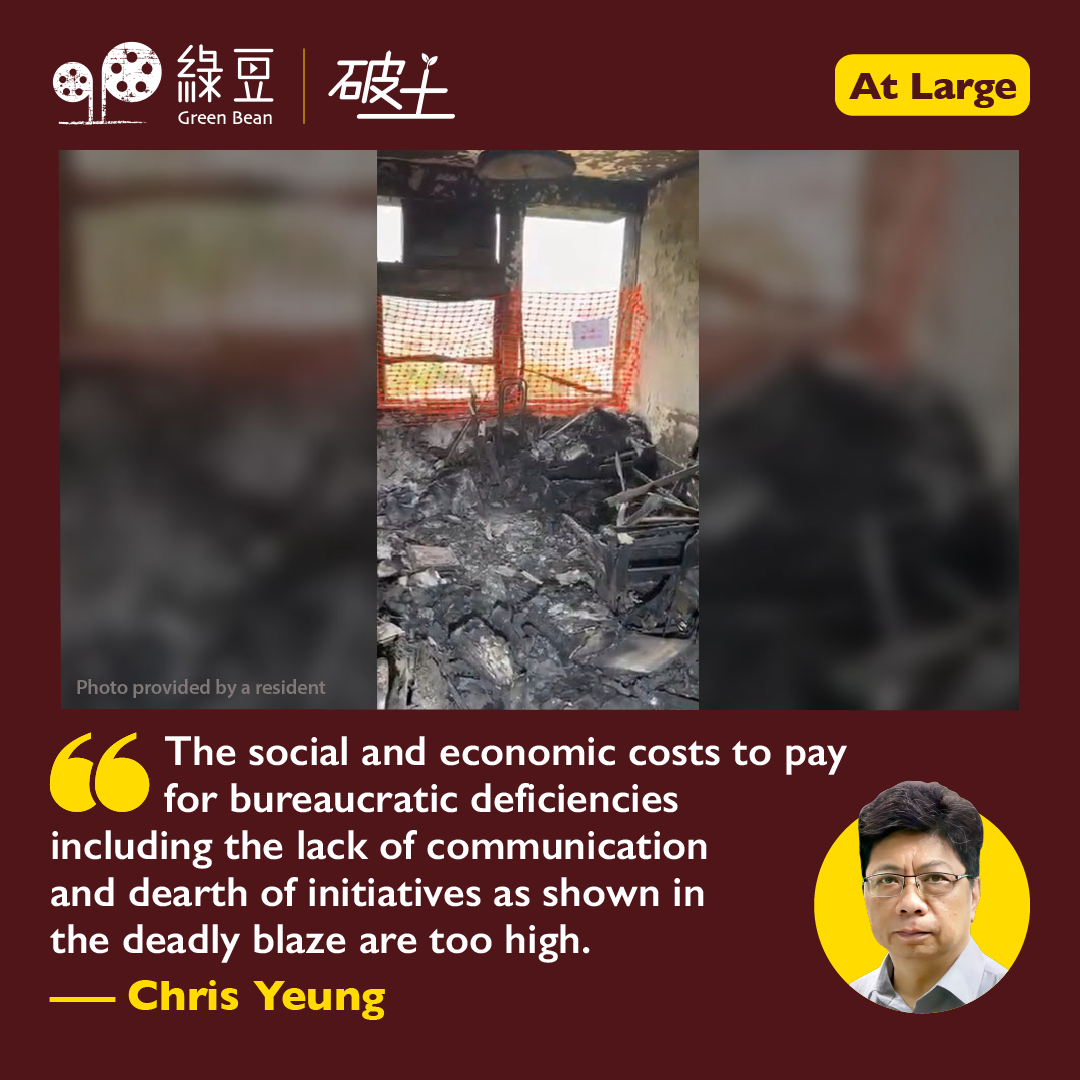
The social and economic costs to pay for bureaucratic deficiencies including the lack of communication and dearth of initiatives as shown in the deadly blaze are too high.
That the grey areas, gaps in inter-departmental communications and mysterious delay in implementation (one hour for the activation of disaster alarm and emergency alert is an example) unearthed from the ashes at the fire-ravaged buildings make a mockery of the avowed goal of Lee in leading a results-oriented, effective and efficient administration.
The buck may stop at the Chief Executive. But when the buck went into the grey area at the lower-layer of the government machinery, it will not end up at his or her table – only if he or she takes the initiative to find it out.
▌ [At Large] About the Author
Chris Yeung is a veteran journalist, a founder and chief writer of the now-disbanded CitizenNews; he now runs a daily news commentary channel on Youtube. He had formerly worked with the South China Morning Post and the Hong Kong Economic Journal.
