One 2019 unrest, two singers’ stories
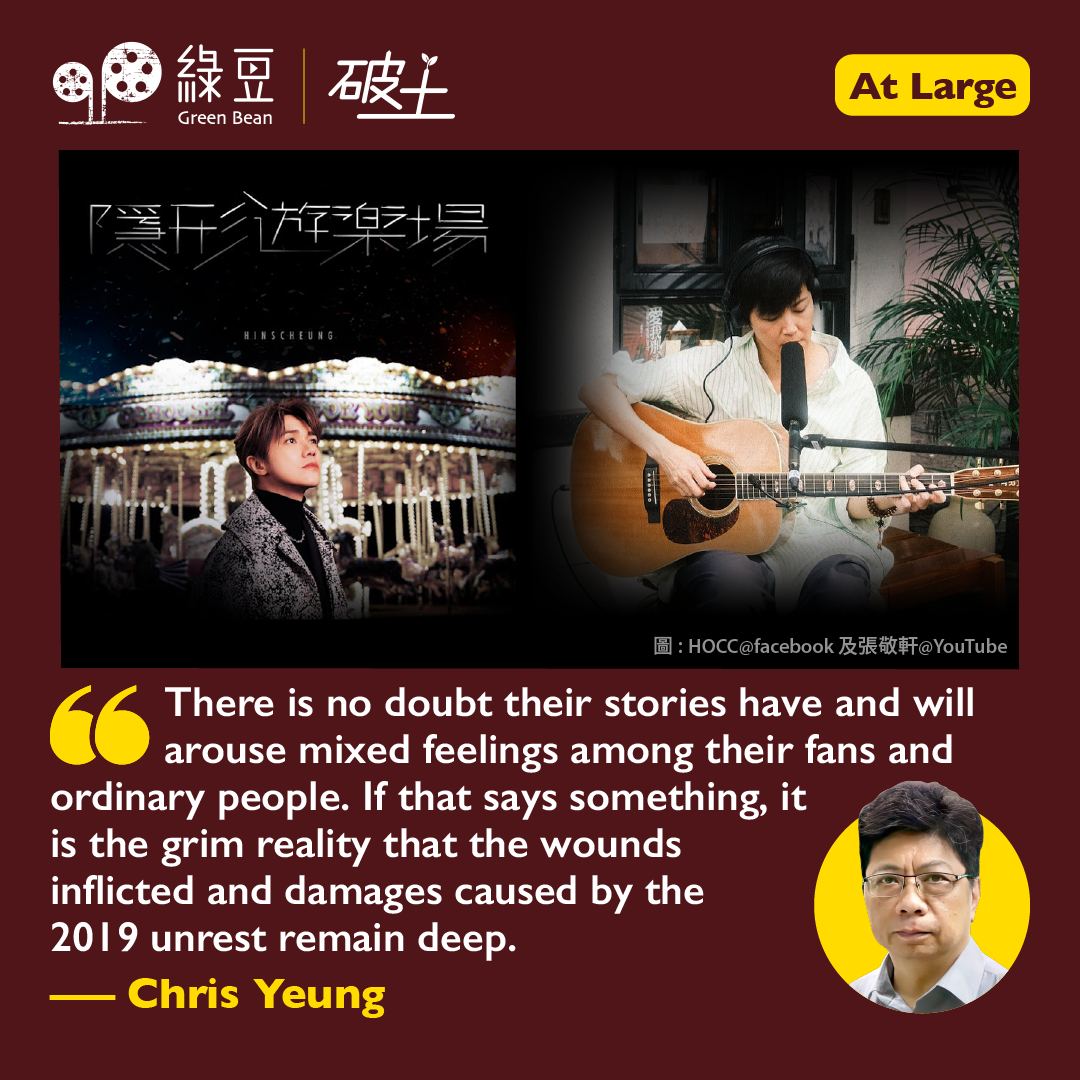
Story one. Award-winning singer Denise Ho won the most popular female singer award held by a Hong Kong-based radio broadcaster in 2006, on track to emulate the success of her idol, late Canto-pop queen Anita Mui. Ho’s political activism in the 2014 Occupy Central movement and 2019 anti-extradition protests has taken its toll on her singing career.
Her efforts to return to the stage to share her music have proved to be futile. An online performance at an independent bookstore in Sheung Wan, Mount Zero, in July 2024 saw the presence of a team of police officers, not for her music, but for an investigation of a noise complaint.
On April 2, she is back with her latest Cantonese album “Rive-Sud, Montréal” – after 13 years.
She said in an interview: “At long last I stand upright, and call myself a singer!”
Hins Cheung’s confession
Story two. Hins Cheung, a Guangzhou-born Hong Kong Canto-pop male singer, hit headlines on last Saturday (April 11). He made a confession in an interview with the pro-Beijing Wen Wei Po, apologising for his views given during the 2019 protests. He did not elaborate.
Cheung revealed he has become a mentor of a special programme organised by the Security Bureau to help give “positive direction” to young people who took part in the protests.
In the interview, he said he had been influenced by the social atmosphere during the 2019 unrest. Some of his views and the way they were expressed, he said, were “inappropriate”, which made some people cast doubts about his feelings and attitude towards Hong Kong and the nation.
“For that, I sincerely apologise and hope that doing so will eliminate those voices. (I also) hope to share my own experience to show to young people the way to understand their mistakes and make a fresh start.”
Security minister Chris Tang has revealed earlier they plan to launch a programme for young people who were arrested but have not been prosecuted to give them a “positive” direction for them to rehabilitate. Tang did not give details.
Cheung said in the interview he was “deeply moved” after reading Tang’s remarks, and took the initiative to contact the bureau to express his wish to participate in the programme. He said he will personally lead a group of participants of the programme to visit the mainland in the first half of this year for young people to “see for themselves the prosperity and growth of the country.”
The wounds remain deep
Like most, if not all, Hongkongers, Denise Ho and Hins Cheung had strong feelings about the wave of protests that enveloped the city since June 2019.
Ho dipped deeper in politics, including an involvement in a fund set up for the protesters. She had been arrested by the police, and was later released. Although no charges have been made, Ho ran into a mountain of difficulty in her pursuit of music. Her application for a government venue for a concert had been repeatedly rejected.
Prior to the release of her album, she revealed being cold-shouldered by electronic media for a presence at their programme to promote her album. “In the past, attending TV and radio programmes was the most basic (promotion). (They all) don’t want to have your footprints there.”
Hins Cheung’s involvement with the 2019 unrest is nothing when compared to Ho’s. That he made double efforts, saying sorry and volunteering to be a “rehabilitation” mentor, has said something about the pressure he might have faced for what he called the “inappropriate” remarks he made more than six years ago.
Both Ho and Cheung have risen to stardom for their talent and charm in music. None of them seem to have set their eyes on high political places, but only a place for performance to share their feelings with audiences.
No thanks to the 2019 protests and its aftershock, their paths to the chasing of excellence in music have been laden with road blocks and hidden holes. In a sense, both were victims of the political unrest ignited by a now-shelved government bill on extradition, which has not been reactivated since late 2019.
Almost seven years on, both have now taken a step forward with Ho releasing a new collection of her songs and Cheung facing the music and telling a good China story.
There is no doubt their stories have and will arouse mixed feelings among their fans and ordinary people. If that says something, it is the grim reality that the wounds inflicted and damages caused by the 2019 unrest remain deep.
Speaking after the 2024 online concert, Ho wrote on social media “The more chaotic it is, just keep making yourself better will be alright.”
The stories of Denise Ho and Hins Cheung are in themselves food for thought for young people and society at large when a return to normality in life is long overdue.
▌ [At Large] About the Author
Chris Yeung is a veteran journalist, a founder and chief writer of the now-disbanded CitizenNews; he now runs a daily news commentary channel on Youtube. He had formerly worked with the South China Morning Post and the Hong Kong Economic Journal.