
Horse-racing, dancing continues, but books look uncertain
“Horse racing will continue, dancing parties will go on.” This is a famous saying by late Chinese paramount leader Deng Xiaoping seeking to assure the jittery Hongkongers in the 1980s that the then British colony’s freewheeling capitalist lifestyles would remain unchanged after 1997.
Like the future of horse-racing and dancing, the post-1997 fate of the June 4 candle-light vigil at Victoria Park and books and magazines that carried content about alleged power struggle, decadence and bad things at the top echelon of the ruling Chinese Communist Party openly sold in bookstores were also indicators.
They were seen as evidence of the preservation of freedoms that made Hong Kong different from the other parts of China. That the communist regime continued to tolerate books and publications in the city they did not like could testify to the “one country, two systems” policy.
Horse-racing has survived the 1997 changeover. It has indeed flourished and increasingly become a major attraction of visitors from the mainland, where horse-racing betting is still prohibited. Dancing in night clubs, once a sign of the city’s extravagant night life and high consumption power, has lost its vibrancy largely because of economic factors and changes in life-styles, not politics.
Both the June 4 vigil and bookstores that sold books and magazines specialising on stories about such sensitive topics as factionalism, nepotism and decadent life-styles among the ruling elites in the mainland have also continued after 1997 – and for a long period of time until about a decade ago.
Causeway Bay Books marked the beginning
Following the implementation of the Hong Kong national security law in July 2020, the annual June 4 vigil at Victoria Park was banned. The Hong Kong Alliance in Support of Patriotic Democratic Movement in China, founded at the heyday of the 1989 Tiananmen protests and organiser of the vigil, was disbanded. Its core leaders are facing a subversion trial.
Signs showing the tolerance of the authorities towards publications with content that they deemed as rumours, speculation and fabrications relating to those at the corridors of power in the mainland began to wear thin emerged in the “Causeway Bay Books missing publishers case” in 2015.
The bookstore was founded in 1994 and known for its range of books that, among others, told stories of the private lives of Communist Party’s top brass. Five staff members had separately reportedly disappeared in late 2015.
Lam Wing-kee, founder of the bookstore, left Hong Kong for Taiwan in 2019. He set up Causeway Bay Books in Taipei. The 1994-founded bookstore located at the heart of Causeway Bay, one of the busiest districts in Hong Kong, has become history. With hindsight, it marked the beginning of the vanishing of books and bookstores that rubbed the nerves of the mainland and Hong Kong authorities.
Independent bookstore become target
Soon after the national security law took effect, an unspecified number of books either written by people considered as politically sensitive figures such as democrats or about sensitive topics including the June 4 crackdown was taken down from the shelves of public libraries, followed by privately-run bookstores.
Independent bookstores that continued to sell books about politics or written by sensitive figures have emerged as a target of inspections by various government departments responsible for food and hygiene, fire services and taxation.
Mount Zero Books, one of the popular independent bookstores, located in Sheung Wan closed down in April 2024 after six years. Its founder cited mounting pressure caused by a string of inspections by authorities following anonymous complaints.
Last week, the founder and three staff members of Book Punch, an independent bookstore located in Sham Shui Po, Kowloon, were arrested by national security police over allegedly “knowingly selling seditious publications.” They have been released on bail. No charges were made as of Saturday. Nor were there briefings by national security police about the case.
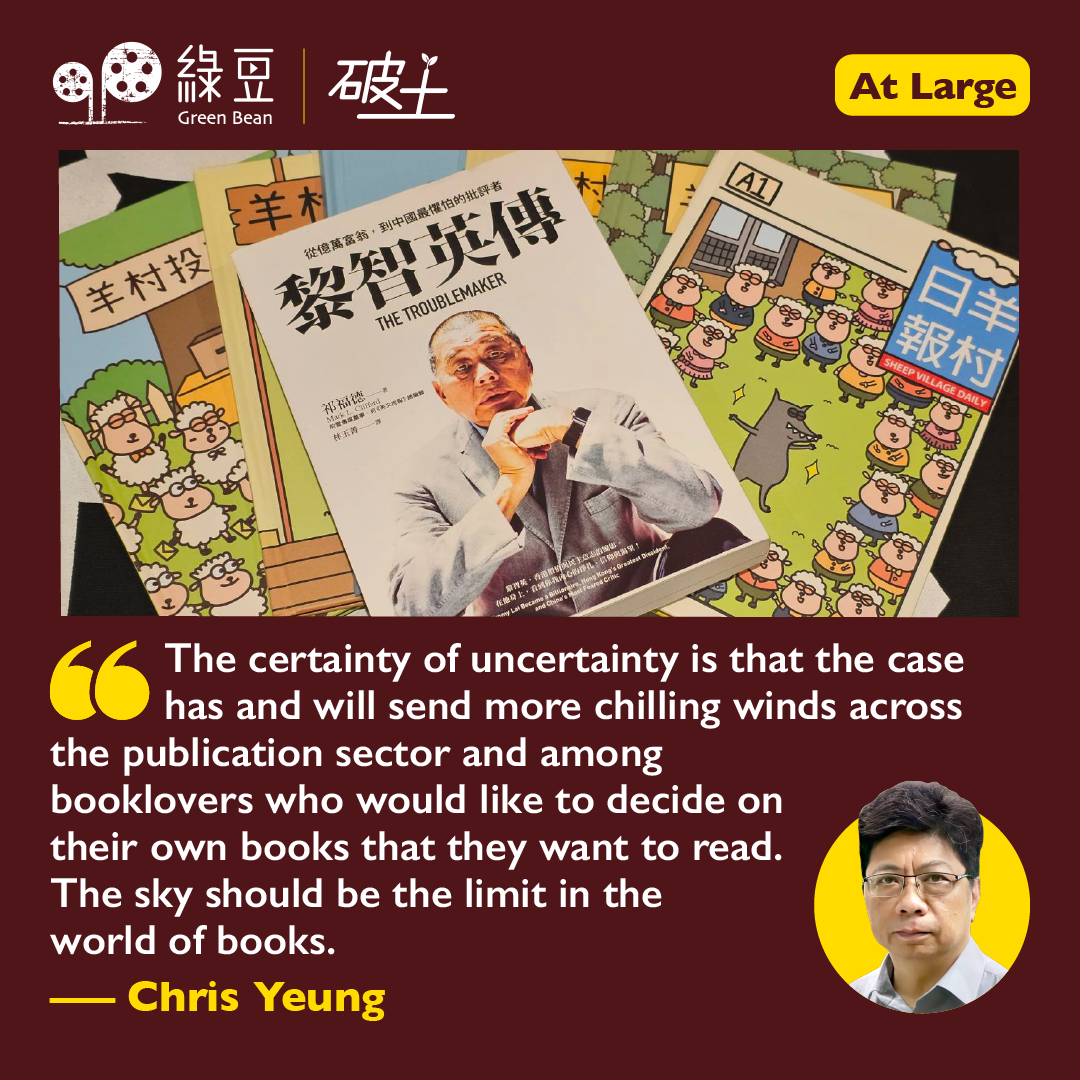
Local media reported, without quoting sources, the four were arrested on suspicion of selling seditious titles, including a biography of jailed media tycoon Jimmy Lai. Government officials did not respond to questions about whether the government would publicise a list of “seditious publications,” assuming there is one.
Based on an English biography entitled “The Troublemaker: How Jimmy Lai Became a Billionaire, Hong Kong’s Greatest Dissident, and China’s Most Feared Critic” written by Mark Clifford, the Chinese version was almost invisible in local bookstores.
Although there is no list of banned books in Hong Kong, fears of breaching the national security and seditious publications laws have worsened self-censorship in the publishing industry and society at large. Few writers risk wading into the “red lines.” Even if they dare to take the risk, publishers and printers don’t want to. And even if they feel safe to do so, only independent bookstores dare to put them on sale.
Dated back to colonial times, the sedition law was invoked after the national security law was enacted in 2020. A Hong Kong court has found in 2022 five speech therapists guilty of sedition over a series of illustrated children’s books that portrayed the city’s democracy supporters as sheep defending their village from wolves. Prosecutors alleged the book as spreading separatism and stirring up hatred and opposition to the government.
It will be the first time bookstores operators and staff members face the charge of “knowingly selling” seditious publications if they are taken to court under the national security law enacted in 2024.
What’s in the Lai biography that are deemed by the authorities as seditious remains unclear. Nor is the evidence that shows Book Punch has sold it, “knowing” that they are seditious.
The certainty of uncertainty is that the case has and will send more chilling winds across the publication sector and among booklovers who would like to decide on their own books that they want to read. The sky should be the limit in the world of books.
▌ [At Large] About the Author
Chris Yeung is a veteran journalist, a founder and chief writer of the now-disbanded CitizenNews; he now runs a daily news commentary channel on Youtube. He had formerly worked with the South China Morning Post and the Hong Kong Economic Journal.
