
No absolute security, but security is everywhere
One day after the sentencing of the Apple Daily case was handed down on last Monday (Feb 9), the Chinese State Council published a white paper on the implementation of the Hong Kong national security law, signaling the beginning of a new stage of the ever-going battle against threats to national security.
Hopes, if any, that it could mean an easing of the crackdown against what are deemed as deeds and words that endanger security, at both state and city levels, seem to be displaced. Last week saw cases of security-obsessed governance in the government – and a leading university.
A show of loyalty and unity
Case one. Shortly after the sentencing of Jimmy Lai, founder of the ill-fated Next Media Group, and other defendants of the case was announced on Monday, Chief Executive John Lee and his team mounted a blitz of publicity on social media platforms throwing their weight behind the court decision and blaming Lai as the “Number One evil” behind a list of “oppose-China, disrupt-Hong Kong” incidents, in particular the 2019 social unrest.
In a show of loyalty and unity, dozens, if not all, legislators have issued statements on their social media platforms mimicking the official line on the Apple Daily case. Some of them who seldom wrote in English on Facebook made a bilingual statement, targeting non-Chinese audiences. Chairing a meeting earlier this month, Legco President Starry Lee has set out a list of five tasks for members. They include taking the initiative of refuting and rebuking unfair and groundless criticism from legislatures overseas against the government. Legislators lost no time in getting the rebuttal task done when it comes to national security.
“Smearing” the police
Case two. On Wednesday, three people were charged under the national security law over comments relating to the Wang Fuk Court fire. Andrew Kan, deputy police commissioner for national security, declined to reveal how many people have been arrested for suspected sedition relating to the deadly blaze in November.
Also at the press conference, Kan gave a veiled warning to groups citing force majeure, or irresistible force, with increasing frequency in recent years as the reason for cancelling events such as dinner or disbanding themselves. He said the term, understood as a euphemism for political pressure or censorship, amounted to “smearing” the police, without elaboration.
He said: “… force majeure could include several different reasons, including finances and resources, or if they are afraid of breaking the law… Using this term appears to place the onus on the police, which I believe is unfair and smears the operations of the police force.”
The Expulsion of Miles Kwan from CUHK
Case three. Chinese University (CUHK) student Miles Kwan was reportedly one of those who had been arrested relating to the Tai Po blaze. He was said to be arrested for “sedition intention” after handing out flyers calling for an independent investigation on a list of “four demands.” It is understood that he has not been formally charged as of last Saturday (Feb 14).
He told Hong Kong Free Press on Friday he was notified by CUHK of his expulsion on grounds that he had committed “multiple acts of misconduct.” He said he was asked to attend a panel under a student discipline committee on January 7 following his arrest in November. In a reply confirming his attendance, he ridiculed the panel as a “kangaroo panel” and a “disgrace”, saying he looked forward to the “circus”.
It could not be more ironic that the university has given credence to Kwan’s accusation by kicking him out without giving a strong and indisputable case, at least for now. If anything, it raises concern about the dire consequences of any deeds and words that have touched the sensitive area of security in the zones of power.
Everything is a national security issue
In a related case relating to law and order on hygiene matters, the government last week made an open recruitment of the post of Director of Food and Environmental Hygiene, specifying a requirement of sharp political sense and strategic vision in policy and enforcement. The newly-added requirement has fuelled speculation that another official with disciplinary forces background will parachute onto the ruling team led by John Lee, who joined the government as a police inspector.
The story of Hong Kong is increasingly enriched with real-life cases relating to national security, law and order and sedition in different aspects of daily life.
In the nation’s first white paper on national security published on Tuesday, the State Council said Hong Kong must mold a kind of “open security” that helps uphold security with openness and promote openness through upholding security.
It specifically spoke against the pursuit of “absolute security” or “generalised security”, without giving concrete cases of that kind.
As soon as the first national security law took effect, concerns were raised about the “weaponisation” of the law and the excessive publicity of warnings and reminders of the task of upholding national security.
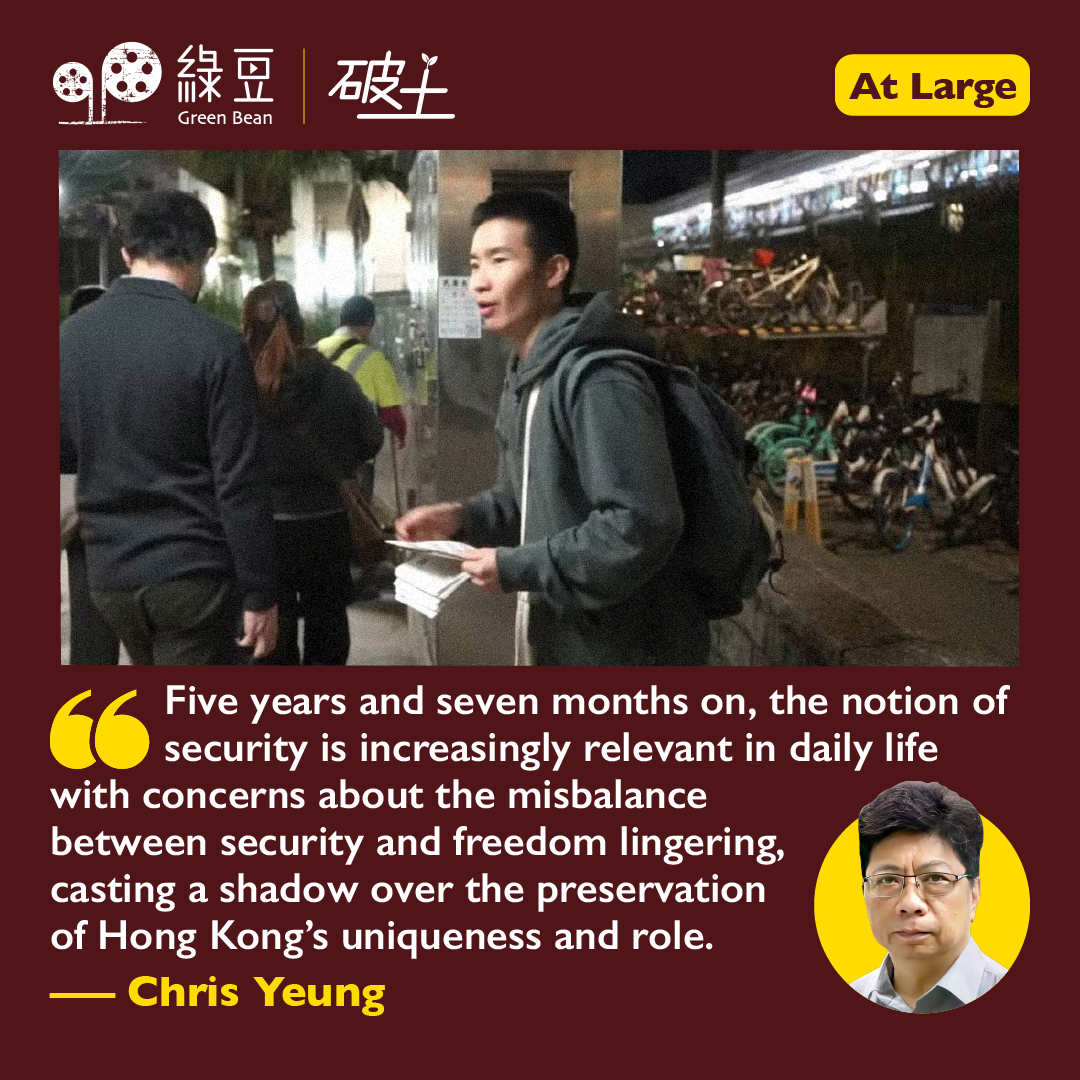
Five years and seven months on, the notion of security is increasingly relevant in daily life with concerns about the misbalance between security and freedom lingering, casting a shadow over the preservation of Hong Kong’s uniqueness and role.
In the Year of the Horse, stay safe and healthy, keep happy and hopeful!
▌ [At Large] About the Author
Chris Yeung is a veteran journalist, a founder and chief writer of the now-disbanded CitizenNews; he now runs a daily news commentary channel on Youtube. He had formerly worked with the South China Morning Post and the Hong Kong Economic Journal.
