When raising an issue becomes bad-mouthing
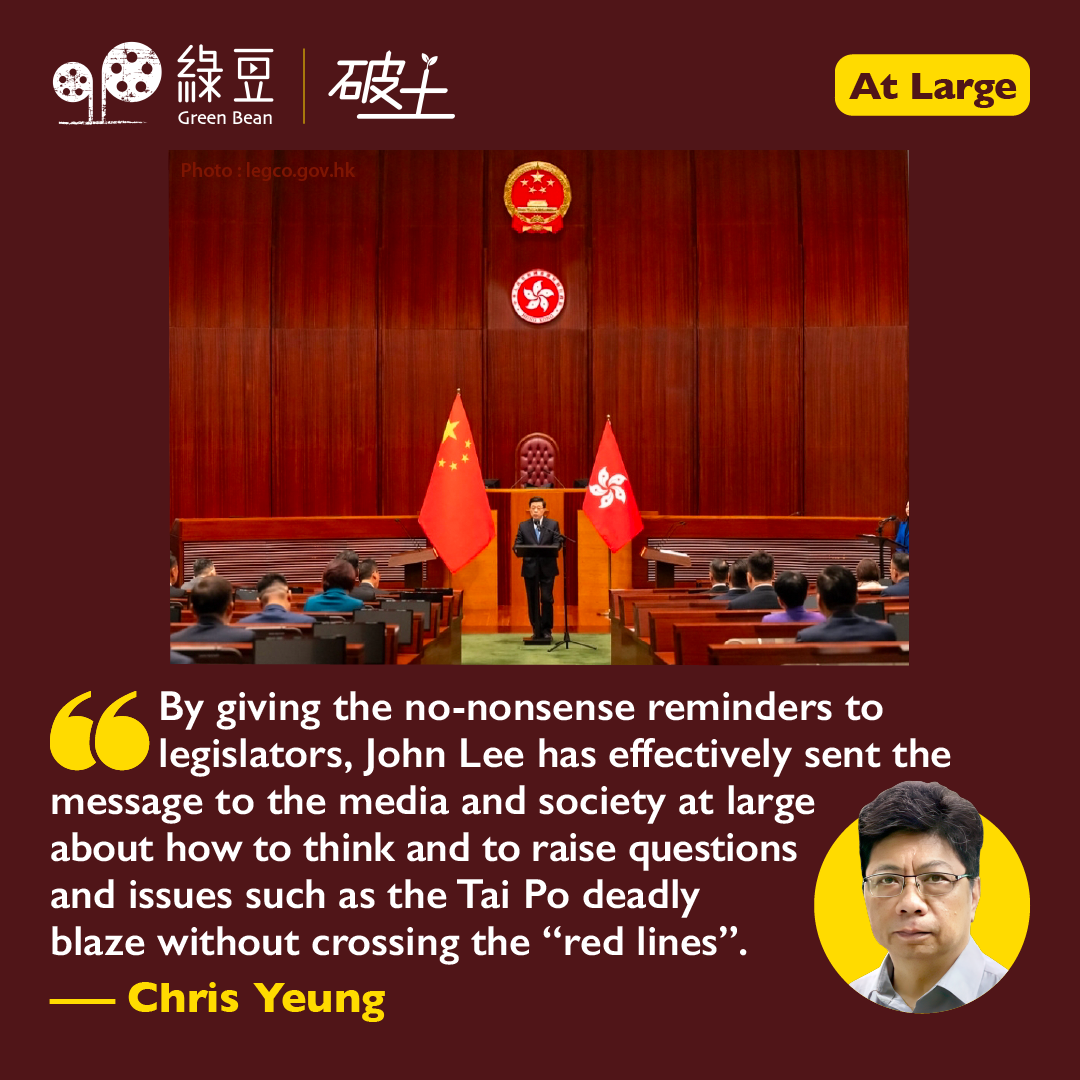
In a move loaded with both symbolic and substantive significance, Chief Executive John Lee addressed the first session of the new Legislative Council term last Wednesday (Jan 14) as soon as the 90 newly-elected legislators took their seats. Following his first speech to the lawmakers after they were sworn on the New Year’s Day, Lee gave another go on elaborating further his “three expectations”.
In the words of the newly-chosen Legco President Starry Lee Wai-king, John Lee is the first chief executive who gave a post-oath-taking speech and spoke at the new legislature’s first session.
The John Lee political antics are indicative of the not-so-subtle change in the interface between the executive authorities and the legislature since the electoral overhaul in 2021.
With directly-elected geographical constituency seats reduced from half of the total number of Legco seats, or 35 out of 70, before 2021, to less than one-fifth, or 20 out of 90, plus newly-added nomination requirements, the last Legco saw the number of democrats down to zero.
The second Legco constituted under the new election system saw the retirement of all veterans who aged 70 or above and more than 20 incumbent lawmakers and the addition of dozens of new faces including Olympiad gold medalist Vivian Kong.
The stage has been set for the second 90-member Legco constituted under the “patriots administering Hong Kong” principle for a new phase of governance in the SAR.
Cautioned against malicious acts
The first to take the stage was the Chief Executive.
In his address at the swearing-in ceremony, John Lee called on the lawmakers to proactively give advice on what they should do when they did not see eye to eye with the government.
“When performing your duties, [lawmakers] should not merely act as commentators, but actively fulfil your role as representatives of the public by proactively advising the government and providing effective solutions.
“Deliberations must be based on facts and evidence. You must not fabricate claims, make biased or insulting remarks, or personal attacks,” he said.
He also cautioned against malicious acts that could stoke conflict, saying the legislature should not be swayed by populism or a single perspective.
“When someone raises an issue, we must discern their true motives. Are they trying to bad-mouth others, sow division or engage in ‘soft resistance’ … are they genuinely concerned about the issue rather than exploiting it to stir up conflict and cause disruption?”
Lee gave similar advice at Legco’s first session last week, but skipped those related to “bad-mouthing”, “division” and “soft resistance”.
How to play their roles
Noticeably nowhere to be seen in both the January 1 and last week’s speeches were such terms as “monitoring”, “supervision” when it came to the role of Legco.
There was plenty of advice, nonetheless, to members on how to think, what to do to avoid being divisive, populist or seen as “bad-mounting” and mounting “soft resistance.” All for the task of “supporting the government’s governance.”
The list of “Dos and Don’ts” laid down by John Lee in his two addresses is neither easy to understand nor to practice for the legislators, in particular the first-term freshman.
How to ask a legitimate question based on facts and with reason that the public wants to know the answer without being construed as “having bad motives” or “bad-mouthing” is a difficult challenge, if not impossible task, for them.
And if asking questions and raising an issue to hold the government accountable to the legislature is now riddled with risks, the question of what and how legislators should play their role in the new political ballgame in the next four years is fraught with uncertainties.
Speaking at a radio programme before the first Legco session, Executive Council convenor Regina Ip Lau Suk-ying, who had not sought re-election, said members should not just coordinate with the government, but play the role of supervision.
She cautioned that it would cause adverse impacts on the government in the long-term and would leave hidden problems unnoticed if members only tried to “pander to” the government. Saying all legislators were patriots, Ip said she did not think anyone will deliberately mount “soft resistance.”
By giving the no-nonsense reminders to legislators, John Lee has effectively sent the message to the media and society at large about how to think and to raise questions and issues such as the Tai Po deadly blaze without crossing the “red lines”.
It will be a difficult balancing game to play for journalists, commentators and ordinary citizens if they care and dare to have their voices heard.
▌ [At Large] About the Author
Chris Yeung is a veteran journalist, a founder and chief writer of the now-disbanded CitizenNews; he now runs a daily news commentary channel on Youtube. He had formerly worked with the South China Morning Post and the Hong Kong Economic Journal.